IGBC Summit Backs Green Urban Growth
ECONOMY & POLICY

IGBC Summit Backs Green Urban Growth

The CII Indian Green Building Council Chandigarh Chapter organised the third Green BuildTech Summit at CII Northern Headquarters, Chandigarh, focusing on ‘High-Performance Buildings & Sustainable Urban Growth’. The summit brought together policymakers, urban planners, developers, architects, industry leaders and sustainability experts.

The event highlighted the role of sustainable infrastructure and high-performance buildings in shaping the future of the Chandigarh Tricity region and supporting India’s transition towards a low-carbon built environment.

Speakers at the summit included Dr Amarpal Singh, IAS (Retd), Chairman, Punjab School Education Board; Rakesh Kumar Goyal, Chairperson, RERA Punjab; Gurmeet Singh Chawla, Vice Chairman, CII Chandigarh UT; Col Shailesh Pathak, Immediate Past Chair, IGBC Chandigarh Chapter; Jagjit Singh Majha, Chairman, IGBC Chandigarh Chapter; and M Anand, Deputy Executive Director, CII IGBC.

Jagjit Singh Majha said the Chandigarh Tricity region is at a pivotal stage of development, with rising demand for quality infrastructure and real estate. He said Chandigarh, Haryana and Punjab together have over 1,700 registered projects, representing 1.09 billion sq ft of green building footprint.

The region has also recorded strong adoption of green and net-zero buildings, including 23 net-zero projects, 1,098 commercial projects, 467 residential projects, 95 industrial projects, 23 built environment projects and 30 transit infrastructure projects.

The summit featured panel discussions and technical sessions on urban growth, high-performance development, net-zero buildings, low-carbon construction technologies, water-efficient infrastructure, sustainable finance and policy interventions.

Key sessions included ‘Tricity at an Inflection Point’, ‘Scalable Solutions for High-Performance Buildings’, ‘Enabling Sustainable Urban Growth’ and a master session on ‘Scaling Net Zero Buildings – From Framework to Execution’.

The event concluded with a call for stronger collaboration among governments, industry leaders, financial institutions, urban planners and technology providers to accelerate the adoption of high-performance and net-zero buildings across the Tricity region.

The CII Indian Green Building Council Chandigarh Chapter organised the third Green BuildTech Summit at CII Northern Headquarters, Chandigarh, focusing on ‘High-Performance Buildings & Sustainable Urban Growth’. The summit brought together policymakers, urban planners, developers, architects, industry leaders and sustainability experts. The event highlighted the role of sustainable infrastructure and high-performance buildings in shaping the future of the Chandigarh Tricity region and supporting India’s transition towards a low-carbon built environment. Speakers at the summit included Dr Amarpal Singh, IAS (Retd), Chairman, Punjab School Education Board; Rakesh Kumar Goyal, Chairperson, RERA Punjab; Gurmeet Singh Chawla, Vice Chairman, CII Chandigarh UT; Col Shailesh Pathak, Immediate Past Chair, IGBC Chandigarh Chapter; Jagjit Singh Majha, Chairman, IGBC Chandigarh Chapter; and M Anand, Deputy Executive Director, CII IGBC. Jagjit Singh Majha said the Chandigarh Tricity region is at a pivotal stage of development, with rising demand for quality infrastructure and real estate. He said Chandigarh, Haryana and Punjab together have over 1,700 registered projects, representing 1.09 billion sq ft of green building footprint. The region has also recorded strong adoption of green and net-zero buildings, including 23 net-zero projects, 1,098 commercial projects, 467 residential projects, 95 industrial projects, 23 built environment projects and 30 transit infrastructure projects. The summit featured panel discussions and technical sessions on urban growth, high-performance development, net-zero buildings, low-carbon construction technologies, water-efficient infrastructure, sustainable finance and policy interventions. Key sessions included ‘Tricity at an Inflection Point’, ‘Scalable Solutions for High-Performance Buildings’, ‘Enabling Sustainable Urban Growth’ and a master session on ‘Scaling Net Zero Buildings – From Framework to Execution’. The event concluded with a call for stronger collaboration among governments, industry leaders, financial institutions, urban planners and technology providers to accelerate the adoption of high-performance and net-zero buildings across the Tricity region.

Next Story
Real Estate

Mahindra Lifespaces Unveils New Phase at Mahindra Citadel

Mahindra Lifespace Developers has launched Codename Sanctum, a new phase of its residential project, Mahindra Citadel, in Pimpri-Chinchwad, Pune. Spread across approximately 9.66 acres, the development has a Gross Development Value (GDV) of nearly Rs 25 billion. The newly launched phase, comprising Towers E, F and G, has an estimated GDV of around Rs 8-8.5 billion and offers a limited inventory of premium 2 and 3 BHK residences.Vimalendra Singh, Chief Business Officer (Residential), Mahindra Lifespace Developers Ltd. said, “Mahindra Citadel has emerged as a strong contributor to our Pune por..

Next Story
Infrastructure Urban

Cabinet Approves Two Year Scheme To Replace Old Trucks And Buses

The Union Cabinet, chaired by the Prime Minister, approved a two-year scheme to reduce air pollution in the Delhi–NCR region and promote cleaner mobility. The programme will be funded through the National Capital Region Planning Board under the Ministry of Housing and Urban Affairs and implemented by the Ministry of Road Transport and Highways and the Ministry of Petroleum and Natural Gas, with participating States and Union Territories of Delhi, Haryana, Rajasthan and Uttar Pradesh. The total financial outlay has been set at Rs 95.85 billion (bn), with the Central Government contributing Rs..
Next Story
Infrastructure Transport

Bengaluru Suburban Rail And Metro To Share 500-Metre Corridor

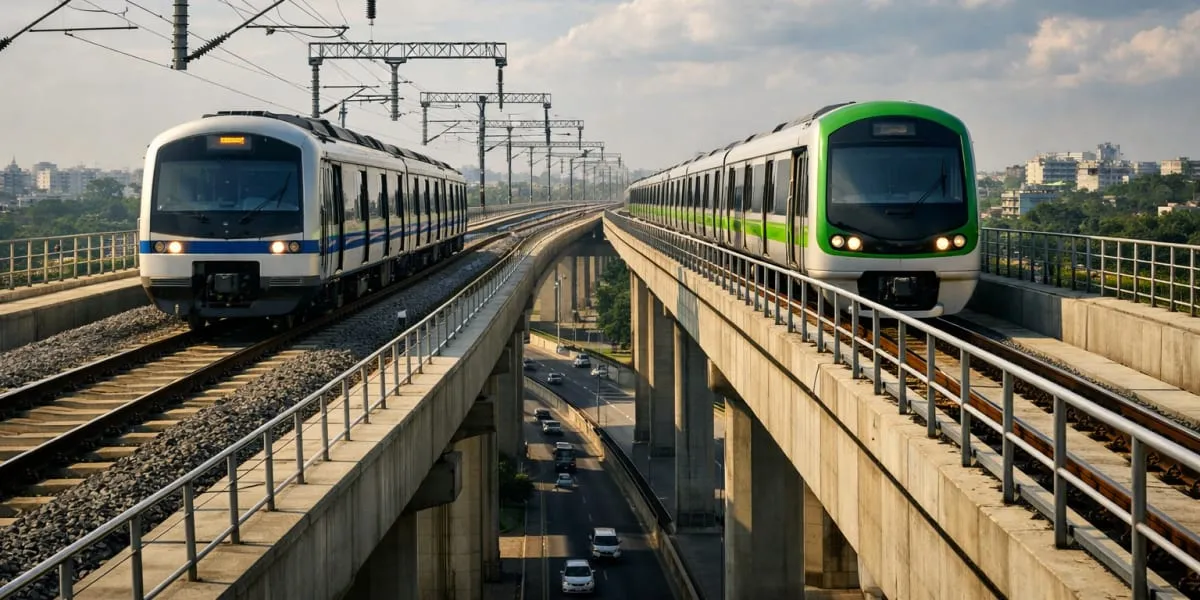
Bengaluru suburban rail and the Metro will share a 500-metre corridor at Benniganahalli, a decision that planners say will reduce capital expenditure and urban disruption. The consolidation of alignments across the short stretch is intended to avoid duplication of elevated structures and station facilities while cutting land acquisition needs. Authorities put the maximum savings at Rs 1.69 bn (1,690 mn). The arrangement also aims to streamline construction interfaces between the two systems. The shared corridor will require coordinated design of track beds, piers and passenger access so that s..

Advertisement

Subscribe to Our Newsletter

Get daily newsletters around different themes from Construction world.

STAY CONNECTED

Advertisement

Advertisement

Advertisement