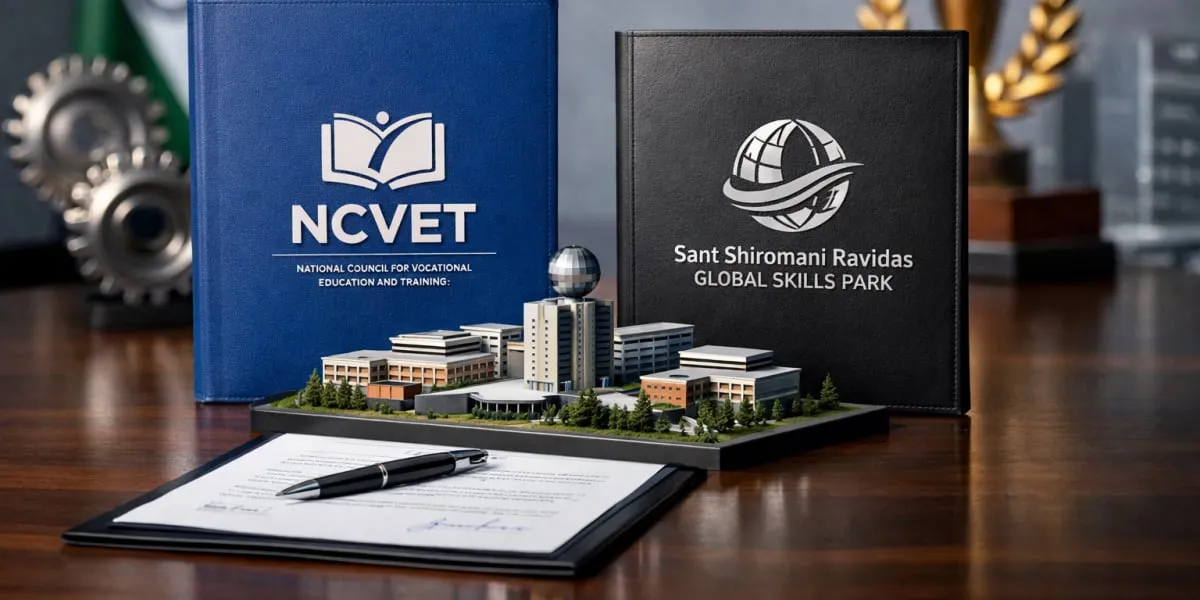
NCVET Recognises Sant Shiromani Ravidas Global Skills Park
ECONOMY & POLICY

NCVET Recognises Sant Shiromani Ravidas Global Skills Park

On two March 2026 the National Council for Vocational Education and Training (NCVET) and Sant Shiromani Ravidas Global Skills Park (SSR GSP) in Bhopal signed an agreement granting recognition to SSR GSP as an Awarding Body in the dual category. The recognition enables the Awarding Body to award, assess and certify learners where training is directly imparted by the body in campuses or training centres owned or fully managed by it for its approved or adopted qualifications.

SSR GSP is a flagship initiative of the Government of Madhya Pradesh and the agreement is presented as a step that consolidates its role as a premier Technical and Vocational Education and Training (TVET) hub. The SSR GSP Bhopal campus was developed with technical support from ITEES Singapore to offer technology oriented courses. As a dual awarding body SSR GSP is empowered to undertake both assessment and certification functions.

The SSR GSP qualification titled Fundamentals of PLC and Sensors Technology has already obtained NCVET approval and will be administered under the new recognition arrangements. Learners completing training at SSR GSP campuses and approved centres are expected to receive assessment and certification directly from the body, thereby aligning credentialing with delivery. This arrangement is intended to enhance the credibility and portability of certificates for employers and training partners.

Officials indicated that the recognition is designed to streamline certification processes and strengthen quality assurance mechanisms across campus based training. The development is also framed as supporting industry aligned curricula and skills pathways that respond to local and regional labour market needs. The recognition may contribute to the broader objective of expanding access to vocational training in the state.

NCVET's role as the regulatory authority was described as central to maintaining standards and ensuring consistency across awarding bodies, while SSR GSP's dual status is anticipated to accelerate delivery of technology oriented skill programmes. The agreement is positioned as a collaborative measure between national and state initiatives to reinforce vocational training infrastructure.

On two March 2026 the National Council for Vocational Education and Training (NCVET) and Sant Shiromani Ravidas Global Skills Park (SSR GSP) in Bhopal signed an agreement granting recognition to SSR GSP as an Awarding Body in the dual category. The recognition enables the Awarding Body to award, assess and certify learners where training is directly imparted by the body in campuses or training centres owned or fully managed by it for its approved or adopted qualifications. SSR GSP is a flagship initiative of the Government of Madhya Pradesh and the agreement is presented as a step that consolidates its role as a premier Technical and Vocational Education and Training (TVET) hub. The SSR GSP Bhopal campus was developed with technical support from ITEES Singapore to offer technology oriented courses. As a dual awarding body SSR GSP is empowered to undertake both assessment and certification functions. The SSR GSP qualification titled Fundamentals of PLC and Sensors Technology has already obtained NCVET approval and will be administered under the new recognition arrangements. Learners completing training at SSR GSP campuses and approved centres are expected to receive assessment and certification directly from the body, thereby aligning credentialing with delivery. This arrangement is intended to enhance the credibility and portability of certificates for employers and training partners. Officials indicated that the recognition is designed to streamline certification processes and strengthen quality assurance mechanisms across campus based training. The development is also framed as supporting industry aligned curricula and skills pathways that respond to local and regional labour market needs. The recognition may contribute to the broader objective of expanding access to vocational training in the state. NCVET's role as the regulatory authority was described as central to maintaining standards and ensuring consistency across awarding bodies, while SSR GSP's dual status is anticipated to accelerate delivery of technology oriented skill programmes. The agreement is positioned as a collaborative measure between national and state initiatives to reinforce vocational training infrastructure.

Next Story
Infrastructure Urban

HVAC: Cool Advice

India’s Cooling Action Plan forecasts cooling demand to grow nearly eight times in the next 20 years. In light of the fact that cooling is no longer just a comfort product but lies at the intersection of national development, public health, climate action and energy security, this means the HVAC industry shoulders a very serious responsibility. Mihir Sanghavi, Managing Partner, Auro Engineering Company, Immediate Past President RATA, Secretary, ISHRAE, and Regional Representative, ASHRAE Region XV, describes that responsibility as “identifying a system that can serve for 15 to 20 years o..

Next Story
Infrastructure Urban

Wanted: 2 Million Workers

Construction, India’s second largest employer by industry, employs about 50 million workers but could additionally absorb another 40 million workers, according to estimates shared by the Construction Skill Development Council of India (CSDCI) in 2023. Within this, citing trade estimates, Rahul Bahl, Managing Director, Krishna Buildestates, says the shortage of trained, skilled workers is currently about 2 million, and is expected to rise to 5 million by 2030.Not only is the construction industry struggling to find workers but construction labour productivity in India significantly trails glo..

Next Story
Infrastructure Transport

The Critical Path

In Ircon International Ltd v. Afcons Infrastructure Ltd, OMP (Comm) 279/2019, the Delhi High Court examined how delay and extension of time (‘EOT’) are to be assessed in construction contracts, particularly in the context of the ‘critical path’ while dealing with challenge to an arbitral award under Section 34 of the Arbitration and Conciliation Act 1996 (‘the Act’). The High Court’s observations regarding the critical path are of significant import for construction and infrastructure projects and related arbitration. The parties entered into a contract for construction of T..

Advertisement

Subscribe to Our Newsletter

Get daily newsletters around different themes from Construction world.

STAY CONNECTED

Advertisement

Advertisement

Advertisement