NITI Aayog and Japanese agency sign Record of Discussions
ECONOMY & POLICY

NITI Aayog and Japanese agency sign Record of Discussions

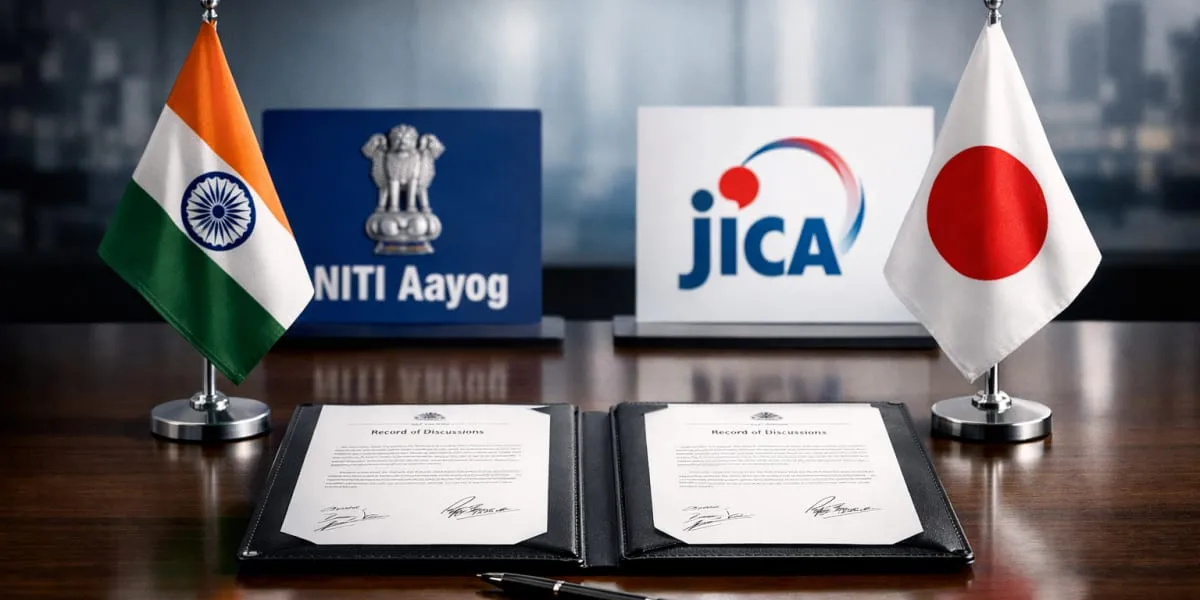
In New Delhi, NITI Aayog and the Japan International Cooperation Agency (JICA) signed the Record of Discussions (RoD) for the Project for Promotion of the Programme for Japan - India Cooperative Actions Towards Sustainable Development Goals – Phase Two. The RoD was signed in the presence of Shri Rohit Kumar, Additional Secretary and Mission Director of the Aspirational Districts and Blocks Programme, and Takeuchi Takuro, Chief Representative of JICA India. The initiative is intended to strengthen bilateral development cooperation focused on the Sustainable Development Goals (SDGs).\n\nNITI Aayog described the collaboration as a reaffirmation of the India-Japan development partnership and said it would advance joint efforts to accelerate inclusive development in underserved regions. The programme will bring together institutional strengths, shared knowledge and on-ground experience to support localised interventions in Aspirational Districts and Aspirational Blocks. Officials indicated that the partnership aims to leverage evidence-based approaches to address priority gaps.\n\nThe project will focus on strengthening policy frameworks and implementation systems across six themes: global partnership; health and nutrition; education; agriculture and water resources; financial inclusion and skill development; and basic infrastructure. It will prioritise institutional capacity building, improved monitoring and evaluation and effective localisation of the Sustainable Development Goals at district and block levels. Planned activities include people to people and capacity-building exchanges, Japan-India knowledge forums and the identification and dissemination of best practices.\n\nRepresentatives of JICA praised the implementation record of the Aspirational Districts and Blocks Programme and noted that India’s district and block level monitoring systems are widely regarded as strong. The signing of the RoD was described as a mutually beneficial step that further strengthens the bilateral partnership for development cooperation. Stakeholders said the arrangement reflects a shared commitment to achieving the Sustainable Development Goals by 2030 through strengthened institutional capacity and evidence-based governance in Aspirational Districts and Aspirational Blocks.

In New Delhi, NITI Aayog and the Japan International Cooperation Agency (JICA) signed the Record of Discussions (RoD) for the Project for Promotion of the Programme for Japan - India Cooperative Actions Towards Sustainable Development Goals – Phase Two. The RoD was signed in the presence of Shri Rohit Kumar, Additional Secretary and Mission Director of the Aspirational Districts and Blocks Programme, and Takeuchi Takuro, Chief Representative of JICA India. The initiative is intended to strengthen bilateral development cooperation focused on the Sustainable Development Goals (SDGs).\n\nNITI Aayog described the collaboration as a reaffirmation of the India-Japan development partnership and said it would advance joint efforts to accelerate inclusive development in underserved regions. The programme will bring together institutional strengths, shared knowledge and on-ground experience to support localised interventions in Aspirational Districts and Aspirational Blocks. Officials indicated that the partnership aims to leverage evidence-based approaches to address priority gaps.\n\nThe project will focus on strengthening policy frameworks and implementation systems across six themes: global partnership; health and nutrition; education; agriculture and water resources; financial inclusion and skill development; and basic infrastructure. It will prioritise institutional capacity building, improved monitoring and evaluation and effective localisation of the Sustainable Development Goals at district and block levels. Planned activities include people to people and capacity-building exchanges, Japan-India knowledge forums and the identification and dissemination of best practices.\n\nRepresentatives of JICA praised the implementation record of the Aspirational Districts and Blocks Programme and noted that India’s district and block level monitoring systems are widely regarded as strong. The signing of the RoD was described as a mutually beneficial step that further strengthens the bilateral partnership for development cooperation. Stakeholders said the arrangement reflects a shared commitment to achieving the Sustainable Development Goals by 2030 through strengthened institutional capacity and evidence-based governance in Aspirational Districts and Aspirational Blocks.

Next Story
Infrastructure Urban

HVAC: Cool Advice

India’s Cooling Action Plan forecasts cooling demand to grow nearly eight times in the next 20 years. In light of the fact that cooling is no longer just a comfort product but lies at the intersection of national development, public health, climate action and energy security, this means the HVAC industry shoulders a very serious responsibility. Mihir Sanghavi, Managing Partner, Auro Engineering Company, Immediate Past President RATA, Secretary, ISHRAE, and Regional Representative, ASHRAE Region XV, describes that responsibility as “identifying a system that can serve for 15 to 20 years o..

Next Story
Infrastructure Urban

Wanted: 2 Million Workers

Construction, India’s second largest employer by industry, employs about 50 million workers but could additionally absorb another 40 million workers, according to estimates shared by the Construction Skill Development Council of India (CSDCI) in 2023. Within this, citing trade estimates, Rahul Bahl, Managing Director, Krishna Buildestates, says the shortage of trained, skilled workers is currently about 2 million, and is expected to rise to 5 million by 2030.Not only is the construction industry struggling to find workers but construction labour productivity in India significantly trails glo..

Next Story
Infrastructure Transport

The Critical Path

In Ircon International Ltd v. Afcons Infrastructure Ltd, OMP (Comm) 279/2019, the Delhi High Court examined how delay and extension of time (‘EOT’) are to be assessed in construction contracts, particularly in the context of the ‘critical path’ while dealing with challenge to an arbitral award under Section 34 of the Arbitration and Conciliation Act 1996 (‘the Act’). The High Court’s observations regarding the critical path are of significant import for construction and infrastructure projects and related arbitration. The parties entered into a contract for construction of T..

Advertisement

Subscribe to Our Newsletter

Get daily newsletters around different themes from Construction world.

STAY CONNECTED

Advertisement

Advertisement

Advertisement