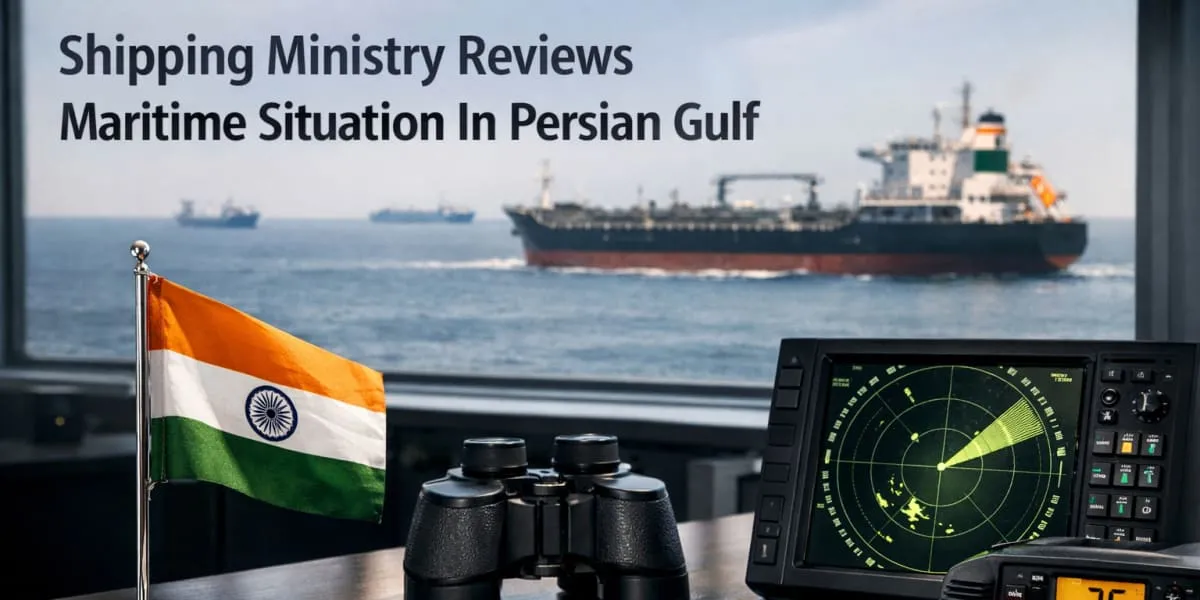
Shipping Ministry Reviews Maritime Situation In Persian Gulf
PORTS & SHIPPING

Shipping Ministry Reviews Maritime Situation In Persian Gulf

The Ministry of Ports, Shipping and Waterways is monitoring the maritime security situation in the Persian Gulf and has strengthened measures to safeguard Indian-flagged vessels and their crews. Union Minister Sarbananda Sonowal chaired a review to assess security risks and implications for Indian maritime assets. The Directorate General of Shipping (DGS) provided a detailed briefing on the status of Indian flag ships and seafarers in the region.

The DGS has activated enhanced monitoring and security oversight in response to reported threats in the Persian Gulf, the Strait of Hormuz, the Gulf of Oman and adjoining sea areas, citing missile and drone activity and electronic interference. Real-time tracking of Indian-flagged vessels has been initiated with increased reporting frequency and 24x7 monitoring through the MMDAC DGComm Centre. Mandatory reporting protocols for vessels, owners and managers have been prescribed to improve situational awareness.

Close coordination is being maintained with the Indian Navy, the Ministry of External Affairs, the Information Fusion Centre–Indian Ocean Region (IFC-IOR), the Maritime Rescue Coordination Centre (MRCC) and Indian missions abroad to facilitate operational and diplomatic responses. Shipping companies and Recruitment and Placement Service Licensees have been advised to exercise caution in crew deployment and to maintain regular communication with seafarers and their families. The DGS and partner agencies are providing support and assistance to affected personnel.

A dedicated Quick Response Team (QRT) has been established to enable timely coordination among authorities and to facilitate prompt assistance to seafarers and their families, and helpline numbers have been activated and shared. Stakeholders have been instructed to maintain heightened vigilance, undertake voyage-specific risk assessments and ensure an enhanced security posture with continuous bridge watch and communication readiness. The minister affirmed that the government remains committed to extending operational, diplomatic and humanitarian support to safeguard Indian vessels and personnel and to continue coordination with domestic and international stakeholders to protect India's maritime interests.

The Ministry of Ports, Shipping and Waterways is monitoring the maritime security situation in the Persian Gulf and has strengthened measures to safeguard Indian-flagged vessels and their crews. Union Minister Sarbananda Sonowal chaired a review to assess security risks and implications for Indian maritime assets. The Directorate General of Shipping (DGS) provided a detailed briefing on the status of Indian flag ships and seafarers in the region. The DGS has activated enhanced monitoring and security oversight in response to reported threats in the Persian Gulf, the Strait of Hormuz, the Gulf of Oman and adjoining sea areas, citing missile and drone activity and electronic interference. Real-time tracking of Indian-flagged vessels has been initiated with increased reporting frequency and 24x7 monitoring through the MMDAC DGComm Centre. Mandatory reporting protocols for vessels, owners and managers have been prescribed to improve situational awareness. Close coordination is being maintained with the Indian Navy, the Ministry of External Affairs, the Information Fusion Centre–Indian Ocean Region (IFC-IOR), the Maritime Rescue Coordination Centre (MRCC) and Indian missions abroad to facilitate operational and diplomatic responses. Shipping companies and Recruitment and Placement Service Licensees have been advised to exercise caution in crew deployment and to maintain regular communication with seafarers and their families. The DGS and partner agencies are providing support and assistance to affected personnel. A dedicated Quick Response Team (QRT) has been established to enable timely coordination among authorities and to facilitate prompt assistance to seafarers and their families, and helpline numbers have been activated and shared. Stakeholders have been instructed to maintain heightened vigilance, undertake voyage-specific risk assessments and ensure an enhanced security posture with continuous bridge watch and communication readiness. The minister affirmed that the government remains committed to extending operational, diplomatic and humanitarian support to safeguard Indian vessels and personnel and to continue coordination with domestic and international stakeholders to protect India's maritime interests.

Next Story
Technology

AI-Enabled Workflows Lift Profitability and Productivity

Organisations modernising frontline workflows with artificial intelligence, automation and real-time data are reporting stronger financial performance, higher productivity and improved employee engagement, according to a global study by Zebra Technologies and Oxford Economics.The research covered 1,000 senior leaders across retail, manufacturing, transportation and logistics in the US, Mexico, the UK, Germany, India, Japan, Australia and New Zealand.In transportation and logistics, 54 per cent of companies that improved picking and packing operations reported faster operational performance, wh..

Next Story
Real Estate

India Leads Global AI Readiness but Implementation Lags

Indian companies lead global averages across all eight artificial intelligence readiness indicators tracked by JLL, but only 19 per cent have started making changes to their workplaces, according to the JLL 2026 Future of Work Survey.The study found that 77 per cent of Indian business leaders expect AI to change their office requirements, creating a 58-percentage-point gap between awareness and implementation. The survey covered more than 2,200 CEOs, CFOs and real estate leaders across 21 countries during the first quarter of 2026.Despite concerns over automation, 58 per cent of Indian leaders..

Next Story
Equipment

Three WOLFF Cranes Build Riyadh Cable-Stayed Bridges

Three WOLFF 180 B luffing jib cranes are supporting the construction of two cable-stayed bridges alongside the existing Wadi Laban Bridge in Riyadh, Saudi Arabia. The project is being developed for the Royal Commission for Riyadh City and executed by the ICRC joint venture comprising IC Ictas and Al Rashid Trading & Contracting Company.The cranes are handling lifting operations including formwork, reinforcement, concrete placement, work platforms, surveying equipment and other construction materials. Each crane is fitted with a 40 m jib, reaches a hook height of 157 m and offers a maximum ..

Advertisement

Subscribe to Our Newsletter

Get daily newsletters around different themes from Construction world.

STAY CONNECTED

Advertisement

Advertisement

Advertisement