Contract for Four 500 t Self Propelled Fuel Barges for Indian Navy
DEFENSE

Contract for Four 500 t Self Propelled Fuel Barges for Indian Navy

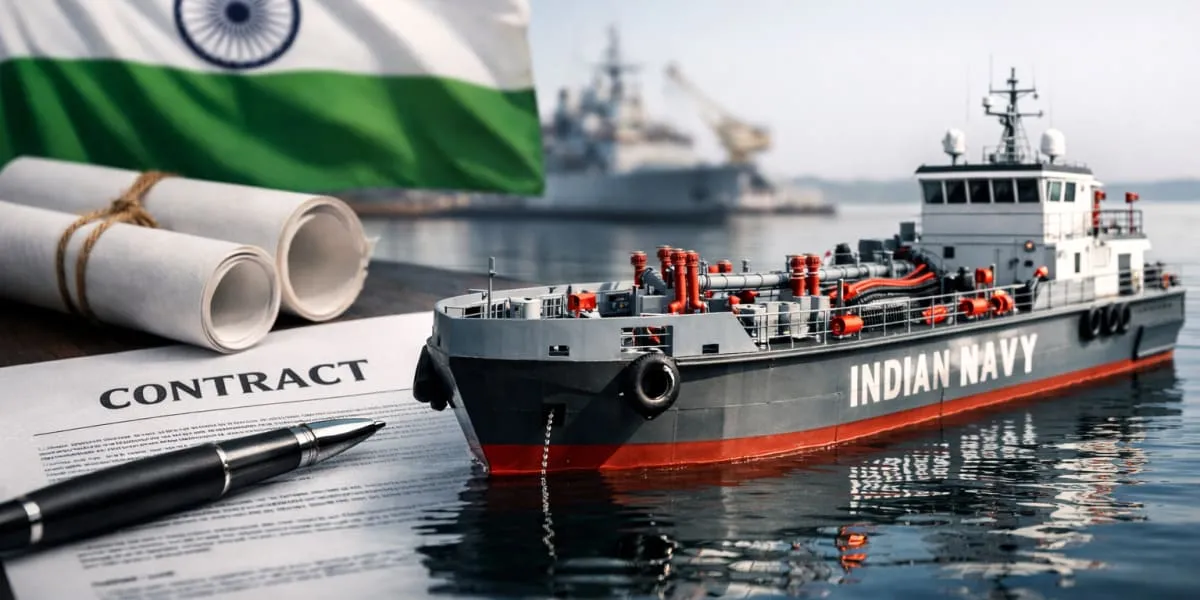
A contract for construction of four 500 tonne (t) self-propelled fuel barges for the Indian Navy was concluded with Shoft Shipyard Private Limited of Thane on two March 2026 under the auspices of the Ministry of Defence and the Press Information Bureau. The vessels will be built under the classification rules of the Indian Register of Shipping (IRS) and will support harbour and anchorage operations. The agreement marks a formal procurement step aimed at enhancing replenishment capabilities for naval units.

The primary role of the barges will be replenishment of fuel to ships and submarines in harbour and at anchorage, enabling efficient harbour support and operational readiness. As self-propelled fuel barges, they will provide mobility and flexibility for refuelling operations alongside stationary fuel delivery assets. The project is expected to augment logistic support without altering strategic operational profiles of fleet units.

The contract has been framed to promote domestic shipbuilding and to encourage Micro, Small and Medium Enterprises (MSME) shipyards by awarding construction to an MSME yard, thereby strengthening the domestic industrial base. The initiative aligns with national manufacturing and self-reliance programmes and with Maritime India Vision 2030 which seeks to grow the domestic maritime sector. Classification and construction processes will adhere to established standards to ensure safety and interoperability with naval requirements.

Shoft Shipyard will undertake construction at its Thane facility and is expected to contribute to the domestic supply chain for naval auxiliary vessels. The four barges of 500 t capacity each will bolster harbour refuelling infrastructure and support the Indian Navy's efforts to rely more on indigenous shipyards. The Ministry of Defence has continued to emphasise support for domestic shipbuilding through such contracts.

A contract for construction of four 500 tonne (t) self-propelled fuel barges for the Indian Navy was concluded with Shoft Shipyard Private Limited of Thane on two March 2026 under the auspices of the Ministry of Defence and the Press Information Bureau. The vessels will be built under the classification rules of the Indian Register of Shipping (IRS) and will support harbour and anchorage operations. The agreement marks a formal procurement step aimed at enhancing replenishment capabilities for naval units. The primary role of the barges will be replenishment of fuel to ships and submarines in harbour and at anchorage, enabling efficient harbour support and operational readiness. As self-propelled fuel barges, they will provide mobility and flexibility for refuelling operations alongside stationary fuel delivery assets. The project is expected to augment logistic support without altering strategic operational profiles of fleet units. The contract has been framed to promote domestic shipbuilding and to encourage Micro, Small and Medium Enterprises (MSME) shipyards by awarding construction to an MSME yard, thereby strengthening the domestic industrial base. The initiative aligns with national manufacturing and self-reliance programmes and with Maritime India Vision 2030 which seeks to grow the domestic maritime sector. Classification and construction processes will adhere to established standards to ensure safety and interoperability with naval requirements. Shoft Shipyard will undertake construction at its Thane facility and is expected to contribute to the domestic supply chain for naval auxiliary vessels. The four barges of 500 t capacity each will bolster harbour refuelling infrastructure and support the Indian Navy's efforts to rely more on indigenous shipyards. The Ministry of Defence has continued to emphasise support for domestic shipbuilding through such contracts.

Next Story
Infrastructure Urban

HVAC: Cool Advice

India’s Cooling Action Plan forecasts cooling demand to grow nearly eight times in the next 20 years. In light of the fact that cooling is no longer just a comfort product but lies at the intersection of national development, public health, climate action and energy security, this means the HVAC industry shoulders a very serious responsibility. Mihir Sanghavi, Managing Partner, Auro Engineering Company, Immediate Past President RATA, Secretary, ISHRAE, and Regional Representative, ASHRAE Region XV, describes that responsibility as “identifying a system that can serve for 15 to 20 years o..

Next Story
Infrastructure Urban

Wanted: 2 Million Workers

Construction, India’s second largest employer by industry, employs about 50 million workers but could additionally absorb another 40 million workers, according to estimates shared by the Construction Skill Development Council of India (CSDCI) in 2023. Within this, citing trade estimates, Rahul Bahl, Managing Director, Krishna Buildestates, says the shortage of trained, skilled workers is currently about 2 million, and is expected to rise to 5 million by 2030.Not only is the construction industry struggling to find workers but construction labour productivity in India significantly trails glo..

Next Story
Infrastructure Transport

The Critical Path

In Ircon International Ltd v. Afcons Infrastructure Ltd, OMP (Comm) 279/2019, the Delhi High Court examined how delay and extension of time (‘EOT’) are to be assessed in construction contracts, particularly in the context of the ‘critical path’ while dealing with challenge to an arbitral award under Section 34 of the Arbitration and Conciliation Act 1996 (‘the Act’). The High Court’s observations regarding the critical path are of significant import for construction and infrastructure projects and related arbitration. The parties entered into a contract for construction of T..

Advertisement

Subscribe to Our Newsletter

Get daily newsletters around different themes from Construction world.

STAY CONNECTED

Advertisement

Advertisement

Advertisement