+
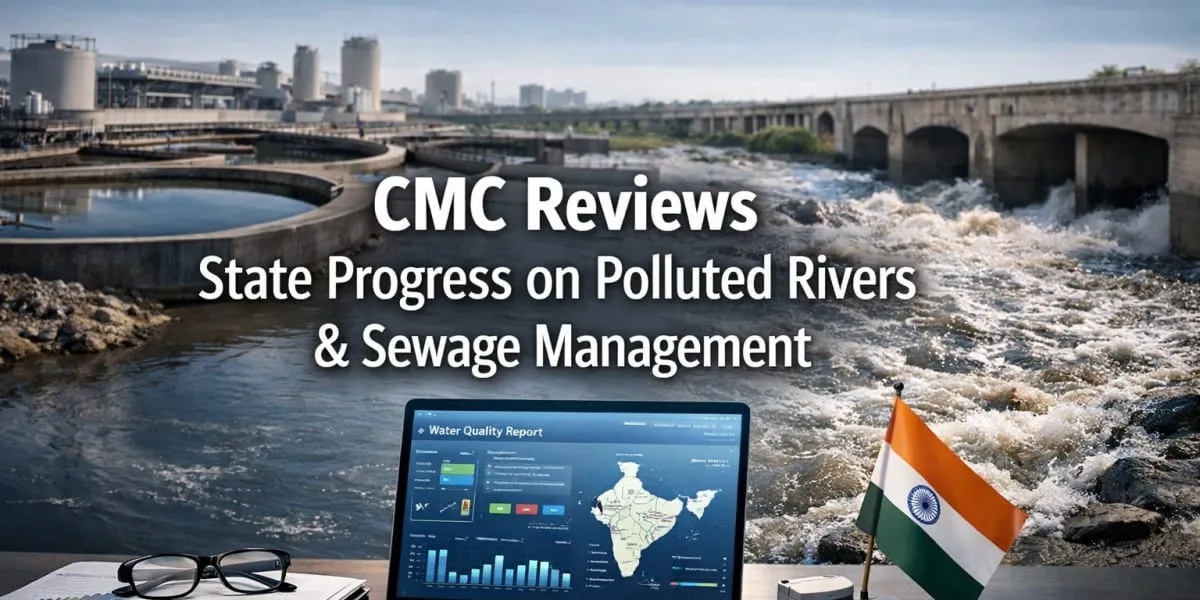
CMC Reviews State Progress on Polluted Rivers and Sewage Management
WATER & WASTE

CMC Reviews State Progress on Polluted Rivers and Sewage Management

The 21st meeting of the Central Monitoring Committee (CMC) on river rejuvenation was held under the chairpersonship of Shri V. L. Kantha Rao, Secretary of the Department of Water Resources, River Development and Ganga Rejuvenation in the Ministry of Jal Shakti. The meeting was attended by senior officials including the Director General of the National Mission for Clean Ganga (NMCG) and representatives of state governments and state pollution control boards.

The committee reviewed the latest status of polluted river stretches based on the Central Pollution Control Board (CPCB) 2025 report and examined progress by states in implementing approved action plans. The chair emphasised that sustainable improvement in river water quality depends not only on the creation of infrastructure but on its effective utilisation, regulatory compliance and timely project execution. Priority areas identified included bridging sewage treatment gaps, improving the performance of existing Sewage Treatment Plants (STPs), expediting ongoing and tendered projects and developing sewage networks, strengthening industrial pollution control, scaling up reuse of treated wastewater and accelerating floodplain demarcation, together with enabling real time monitoring to enhance transparency and accountability.

A comparative review of polluted river stretches identified in 2018, 2022 and 2025 showed a continued reduction in the overall number of polluted stretches since 2018, while noting that certain states have reported additions of new polluted stretches and deterioration in specific river segments requiring focused corrective action. The committee reviewed progress on STPs, capacity utilisation, floodplain zoning, reuse of treated wastewater and institutional monitoring through River Rejuvenation Committees in respect of Uttarakhand, Uttar Pradesh, Bihar, Jharkhand, West Bengal, Delhi, Haryana, Chhattisgarh, Madhya Pradesh, Rajasthan, Andaman and Nicobar, Lakshadweep, Odisha, Jammu and Kashmir and Punjab.

The meeting concluded with a call for states to adopt a time-bound, outcome-oriented approach to river rejuvenation with emphasis on operational efficiency, inter-departmental coordination and sustained compliance to achieve long-term water quality improvement. The secretary directed states to adopt time-bound action and to strengthen STP performance and monitoring.

The 21st meeting of the Central Monitoring Committee (CMC) on river rejuvenation was held under the chairpersonship of Shri V. L. Kantha Rao, Secretary of the Department of Water Resources, River Development and Ganga Rejuvenation in the Ministry of Jal Shakti. The meeting was attended by senior officials including the Director General of the National Mission for Clean Ganga (NMCG) and representatives of state governments and state pollution control boards. The committee reviewed the latest status of polluted river stretches based on the Central Pollution Control Board (CPCB) 2025 report and examined progress by states in implementing approved action plans. The chair emphasised that sustainable improvement in river water quality depends not only on the creation of infrastructure but on its effective utilisation, regulatory compliance and timely project execution. Priority areas identified included bridging sewage treatment gaps, improving the performance of existing Sewage Treatment Plants (STPs), expediting ongoing and tendered projects and developing sewage networks, strengthening industrial pollution control, scaling up reuse of treated wastewater and accelerating floodplain demarcation, together with enabling real time monitoring to enhance transparency and accountability. A comparative review of polluted river stretches identified in 2018, 2022 and 2025 showed a continued reduction in the overall number of polluted stretches since 2018, while noting that certain states have reported additions of new polluted stretches and deterioration in specific river segments requiring focused corrective action. The committee reviewed progress on STPs, capacity utilisation, floodplain zoning, reuse of treated wastewater and institutional monitoring through River Rejuvenation Committees in respect of Uttarakhand, Uttar Pradesh, Bihar, Jharkhand, West Bengal, Delhi, Haryana, Chhattisgarh, Madhya Pradesh, Rajasthan, Andaman and Nicobar, Lakshadweep, Odisha, Jammu and Kashmir and Punjab. The meeting concluded with a call for states to adopt a time-bound, outcome-oriented approach to river rejuvenation with emphasis on operational efficiency, inter-departmental coordination and sustained compliance to achieve long-term water quality improvement. The secretary directed states to adopt time-bound action and to strengthen STP performance and monitoring.

Next Story
Building Material

Operational Excellence Redefined!

Operational excellence in cement has moved far beyond the old pursuit of ‘more tonne’. The new benchmark is smarter, cleaner, more reliable production—delivered with discipline across process, people and data. In an industry where energy can account for nearly 30 per cent of manufacturing cost, even marginal gains translate into meaningful value. As Dr SB Hegde, Professor, Jain College of Engineering & Technology, Hubli and Visiting Professor, Pennsylvania State University, USA, puts it, “Operational excellence… is no longer about producing more. It is about producing smarter, cleane..

Advertisement

Subscribe to Our Newsletter

Get daily newsletters around different themes from Construction world.

STAY CONNECTED

Advertisement

Advertisement

Advertisement

Open In App