Here’s what’s trending in the smart homes space
Real Estate

Here’s what’s trending in the smart homes space

Photo courtesy: BuildTrack

Although a relatively new concept, smart homes arecreating a buzz in the market, globally and in India.
Smart homes use Internet-connected devices to enable remote monitoring and management of appliances and systems. In fact, home automation is increasingly being considered a necessity than a luxury, with safety, security and energy-efficiency as imperatives. Today’s smart homes feature TVs, lighting systems, thermostats, locks, security cameras, kitchen appliances and household system monitors—which are all smart!

Globally, the smart home appliances market is expected to grow at about 32 per cent CAGR during 2019-2025. What’s more, the Asia Pacific region is expected to witness the fastest growth rate in this period, considering the increase in the number of home appliances vendors in this region. In India, the home automation market currently stands at $ 1.6 billion and is estimated to reach $ 7.2 billion by 2023. It is dominated by smart appliances, security systems, lighting and controls, and energy management.

Trending features
In India, technologies like motion-sensing cameras, smart alarms and video door monitoring systems have been highly popular. According to Ashish R Puravankara, Managing Director, Puravankara, “We have also noticed that plug-and-play, voice-controlled devices like Google Home and similar devices have gained greater acceptance among homebuyers who are now looking to convert their living spaces into voice-enabled smart homes.”

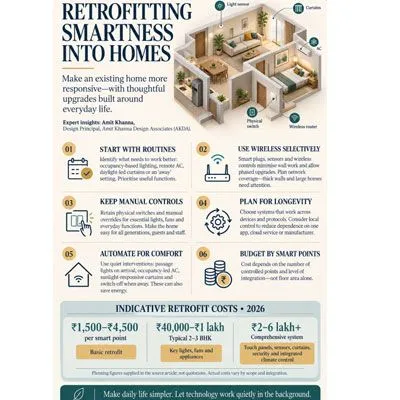
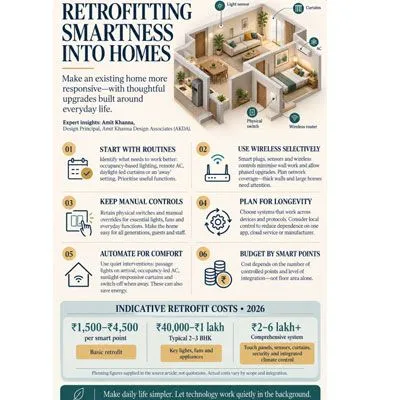
Agreeing that voice assistants like Google Home and Amazon Alexa are becoming popular, Dr Narendra Bhat, President, BuildTrack, says, “This is a new interface to home automation and adds another layer of convenience to the usual smart app option. Besides, homeowners are increasingly inquiring about wireless home automation that can retrofit existing homes without disrupting the ambience or décor and making changes to existing switchboards. On the smart app front, users are looking to go beyond a list of devices and seeking more interesting 360o panoramic room views where the device controls or monitors are placed, as they are more intuitive and appealing to use.”

“Certain parts of a home, like the living room, tend to have more automation,” says Ayan Sen, Founder, Ayan Sen Architects. Also, in terms of safety and security systems, he mentions that people are getting more used to monitors in their home. And Avinash K Gautam, CEO, Silvan Innovation Labs, adds, “Smart appliances and smart lights are gaining a lot of traction.”

Buyer requirements on the safety and security front include sensors for smoke, gas leak, door intrusion, glass break, motion, etc, which can send them notifications on smart apps. And on the comfort and convenience side, they look for control of lights, fans, ACs, curtains or blinds, TVs and media devices via smart apps, adds Dr Bhat.

Peak efficiency
Home automation has become popular because of its innate ability to minimise wastage by providing complete control of interconnected devices to the homeowner. “With home automation providing complete control over appliances and devices to homeowners, one can benefit from these technologies, especially in terms of energy saving,” adds Puravankara. “One can keep energy consumption in check, thereby saving a lot of money.”

An example is the ‘PresetScene’ feature in home automation. As a spokesperson from Kalpataru shares, it prevents the wastage of energy by operating lights, air-conditioners and air-ventilation systems on a real-time requirement. As automation can be controlled from applications on smart devices, it helps to monitor the status of devices. These devices are capable of learning, processing and adapting to your preferences and habits.

Affordable housing driving demand
In the past, smart homes were viewed as a luxury. This has changed substantially, because of the development of technologies like IoT and social transformation. As Dr Bhat explains, “The number of smartphones in India is anticipated to reach 440 million by 2022. These phones that serve multiple needs are also a gateway to access smart automation at no additional expense. As people in the affordable home segment already have these smartphones, they incrementally seek home automation solutions for their homes where they see a need; say, for safety, security or convenience.”

The good news is that the advent of IoT has made the products quite inexpensive and within the reach of the masses. “We are working with several real-estate developers in the affordable sector to see what kind of technology can be adopted,” shares Gautam.

Posing concerns
By and large, the average homebuyer in India is still technophobic. “So, we have to realise that technophobia is our biggest challenge and consider the maintainability of such items and technology,” says Sen.

Also, given that Indian homes are constructed using brick and concrete, the use of wireless systems constantly poses a challenge, adds Dr Bhat. “We typically recommend that during construction or renovation, users set up requisite wiring so they can add on home automation aspects when they need or wish to.”

Opportunities ahead
Home automation is definitely on the rise. BuildTrack is focusing on providing more options for users to enjoy their interfaces with their home automation system. “We are doing it in three ways,” elaborates Dr Bhat. “We are introducing a range of automation-ready glass touch switches in multiple colours, sizes and layouts; adding functionality via Alexa or Google voice assistants to improve usability of home automation; and enabling visually appealing 360o panoramic images of users’ homes as backgrounds through visual smart apps on which the appropriate home automation devices and their status can be displayed.”

“The infrastructure situation here demands that products be customised for the Indian market,” says Gautam. “That, by itself, opens opportunities for companies wanting to do business in this domain.” Going forward, Silvan Innovation Labs plansto expand its strong presence in southern India across the country.

Indeed, with strong economic growth in the Asia-Pacific region, domestic as well as foreign manufacturers and retailers of home appliances are witnessing potential opportunities for expansion. Further, the increase in demand for energy-efficient appliances is anticipated to create new business opportunities. The market is undoubtedly turning smarter!

- SERAPHINA D’SOUZA

Photo courtesy: BuildTrack Although a relatively new concept, smart homes arecreating a buzz in the market, globally and in India. Smart homes use Internet-connected devices to enable remote monitoring and management of appliances and systems. In fact, home automation is increasingly being considered a necessity than a luxury, with safety, security and energy-efficiency as imperatives. Today’s smart homes feature TVs, lighting systems, thermostats, locks, security cameras, kitchen appliances and household system monitors—which are all smart! Globally, the smart home appliances market is expected to grow at about 32 per cent CAGR during 2019-2025. What’s more, the Asia Pacific region is expected to witness the fastest growth rate in this period, considering the increase in the number of home appliances vendors in this region. In India, the home automation market currently stands at $ 1.6 billion and is estimated to reach $ 7.2 billion by 2023. It is dominated by smart appliances, security systems, lighting and controls, and energy management. Trending features In India, technologies like motion-sensing cameras, smart alarms and video door monitoring systems have been highly popular. According to Ashish R Puravankara, Managing Director, Puravankara, “We have also noticed that plug-and-play, voice-controlled devices like Google Home and similar devices have gained greater acceptance among homebuyers who are now looking to convert their living spaces into voice-enabled smart homes.” Agreeing that voice assistants like Google Home and Amazon Alexa are becoming popular, Dr Narendra Bhat, President, BuildTrack, says, “This is a new interface to home automation and adds another layer of convenience to the usual smart app option. Besides, homeowners are increasingly inquiring about wireless home automation that can retrofit existing homes without disrupting the ambience or décor and making changes to existing switchboards. On the smart app front, users are looking to go beyond a list of devices and seeking more interesting 360o panoramic room views where the device controls or monitors are placed, as they are more intuitive and appealing to use.” “Certain parts of a home, like the living room, tend to have more automation,” says Ayan Sen, Founder, Ayan Sen Architects. Also, in terms of safety and security systems, he mentions that people are getting more used to monitors in their home. And Avinash K Gautam, CEO, Silvan Innovation Labs, adds, “Smart appliances and smart lights are gaining a lot of traction.” Buyer requirements on the safety and security front include sensors for smoke, gas leak, door intrusion, glass break, motion, etc, which can send them notifications on smart apps. And on the comfort and convenience side, they look for control of lights, fans, ACs, curtains or blinds, TVs and media devices via smart apps, adds Dr Bhat. Peak efficiency Home automation has become popular because of its innate ability to minimise wastage by providing complete control of interconnected devices to the homeowner. “With home automation providing complete control over appliances and devices to homeowners, one can benefit from these technologies, especially in terms of energy saving,” adds Puravankara. “One can keep energy consumption in check, thereby saving a lot of money.” An example is the ‘PresetScene’ feature in home automation. As a spokesperson from Kalpataru shares, it prevents the wastage of energy by operating lights, air-conditioners and air-ventilation systems on a real-time requirement. As automation can be controlled from applications on smart devices, it helps to monitor the status of devices. These devices are capable of learning, processing and adapting to your preferences and habits. Affordable housing driving demand In the past, smart homes were viewed as a luxury. This has changed substantially, because of the development of technologies like IoT and social transformation. As Dr Bhat explains, “The number of smartphones in India is anticipated to reach 440 million by 2022. These phones that serve multiple needs are also a gateway to access smart automation at no additional expense. As people in the affordable home segment already have these smartphones, they incrementally seek home automation solutions for their homes where they see a need; say, for safety, security or convenience.” The good news is that the advent of IoT has made the products quite inexpensive and within the reach of the masses. “We are working with several real-estate developers in the affordable sector to see what kind of technology can be adopted,” shares Gautam. Posing concerns By and large, the average homebuyer in India is still technophobic. “So, we have to realise that technophobia is our biggest challenge and consider the maintainability of such items and technology,” says Sen. Also, given that Indian homes are constructed using brick and concrete, the use of wireless systems constantly poses a challenge, adds Dr Bhat. “We typically recommend that during construction or renovation, users set up requisite wiring so they can add on home automation aspects when they need or wish to.” Opportunities ahead Home automation is definitely on the rise. BuildTrack is focusing on providing more options for users to enjoy their interfaces with their home automation system. “We are doing it in three ways,” elaborates Dr Bhat. “We are introducing a range of automation-ready glass touch switches in multiple colours, sizes and layouts; adding functionality via Alexa or Google voice assistants to improve usability of home automation; and enabling visually appealing 360o panoramic images of users’ homes as backgrounds through visual smart apps on which the appropriate home automation devices and their status can be displayed.” “The infrastructure situation here demands that products be customised for the Indian market,” says Gautam. “That, by itself, opens opportunities for companies wanting to do business in this domain.” Going forward, Silvan Innovation Labs plansto expand its strong presence in southern India across the country. Indeed, with strong economic growth in the Asia-Pacific region, domestic as well as foreign manufacturers and retailers of home appliances are witnessing potential opportunities for expansion. Further, the increase in demand for energy-efficient appliances is anticipated to create new business opportunities. The market is undoubtedly turning smarter! - SERAPHINA D’SOUZA

Related Stories

Gold Stories

Next Story
Real Estate

LML Realty Sells Out Jhirka Valley Industrial Park in Haryana

LML Realty, the real estate arm of LML Group, recently announced the complete sell-out of its Jhirka Valley Industrial Park in Haryana, with over 1.17 million sq ft of industrial space acquired by more than 50 companies. With utilities and internal infrastructure in place, the company has commenced plot handovers, enabling buyers to begin construction and establish their operations.The industrial park has attracted companies across diverse sectors, including chemicals, metals and alloys, textiles, electrical equipment, energy, logistics, construction, polymers and engineering. Key buyers inclu..

Next Story
Real Estate

WSB Real Estate Partners Exits Six Housing Investments

WSB Real Estate Partners recently announced the successful exit of six residential investments across Bengaluru, Mumbai Metropolitan Region (MMR) and National Capital Region (NCR), delivering an average internal rate of return (IRR) of 19–21 per cent and an overall investment return of 1.4 times.The real estate-focused investment firm invested approximately Rs 7 billion across six mid-affordable housing projects over the past four years. All six investments were fully repaid between April and November 2026, several months ahead of their original investment tenures.WSB collaborated with sever..

Next Story
Infrastructure Transport

Aluminium Industry Seeks Policy Support for Rs 4 Trillion Investment

The Aluminium Association of India (AAI) has recently urged the government to introduce supportive policy measures to safeguard the sector’s proposed Rs 4 trillion investment pipeline. The association highlighted the need for a predictable policy framework to strengthen domestic manufacturing, expand production capacity and reduce import dependence.AAI submitted its recommendations for the Union Budget 2027-28 to the Ministries of Finance, Commerce and Industry, and Mines, along with the Department for Promotion of Industry and Internal Trade (DPIIT).India’s aluminium demand is projected t..

Subscribe to Our Newsletter

Get daily newsletters around different themes from Construction world.

STAY CONNECTED

Advertisement

SPECIAL OFFER
QR Code