Reliance Turns to American Crude amid Middle East Disruptions
OIL & GAS

Reliance Turns to American Crude amid Middle East Disruptions

Reliance Industries broadened its crude procurement and adjusted product exports during the July-September quarter as disruptions in the Middle East affected global oil flows. The company’s response included sourcing feedstock from new regions, managing shipping costs and placing refined products in markets offering stronger returns.

Reliance supplied high-speed diesel and motor spirit to its Jio-bp retail outlets, industrial customers and public-sector oil marketing companies facing product shortages. The supplies helped meet domestic fuel requirements without requiring imports, while the company continued operating its refineries amid uncertainty in international crude trade.

Restrictions affecting the Strait of Hormuz and the temporary shutdown of Saudi Arabia’s East-West pipeline constrained crude movement during the quarter. Reliance also faced higher freight rates and a wider price differential for Arab Gulf crude, increasing the logistical and commercial challenges associated with feedstock procurement.

To maintain refinery operations, Reliance sourced crude from Latin America, North America and the Mediterranean in addition to its traditional supply routes. The company did not disclose the volumes obtained from each region or their share of its overall crude basket, but the wider sourcing network reduced its dependence on individual routes during the disruption.

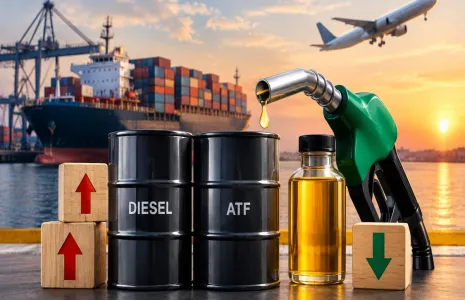
Reliance also changed the geographical distribution of its petroleum product exports. It directed light distillates to East and South Africa, while middle distillates were sent to Europe, Latin America and West Africa according to market returns. Transportation-fuel cracks rose to between 3 and 3.7 times their levels in the corresponding period a year earlier, reaching historic highs. Fuel cracks measure the difference between refined-product prices and crude costs, although refining profitability also depends on freight, product mix and operating expenses. The company reported improved margins in parts of its downstream chemicals business, which includes refining and petrochemical production.

Reliance Industries broadened its crude procurement and adjusted product exports during the July-September quarter as disruptions in the Middle East affected global oil flows. The company’s response included sourcing feedstock from new regions, managing shipping costs and placing refined products in markets offering stronger returns. Reliance supplied high-speed diesel and motor spirit to its Jio-bp retail outlets, industrial customers and public-sector oil marketing companies facing product shortages. The supplies helped meet domestic fuel requirements without requiring imports, while the company continued operating its refineries amid uncertainty in international crude trade. Restrictions affecting the Strait of Hormuz and the temporary shutdown of Saudi Arabia’s East-West pipeline constrained crude movement during the quarter. Reliance also faced higher freight rates and a wider price differential for Arab Gulf crude, increasing the logistical and commercial challenges associated with feedstock procurement. To maintain refinery operations, Reliance sourced crude from Latin America, North America and the Mediterranean in addition to its traditional supply routes. The company did not disclose the volumes obtained from each region or their share of its overall crude basket, but the wider sourcing network reduced its dependence on individual routes during the disruption. Reliance also changed the geographical distribution of its petroleum product exports. It directed light distillates to East and South Africa, while middle distillates were sent to Europe, Latin America and West Africa according to market returns. Transportation-fuel cracks rose to between 3 and 3.7 times their levels in the corresponding period a year earlier, reaching historic highs. Fuel cracks measure the difference between refined-product prices and crude costs, although refining profitability also depends on freight, product mix and operating expenses. The company reported improved margins in parts of its downstream chemicals business, which includes refining and petrochemical production.

Related Stories

Gold Stories

Next Story
Infrastructure Urban

Jupiter Wagons Wins Rs. 3.24 bn ACT2 Wagon Orders from Private Firms

Jupiter Wagons has secured private-sector orders worth more than Rs. 3.24 bn from GATX India and Chetak International for its ACT2 automobile carrier wagons. The company announced the orders on 2 November 2026, saying the contracts would strengthen its business with private wagon-leasing and logistics operators. GATX India has issued a Letter of Intent (LOI) for the manufacture and supply of 10 rakes comprising 270 ACT2 wagons. The LOI is valued at Rs. 2.15 bn and covers the production and delivery of the company’s new-design automobile carrier platform. Chetak International has separately p..

Next Story
Infrastructure Urban

Tata Motors Takes Control of Iveco with 89.42 Per Cent Stake

Tata Motors has taken control of Italian commercial-vehicle maker Iveco after acquiring an 89.42 per cent stake for approximately €3.43 bn, or Rs. 363.87 bn. The transaction gives India’s largest commercial-vehicle manufacturer control of a European business with annual revenue of Rs. 1.42 tn, while shifting attention to integration, cash-flow generation and repayment of acquisition debt. TML CV Holdings B.V., Tata Motors’ indirect wholly owned subsidiary, acquired 238.16 mn common shares at €14.40 apiece. The holding represents 89.42 per cent of Iveco’s common share capital, excludi..

Next Story
Building Material

Ambuja Cements to Invest Rs. 145 bn to Raise Capacity by FY30

Ambuja Cements will invest Rs. 145 bn to expand its cement capacity to 155 mn tonnes per annum by fiscal 2030. The planned investment, equivalent to $1.53 bn, will increase production capacity from the company’s current level of 113.5 MTPA. The company expects capacity to reach 119 MTPA by March 2027, with the wider expansion programme adding facilities across several major cement markets. The investment is intended to support the company’s long-term growth and strengthen its manufacturing network in India. The new capacity will be developed across Assam, Bihar, Jharkhand, Gujarat, Maharas..

Advertisement

Subscribe to Our Newsletter

Get daily newsletters around different themes from Construction world.

STAY CONNECTED

Advertisement

SPECIAL OFFER
QR Code