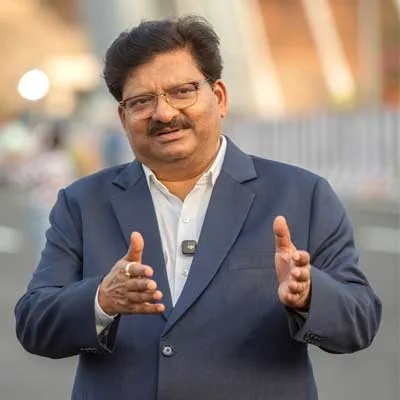
Mumbai-Pune Connecting Link is designed to ensure reliable all-weather, high-speed transport.
ROADS & HIGHWAYS

Mumbai-Pune Connecting Link is designed to ensure reliable all-weather, high-speed transport.

Infrastructure connectivity will be one of the keys to achieve Viksit Bharat. And the Mumbai-Pune Connecting Link has been developed as a long-term infrastructure solution for Western India. Dr Anilkumar Gaikwad, Vice Chairman & Managing Director, Maharashtra State Road Development Corporat...

"Join industry leaders at RAHSTA Expo, India's premier platform for roads, highways and traffic infrastructure. Register now to explore innovations, network with experts and shape the future of mobility."

Infrastructure connectivity will be one of the keys to achieve Viksit Bharat. And the Mumbai-Pune Connecting Link has been developed as a long-term infrastructure solution for Western India. Dr Anilkumar Gaikwad, Vice Chairman & Managing Director, Maharashtra State Road Development Corporation (MSRDC), a speaker at the RAHSTA Expo 2026, elaborates upon the project and its significance.The Mumbai-Pune Connecting Link has largely been discussed as a travel-time reduction project. From MSRDC’s perspective, what larger infrastructure and mobility problem was this project actually designed to solve?The Mumbai-Pune Connecting Link was conceived not merely as a travel-time reduction with bypass to the Khandala-Lonavala ghat section, but as a long-term infrastructure solution to address capacity, traffic safety and operational challenges along one of India’s busiest economic corridors.It aims to solve mobility issues like steep gradient in the ghat area and reduce fuel consumption and travel time. The new alignment reduces the overall expressway length, allows more lanes for uninterrupted traffic, and is designed to ensure reliable all-weather, high-speed transport.Executing twin eight-lane tunnels through the Sahyadri ranges, including a tunnel passing nearly 182 m below Lonavala Lake, involved considerable geological and environmental complexity. What were the most critical engineering decisions that shaped the final execution strategy of the project?Extensive initial/intermittent study and analysis of the geological mapping of the rock strata with the involvement of expatriates and the application of international standards has shaped the precise strategy of execution. We have taken the decision to appoint excellent resources to ensure continuous geological monitoring with face mapping, probe drilling and support (shotcrete, rock bolts, ribs, drainage, waterproofing) for slabbing, fractures and groundwater.The project encountered fractured rock formations, high hydrostatic pressure zones, extreme monsoon conditions and difficult terrain logistics. How did MSRDC approach risk management and decision-making during such uncertain construction conditions?We undertook joint geological monitoring and review of every excavation round and advance probe drilling to spot fractures, weak strata and groundwater. There was expert involvement for timely decisions, controlled excavation, immediate supports (shotcrete, bolts), drainage and waterproofing. Monsoon measures included drainage, slope stabilisation and safe access. There was early integration of safety redundancies like 300-m spaced cross passages for evacuation, fire safety and ventilation.The Tiger Valley cable-stayed bridge has emerged as one of the defining visual and structural elements of the project. What were the biggest technical and construction challenges in executing this bridge in a high-wind, high-rainfall and low-visibility environment?The challenges included making an access road of 10 km through forest and implementation of safety standards as well as execution of proven construction techniques like pylon jump-form (Doka) and CFT (cantilever form traveller) in a deep valley with high-precision geometry control adhering to safety standards. Also, we managed great progress during the COVID outbreak amid the availability of foreign test slots. Exact data collection of the fluttering wind with gust on the actual site, for a test like WTT to design the model, was the biggest challenge. Retention of high-skilled labour was also a challenge to surmount.Long tunnels require active mechanical ventilation systems to supply oxygen, remove toxic exhaust fumes and manage heat, especially as natural airflow becomes insufficient over long distances. How was this managed?We used adits for better airflow and multiple work fronts; installed longitudinal ventilation ducts for supply of fresh air and removal of harmful gases during blasting; used vertical shafts for air intake and exhaust and high-capacity fans/blowers to control dust during blasting and employed an emergency response team with oxygen cylinders/first aid kits with a safe evacuation plan.The Connecting Link required coordination across international consultants, contractors, geotechnical experts, environmental agencies and multiple government stakeholders over several years. What institutional and project management lessons has MSRDC drawn from executing a corridor of this complexity?We have learnt the importance of integrated coordination among multiple stakeholders; early engagement with environmental and regulatory agencies; robust planning with flexibility for uncertainties; digital monitoring and reporting systems; and a strong emphasis on safety governance and accountability frameworks. Such megaprojects require collaborative decision-making and transparent communication.As India begins developing increasingly complex high-speed corridors, tunnels and mountain infrastructure, what lessons from this project could shape the next generation of expressway development in the country?We must shift towards tunnel-based alignments in difficult terrain; incorporate advanced construction technologies and monitoring systems; have a greater focus on safety as a core design parameter; use data-driven project management and risk mitigation; and lay emphasis upon sustainability and minimal environmental impact. These lessons will help shape next-generation expressways and high-speed corridors, making them safer, more resilient and efficient.

Next Story
Real Estate

The Workplace Reset

If the past few years have seen sustainability emerge as a buzzword in the design of commercial spaces, the next few years will see the focus shift to ‘experience’. Workplaces that prioritise superior employee experiences consistently report stronger talent attraction and higher retention rates and productivity, while using resources sustainably.First things first; what sort of experiences are expected from a workplace?As Vandana Dhawan Saxena, Founder and Design Principal, Studio IV Designs, explains, “Offices have grown into environments that need to support various kinds of experience..
Next Story
Infrastructure Urban

Designing Human-Centric High-Rises

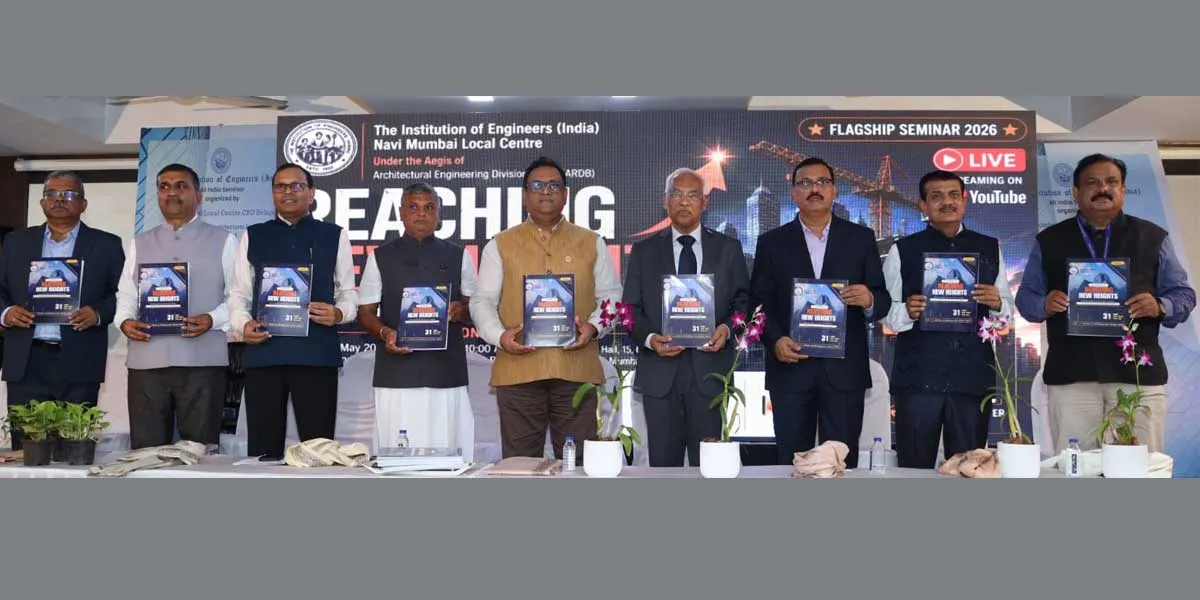
The Institution of Engineers (India) (IEI), Navi Mumbai Local Centre, under the aegis of the Architectural Engineering Division Board, organised a one-day national seminar, ‘Reaching New Heights – Overcoming High-Rise Construction Challenges’, at CBD Belapur, Navi Mumbai.The seminar brought together architects, engineers, planners, developers, academicians and industry professionals to deliberate on the design, construction, operation and sustainability of tall buildings in rapidly urbanising cities...To read the full article Click Here ..

Next Story
Infrastructure Urban

Carbon-negative and ultra-low carbon are not just claims!

In an interaction with Construction World, Tarun Jami, Founder, GreenJams, explains how the company is cutting cement’s carbon footprint by 80 per cent through Binder, while scaling innovations such as Agrocrete® and Novastone to make buildings lighter, faster and carbon-negative.Agrocrete® is positioned as a carbon-negative material. What does this mean for developers?For developers, Agrocrete® offers a practical way to reduce embodied carbon at the material level. Since walling forms a significant part of a building’s material footprint, using carbon-negative blocks can bring the net ..

Advertisement

Subscribe to Our Newsletter

Get daily newsletters around different themes from Construction world.

STAY CONNECTED

Advertisement

Advertisement

Advertisement