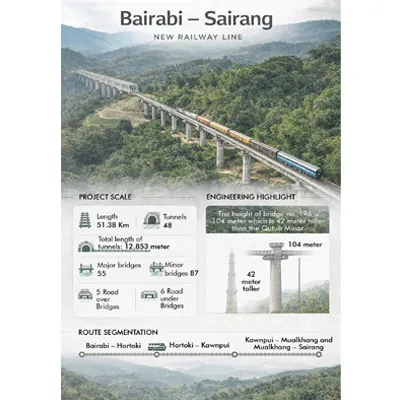
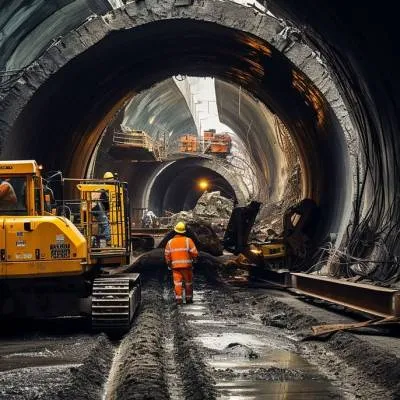
For nearly seven decades, the idea of a train reaching Aizawl, the capital city of Mizoram, remained more hope than plan. Maps were drawn, alignments debated, surveys conducted – and shelved. In a state defined by steep hills, deep valleys and fragile geology, rail connectivity to the capital seemed perpetually just out of reach. Roads did what they could, but the absence of railways left Mizoram isolated from India’s logistics spine, its people dependent on slow, weather-bound surface transport.That long wait finally ended when the first railway line rolled into Sairang, completing the Bairabi–Sairang New Line Railway Project. More than an infrastructure milestone, the project represents the fulfilment of a generational aspiration – one that connects Mizoram’s capital to the national railway grid for the first time and quietly redraws the region’s economic and mobility map.A landmark link to the capitalWith the successful commissioning and Commissioner of Railway Safety (CRS) authorisation of the final Hortoki–Sairang section, the 51.38-km Bairabi-Sairang broad gauge railway line now stands complete. The project integrates Aizawl into India’s railway network, transforming how passengers and freight move in and out of the state.The CRS inspection of the final 33.864-km stretch was carried out between 6 and 10 June 2025, involving detailed checks conducted on foot and by motor trolley, followed by speed trials using an inspection special hauled by a diesel locomotive. The authorisation marked the culmination of years of construction and testing, with close scrutiny of alignment, structural integrity and safety systems across the challenging hilly terrain marked by extensive tunnelling and bridges. Following clearance, the line has been opened for passenger and freight services at a maximum permissible speed of 90 kmph on the main line.For Mizoram, this moment marks the end of infrastructural isolation and the beginning of seamless rail-based connectivity with the rest of the country.Four sections, one continuous visionThe Bairabi-Sairang railway project was executed in four distinct sections – Bairabi–Hortoki, Hortoki–Kawnpui, Kawnpui–Mualkhang and Mualkhang–Sairang – each presenting its own engineering challenges. While the earlier sections brought the railhead steadily closer to Aizawl, it was the final leg that demanded the most intensive engineering intervention.The last leg was carved through some of the most difficult terrain in the Northeast; the alignment cuts across steep hillsides, unstable slopes and complex geological formations. With limited access routes and narrow working windows dictated by weather, execution demanded not only technical capability but sustained coordination and adaptability on the ground.Engineering through the hillsFrom an engineering standpoint, the Bairabi-Sairang line ranks among Indian Railways’ most complex projects. Bridge engineering across steep valleys and elevated piers demanded meticulous execution. As Ayush Khaitan, Executive Director (Projects), Rahee Infratech, explains, “The Bairabi-Sairang broad gauge line traverses one of the most challenging geographies in the country, with steep gradients, deep valleys, high rainfall intensity and limited site accessibility. Within this demanding environment, Rahee Infratech was entrusted with the supply, fabrication, assembly and erection of composite girders for 12 major bridges comprising 71 spans, ranging from 18.3 m to 30.5 m.”Launching girders atop piers reaching 45 m required meticulous sequencing and strict safety control. “These challenges were addressed through detailed engineering planning, pre-assembly checks, controlled fabrication processes and the use of the cantilever erection method,” he adds, highlighting the precision-driven execution that enabled safe delivery in difficult terrain.Tunnelling under extreme conditionsTunnelling along the Bairabi-Sairang corridor required navigating some of the most complex geological conditions encountered on Indian railway projects.As described by Er. Navaneeth Chand Thalluri, Planning Manager, Vensar Constructions, “The execution of single-line, broad-gauge tunnels along the Bairabi-Sairang rail corridor involved highly complex geological formations marked by fractured rock masses, shear zones, soft ground pockets, steep hill slopes and intense monsoon conditions.”Ground conditions were further complicated by severe water ingress and unstable strata. He notes that key challenges included “high groundwater ingress reaching up to 300-600 litre/minute in critical tunnel stretches and weak and weathered rock strata requiring immediate support”.To manage these risks, execution relied on proactive investigation and rapid response. Mitigation measures included “continuous geological face mapping and probe drilling ahead of excavation and controlled drill-and-blast techniques with optimised vibration control”, he adds.Primary support systems formed the backbone of tunnel stability, comprising rock bolting (4-6 m), steel ribs, shotcrete up to 150-mm thickness and fore-poling in weak zones, shares Thalluri. These were complemented by “comprehensive drainage systems for groundwater diversion and portal protection through rock anchors, shotcrete, gabion walls and retaining structures”. He concludes, “Real-time monitoring and adaptive design approaches ensured safety, structural stability and consistent progress.”Delivering pace without compromising safetyAs a JV partner responsible for Tunnel Lots 14A and 15A, Vensar Constructions, in association with Hindustan Construction Company, executed approximately 2.8 km of tunnelling works.S M Rafi, Project In Charge, Vensar Constructions, highlights the scale and precision of execution, saying, “We achieved a peak monthly excavation progress of 210-240 m per month, with an average daily advance of 6-8 m per day in stable strata.” He further emphasises the technical complexity managed on site: “Even the most difficult geological sections were completed safely, including weak zone crossings with zero collapse incidents.” Safety remained central throughout the project lifecycle. As Rafi notes, “We have completed over 450,000 man-hours with zero lost time injuries (LTI), supported by strict operational controls and continuous workforce training.”Mechanisation played a critical role in maintaining productivity and consistency. “We deployed hydraulic drilling jumbos, mechanised loaders and conveyor-based mucking systems, along with customised blast designs based on rock mass rating (RMR),” he adds.Steel that holds the line togetherAs per information shared by the Steel Authority of India (SAIL), the company supplied 9,981 metric tonne (mt) of 60-kg, 13-m rails in R260 grade prime quality for the project, forming the backbone of the track infrastructure. In addition, SAIL supplied a range of critical steel products essential to execution, including 2,540 tonne of PM plates, 560 tonne of chequered plates, 480 tonne of HR plates, 392 tonne of HR coils, 627 tonne of TMT bars and 310 tonne of structural steel.These supplies supported not only track laying but also bridge construction, structural works and allied infrastructure, ensuring consistency in quality across one of Indian Railways’ most demanding new line projects.A gateway to regional integrationStrategically, the project reinforces the commitment of Indian Railways to extending infrastructure into remote and challenging regions. By connecting Aizawl to the broader network, the Bairabi-Sairang line strengthens regional integration, supports economic inclusion and enhances resilience in a strategically important part of the country.For Mizoram’s 1.2 million residents, the railway signals a decisive shift in everyday life. Travel becomes faster and safer; farmers gain wider markets; essential goods grow more affordable; and new jobs emerge across tourism, logistics and retail. Students, patients and entrepreneurs can now move with certainty rather than weather-bound delay. Beyond economics, the line reshapes identity, placing Aizawl firmly on India’s rail map and narrowing both physical and psychological distance. As officially released by North Central Railways, what was once isolation is now integration, with opportunity arriving on steel tracks that promise stability, inclusion and sustained growth.FACT FILEProject: Bairabi-Sairang New Line Broad Gauge Railway ProjectCompletion/authorisation: 2025Implementing zone: Northeast Frontier Railway (NFR)Structural works: Rahee Infratech, Tribeni Constructions LtdTunnelling/civil engineering: Hindustan Construction Company, Vensar ConstructionsElectrical/telecom: RailTel Corporation of IndiaSteel: Steel Authority of India LtdOther authorities/stakeholders: Commissioner of Railway Safety (CRS), Indian Railways