IGBC to drive India's transition towards Net Zero cities
Real Estate

IGBC to drive India's transition towards Net Zero cities

India has emerged as the world's second-largest green building market, with more than 20,620 registered projects covering 16.55 billion sq ft. Building on this momentum, the Confederation of Indian Industry (CII)-Indian Green Building Council (IGBC) will organise the 24th Green Building Congress 2026 from 26 to 28 November at the Jio World Convention Centre, Mumbai. The three-day international conference and exhibition will focus on accelerating the adoption of green and Net Zero solutions across buildings, campuses and cities.

The Congress is expected to bring together over 3,000 delegates, 10,000 business visitors, more than 150 thought leaders and over 100 institutional and industry partners. It will be held under the theme ‘Forging a Sustainable Future – Do Good, Feel Good. Building Greener Worlds Together’, coinciding with IGBC completing 25 years of promoting sustainable construction in India.

Established by CII in 2001, IGBC has been instrumental in advancing green building practices across residential, commercial, industrial, institutional and infrastructure sectors. Its portfolio of 33 Green and Net Zero rating systems provides frameworks for resource-efficient, environmentally responsible and healthier built environments, covering both new developments and existing buildings.

C Shekar Reddy, National Chairman, CII-IGBC and Chairman, Green Building Congress 2026, said India's green building movement had evolved from an emerging concept into a nationwide transformation over the past 25 years. He highlighted the measurable impact of IGBC-rated buildings, which are estimated to save around 64 billion units of electricity and 199 billion litres of water annually, while avoiding approximately 53 million tonnes of CO₂ emissions every year.

He said green buildings could also improve community well-being through healthier living environments, better access to essential resources and more resilient neighbourhoods. With rising temperatures and growing cooling requirements, buildings would need to become central to India's response to climate risks and energy security.

"The next phase must move beyond individual green buildings to Net Zero buildings, campuses, townships and sustainable cities," Reddy said, adding that the government should encourage the mainstreaming of green building practices across cities and communities.

Accelerating the transition towards Net Zero

A central focus of the Congress will be India's transition towards Net Zero buildings and climate-resilient cities. IGBC's Mission on Net Zero, launched in 2021, covers four dimensions: Net Zero Energy, Net Zero Water, Net Zero Waste and Net Zero Carbon. More than 350 organisations in the building sector have committed to achieving Net Zero status for their new and existing buildings.

The deliberations will address energy efficiency, renewable energy integration, water conservation, waste management, sustainable materials, circularity and lifecycle carbon reduction. The Congress will also examine how green buildings can strengthen India's energy security by moderating electricity demand through efficient building design, advanced cooling systems, smart energy management and renewable energy integration.

M Anand, Executive Director, CII-IGBC, said the council's 33 Green and Net Zero rating systems addressed virtually every building typology, from homes and offices to factories, healthcare facilities, educational institutions, airports and large infrastructure projects. He said the next phase of sustainable development would be defined by Net Zero performance, climate resilience and healthier indoor environments.

"Achieving this will require efficient design, renewable energy integration, responsible resource management and the retrofitting of existing buildings," Anand said. He also highlighted the role of artificial intelligence, IoT-enabled monitoring, smart building management systems, advanced cooling technologies and low-carbon materials in improving building performance.

Green finance to unlock investments

Green finance will be another key theme at the Congress, with discussions examining how financial institutions, housing finance companies, developers and investors can strengthen financing mechanisms for sustainable buildings and infrastructure.

Proposed areas of focus include preferential interest rates for certified green projects, green home loans, green mortgages, green bonds and ESG-linked investments. These mechanisms could help bridge the gap between higher initial investments and long-term operational savings, making green buildings more affordable and accessible to homebuyers, businesses and institutions.

The release noted that green buildings offer long-term economic benefits through lower electricity and water consumption, improved resource efficiency and reduced operating costs. As India's real estate and infrastructure sectors continue to expand, sustainable construction is also expected to create opportunities for manufacturers of green building materials, energy-efficient equipment, renewable energy technologies, smart building systems and low-carbon construction solutions.

Maharashtra's green building agenda

The Government of Maharashtra is a partner in the Congress and is encouraging stakeholders across government, industry and the wider built-environment ecosystem to advance green building practices. Hosting the event in Mumbai will highlight the state's contribution to India's green building movement and the opportunity to align urban development and infrastructure expansion with sustainability.

The Congress will examine how green buildings can address Mumbai's challenges relating to energy consumption, water security, waste management, urban heat and climate resilience. The focus will extend beyond new developments to the retrofitting of existing buildings, metro infrastructure, railway stations, healthcare facilities and public buildings.

Chitranjan Kaushik, Chairman, IGBC Mumbai Chapter and Co-Chair, Green Building Congress 2026, said Mumbai and Maharashtra were well positioned to lead India's transition towards sustainable urban development. With significant investments in housing, transport and public infrastructure, the state had an opportunity to integrate sustainability into development decisions and accelerate the green retrofitting of existing buildings.

He said the Congress would bring together policymakers, developers and technology providers to build partnerships and advance green building practices across the region.

Prashant Khandelwal, Co-Chair, IGBC Mumbai Chapter, said green buildings could support Mumbai and Maharashtra's growth by improving resource efficiency, lowering operating costs and strengthening resilience to climate risks. He added that the IGBC Mumbai Chapter would continue working with stakeholders to make green building practices accessible across developments of different sizes, including existing buildings.

Three days of knowledge and innovation

The Congress will include a three-day international conference and Green Building Expo, showcasing products, materials, technologies and solutions from Indian and international companies. The programme will comprise technical sessions, expert deliberations, product launches, business-to-business meetings and opportunities for international knowledge exchange.

The IGBC Project Awards 2026 and IGBC Leadership Awards 2026 will recognise excellence and leadership in sustainable building practices. Other initiatives will include the IGBC Green Design Competition, Performance Challenge for Green Built Environment, Green Your School Programme and Green Education Conclave.

As IGBC completes 25 years, the Congress aims to strengthen collaboration among government, industry, financial institutions, technology providers and other stakeholders to accelerate the adoption of green and Net Zero solutions and advance sustainable buildings and cities in India.

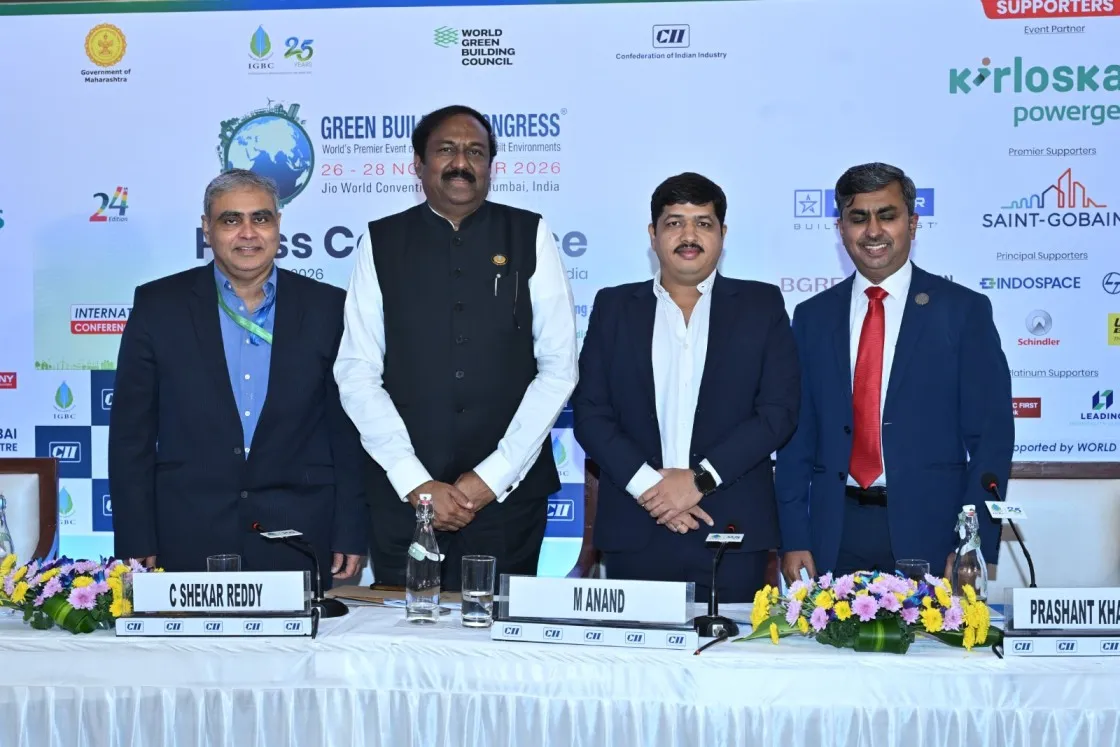
Image caption: Left to right: Chitranjan Kaushik, Chairperson IGBC Mumbai Chapter, C Shekar Reddy, National Chairman IGBC,  Prashant Khandelwal, Co-Chair IGBC Mumbai Chapter, and M Anand Executive Director IGBC.

India has emerged as the world's second-largest green building market, with more than 20,620 registered projects covering 16.55 billion sq ft. Building on this momentum, the Confederation of Indian Industry (CII)-Indian Green Building Council (IGBC) will organise the 24th Green Building Congress 2026 from 26 to 28 November at the Jio World Convention Centre, Mumbai. The three-day international conference and exhibition will focus on accelerating the adoption of green and Net Zero solutions across buildings, campuses and cities.The Congress is expected to bring together over 3,000 delegates, 10,000 business visitors, more than 150 thought leaders and over 100 institutional and industry partners. It will be held under the theme ‘Forging a Sustainable Future – Do Good, Feel Good. Building Greener Worlds Together’, coinciding with IGBC completing 25 years of promoting sustainable construction in India.Established by CII in 2001, IGBC has been instrumental in advancing green building practices across residential, commercial, industrial, institutional and infrastructure sectors. Its portfolio of 33 Green and Net Zero rating systems provides frameworks for resource-efficient, environmentally responsible and healthier built environments, covering both new developments and existing buildings.C Shekar Reddy, National Chairman, CII-IGBC and Chairman, Green Building Congress 2026, said India's green building movement had evolved from an emerging concept into a nationwide transformation over the past 25 years. He highlighted the measurable impact of IGBC-rated buildings, which are estimated to save around 64 billion units of electricity and 199 billion litres of water annually, while avoiding approximately 53 million tonnes of CO₂ emissions every year.He said green buildings could also improve community well-being through healthier living environments, better access to essential resources and more resilient neighbourhoods. With rising temperatures and growing cooling requirements, buildings would need to become central to India's response to climate risks and energy security.The next phase must move beyond individual green buildings to Net Zero buildings, campuses, townships and sustainable cities, Reddy said, adding that the government should encourage the mainstreaming of green building practices across cities and communities.Accelerating the transition towards Net ZeroA central focus of the Congress will be India's transition towards Net Zero buildings and climate-resilient cities. IGBC's Mission on Net Zero, launched in 2021, covers four dimensions: Net Zero Energy, Net Zero Water, Net Zero Waste and Net Zero Carbon. More than 350 organisations in the building sector have committed to achieving Net Zero status for their new and existing buildings.The deliberations will address energy efficiency, renewable energy integration, water conservation, waste management, sustainable materials, circularity and lifecycle carbon reduction. The Congress will also examine how green buildings can strengthen India's energy security by moderating electricity demand through efficient building design, advanced cooling systems, smart energy management and renewable energy integration.M Anand, Executive Director, CII-IGBC, said the council's 33 Green and Net Zero rating systems addressed virtually every building typology, from homes and offices to factories, healthcare facilities, educational institutions, airports and large infrastructure projects. He said the next phase of sustainable development would be defined by Net Zero performance, climate resilience and healthier indoor environments.Achieving this will require efficient design, renewable energy integration, responsible resource management and the retrofitting of existing buildings, Anand said. He also highlighted the role of artificial intelligence, IoT-enabled monitoring, smart building management systems, advanced cooling technologies and low-carbon materials in improving building performance.Green finance to unlock investments Green finance will be another key theme at the Congress, with discussions examining how financial institutions, housing finance companies, developers and investors can strengthen financing mechanisms for sustainable buildings and infrastructure.Proposed areas of focus include preferential interest rates for certified green projects, green home loans, green mortgages, green bonds and ESG-linked investments. These mechanisms could help bridge the gap between higher initial investments and long-term operational savings, making green buildings more affordable and accessible to homebuyers, businesses and institutions.The release noted that green buildings offer long-term economic benefits through lower electricity and water consumption, improved resource efficiency and reduced operating costs. As India's real estate and infrastructure sectors continue to expand, sustainable construction is also expected to create opportunities for manufacturers of green building materials, energy-efficient equipment, renewable energy technologies, smart building systems and low-carbon construction solutions.Maharashtra's green building agendaThe Government of Maharashtra is a partner in the Congress and is encouraging stakeholders across government, industry and the wider built-environment ecosystem to advance green building practices. Hosting the event in Mumbai will highlight the state's contribution to India's green building movement and the opportunity to align urban development and infrastructure expansion with sustainability.The Congress will examine how green buildings can address Mumbai's challenges relating to energy consumption, water security, waste management, urban heat and climate resilience. The focus will extend beyond new developments to the retrofitting of existing buildings, metro infrastructure, railway stations, healthcare facilities and public buildings.Chitranjan Kaushik, Chairman, IGBC Mumbai Chapter and Co-Chair, Green Building Congress 2026, said Mumbai and Maharashtra were well positioned to lead India's transition towards sustainable urban development. With significant investments in housing, transport and public infrastructure, the state had an opportunity to integrate sustainability into development decisions and accelerate the green retrofitting of existing buildings.He said the Congress would bring together policymakers, developers and technology providers to build partnerships and advance green building practices across the region.Prashant Khandelwal, Co-Chair, IGBC Mumbai Chapter, said green buildings could support Mumbai and Maharashtra's growth by improving resource efficiency, lowering operating costs and strengthening resilience to climate risks. He added that the IGBC Mumbai Chapter would continue working with stakeholders to make green building practices accessible across developments of different sizes, including existing buildings.Three days of knowledge and innovationThe Congress will include a three-day international conference and Green Building Expo, showcasing products, materials, technologies and solutions from Indian and international companies. The programme will comprise technical sessions, expert deliberations, product launches, business-to-business meetings and opportunities for international knowledge exchange.The IGBC Project Awards 2026 and IGBC Leadership Awards 2026 will recognise excellence and leadership in sustainable building practices. Other initiatives will include the IGBC Green Design Competition, Performance Challenge for Green Built Environment, Green Your School Programme and Green Education Conclave.As IGBC completes 25 years, the Congress aims to strengthen collaboration among government, industry, financial institutions, technology providers and other stakeholders to accelerate the adoption of green and Net Zero solutions and advance sustainable buildings and cities in India.Image caption: Left to right: Chitranjan Kaushik, Chairperson IGBC Mumbai Chapter, C Shekar Reddy, National Chairman IGBC,  Prashant Khandelwal, Co-Chair IGBC Mumbai Chapter, and M Anand Executive Director IGBC.

Related Stories

Gold Stories

Next Story
Infrastructure Energy

Jyoti Structures receives bank guarantee and LC facilities

Jyoti Structures has started receiving bank guarantees and letters of credit (LCs) from its lenders under the resolution plan approved by the National Company Law Tribunal (NCLT). The facilities are expected to strengthen the engineering, procurement and construction (EPC) company's ability to execute its existing order book and pursue new opportunities in the power transmission and infrastructure sectors.The company said the lenders had progressively begun releasing the facilities following its requests, made in accordance with the NCLT-approved resolution plan and subsequent directions of th..

Advertisement

Subscribe to Our Newsletter

Get daily newsletters around different themes from Construction world.

STAY CONNECTED

Advertisement

SPECIAL OFFER
QR Code