
MSME Ministry Announces IITF 2026 Framework
ECONOMY & POLICY

MSME Ministry Announces IITF 2026 Framework

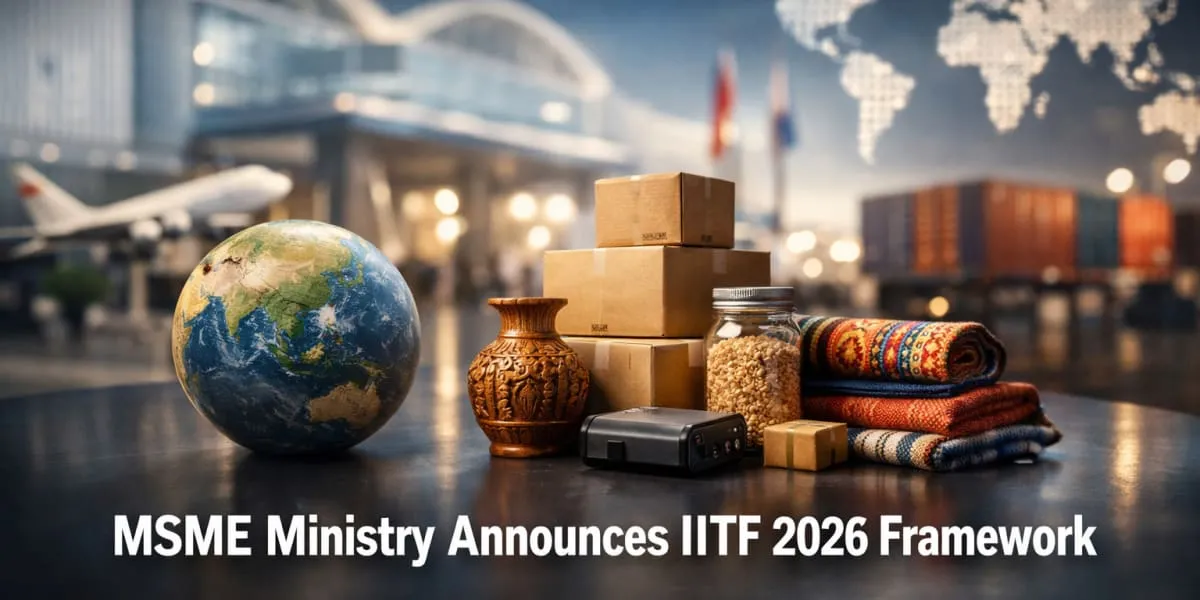
The Ministry of Micro, Small and Medium Enterprises has announced the framework for the India International Trade Fair 2026 designed to expand market access for micro and small enterprises. The scheme provides a structured pathway for such enterprises to present products to international buyers and trade delegations at the fair. The announcement emphasised the fair as a strategic platform for market integration.

The ministry said the framework aims to connect participants with global procurement networks and to facilitate export enquiries through curated business interactions. It outlined measures to support participation, including streamlined registration, shared exhibition spaces and coordinated logistics support to reduce entry barriers for smaller firms. Officials described the initiative as part of a broader effort to raise competitiveness among domestic small firms.

The fair is intended to offer opportunities for order generation, business partnerships and supply chain linkages between domestic manufacturers and overseas buyers. The framework includes mechanisms for targeted buyer outreach and structured meetings between sellers and procurement teams to enhance matchmaking efficiency. Organisers plan to combine physical exhibition space with digital showcases to widen visibility.

The ministry indicated that capacity building and information services will accompany exhibition opportunities to help enterprises prepare for international demand and compliance requirements. Collaboration with state nodal agencies and industry bodies is expected to streamline outreach and selection of participating firms. The emphasis on integrated support seeks to ensure that micro and small enterprises can capitalise on enquiries generated at the event.

Registration procedures and timelines for participation are to be communicated through official channels ahead of the event in 2026. The ministry framed the framework as a step to strengthen export readiness and to connect smaller firms to sustained global business flows. Stakeholders can expect coordinated guidance to navigate participation and follow up on commercial leads.

The Ministry of Micro, Small and Medium Enterprises has announced the framework for the India International Trade Fair 2026 designed to expand market access for micro and small enterprises. The scheme provides a structured pathway for such enterprises to present products to international buyers and trade delegations at the fair. The announcement emphasised the fair as a strategic platform for market integration. The ministry said the framework aims to connect participants with global procurement networks and to facilitate export enquiries through curated business interactions. It outlined measures to support participation, including streamlined registration, shared exhibition spaces and coordinated logistics support to reduce entry barriers for smaller firms. Officials described the initiative as part of a broader effort to raise competitiveness among domestic small firms. The fair is intended to offer opportunities for order generation, business partnerships and supply chain linkages between domestic manufacturers and overseas buyers. The framework includes mechanisms for targeted buyer outreach and structured meetings between sellers and procurement teams to enhance matchmaking efficiency. Organisers plan to combine physical exhibition space with digital showcases to widen visibility. The ministry indicated that capacity building and information services will accompany exhibition opportunities to help enterprises prepare for international demand and compliance requirements. Collaboration with state nodal agencies and industry bodies is expected to streamline outreach and selection of participating firms. The emphasis on integrated support seeks to ensure that micro and small enterprises can capitalise on enquiries generated at the event. Registration procedures and timelines for participation are to be communicated through official channels ahead of the event in 2026. The ministry framed the framework as a step to strengthen export readiness and to connect smaller firms to sustained global business flows. Stakeholders can expect coordinated guidance to navigate participation and follow up on commercial leads.

Related Stories

Gold Stories
Next Story
Real Estate

WSB Real Estate Partners Exits Six Housing Investments

WSB Real Estate Partners recently announced the successful exit of six residential investments across Bengaluru, Mumbai Metropolitan Region (MMR) and National Capital Region (NCR), delivering an average internal rate of return (IRR) of 19–21 per cent and an overall investment return of 1.4 times.The real estate-focused investment firm invested approximately Rs 7 billion across six mid-affordable housing projects over the past four years. All six investments were fully repaid between April and November 2026, several months ahead of their original investment tenures.WSB collaborated with sever..

Next Story
Infrastructure Transport

Aluminium Industry Seeks Policy Support for Rs 4 Trillion Investment

The Aluminium Association of India (AAI) has recently urged the government to introduce supportive policy measures to safeguard the sector’s proposed Rs 4 trillion investment pipeline. The association highlighted the need for a predictable policy framework to strengthen domestic manufacturing, expand production capacity and reduce import dependence.AAI submitted its recommendations for the Union Budget 2027-28 to the Ministries of Finance, Commerce and Industry, and Mines, along with the Department for Promotion of Industry and Internal Trade (DPIIT).India’s aluminium demand is projected t..

Next Story
Technology

ABB Unveils Intelligent Motor to Accelerate Industrial AI Adoption

ABB recently launched Intelleqt, which it describes as the world’s first low-voltage motor with factory-integrated intelligence, at the SPS trade fair in Germany. Designed to deliver real-time operational insights from its first rotation, the motor enables industrial operators to integrate equipment-level data into existing digital platforms while retaining full ownership of their data.The launch addresses growing challenges in scaling artificial intelligence (AI) across industrial operations, particularly data quality and availability. According to Deloitte, while 84 per cent of manufacture..

Advertisement

Subscribe to Our Newsletter

Get daily newsletters around different themes from Construction world.

STAY CONNECTED

Advertisement

SPECIAL OFFER
QR Code