
Indian Steel Industry Poised For Volume-Led Recovery In H2FY27
Steel

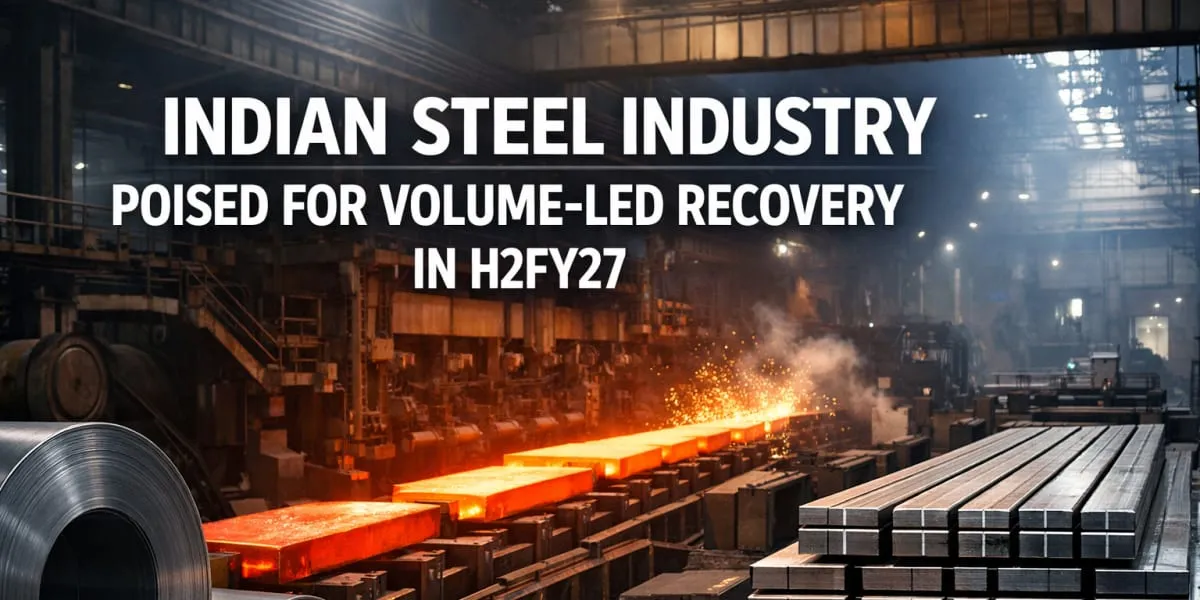
Indian Steel Industry Poised For Volume-Led Recovery In H2FY27

India's steel industry is expected to see a volume-led recovery in the second half of FY27, supported by easing input costs, reduced maintenance disruptions and resilient domestic demand, according to a brokerage report. The report noted that producers stand to benefit from strong domestic fundamentals and ongoing investment in capacity and downstream capabilities. This outlook comes amid a seasonally softer second quarter which management commentary described as temporary.

The brokerage projected industry growth of up to nine per cent in FY27 and indicated that capacity utilisation remains robust across major producers. It said expansion projects, debottlenecking initiatives and downstream investments are progressing as planned, underpinning medium-term supply growth. Management commentary across the sector was reported as constructive despite expectations of a softer Q2.

The report flagged import trends from China, Japan and Russia as key monitorables, while noting that a 12 per cent safeguard duty has provided some protection to domestic players. Analysts cautioned that domestic steel realisations could soften marginally in Q2FY27, even as lower coking coal costs from August and the normalisation of maintenance shutdowns may support margins. Continued cost optimisation and disciplined capital allocation were highlighted as important for sustaining profitability.

The brokerage also expressed a constructive view on non-ferrous metals, citing a favourable outlook for aluminium, zinc and silver prices driven by supply constraints and supportive demand. It pointed to potential supply-side disruptions, including the closure of the Mozal smelter and geopolitical tensions, which could keep the global aluminium market in deficit for the remainder of FY27. Supportive metal prices and structural cost advantages were identified as key earnings drivers over the medium term. It added that supportive policy measures, execution discipline at company level and sustained domestic infrastructure demand will determine the pace of recovery and investor returns over the medium term.

India's steel industry is expected to see a volume-led recovery in the second half of FY27, supported by easing input costs, reduced maintenance disruptions and resilient domestic demand, according to a brokerage report. The report noted that producers stand to benefit from strong domestic fundamentals and ongoing investment in capacity and downstream capabilities. This outlook comes amid a seasonally softer second quarter which management commentary described as temporary. The brokerage projected industry growth of up to nine per cent in FY27 and indicated that capacity utilisation remains robust across major producers. It said expansion projects, debottlenecking initiatives and downstream investments are progressing as planned, underpinning medium-term supply growth. Management commentary across the sector was reported as constructive despite expectations of a softer Q2. The report flagged import trends from China, Japan and Russia as key monitorables, while noting that a 12 per cent safeguard duty has provided some protection to domestic players. Analysts cautioned that domestic steel realisations could soften marginally in Q2FY27, even as lower coking coal costs from August and the normalisation of maintenance shutdowns may support margins. Continued cost optimisation and disciplined capital allocation were highlighted as important for sustaining profitability. The brokerage also expressed a constructive view on non-ferrous metals, citing a favourable outlook for aluminium, zinc and silver prices driven by supply constraints and supportive demand. It pointed to potential supply-side disruptions, including the closure of the Mozal smelter and geopolitical tensions, which could keep the global aluminium market in deficit for the remainder of FY27. Supportive metal prices and structural cost advantages were identified as key earnings drivers over the medium term. It added that supportive policy measures, execution discipline at company level and sustained domestic infrastructure demand will determine the pace of recovery and investor returns over the medium term.

Related Stories

Gold Stories
Next Story
Real Estate

LML Realty Sells Out Jhirka Valley Industrial Park in Haryana

LML Realty, the real estate arm of LML Group, recently announced the complete sell-out of its Jhirka Valley Industrial Park in Haryana, with over 1.17 million sq ft of industrial space acquired by more than 50 companies. With utilities and internal infrastructure in place, the company has commenced plot handovers, enabling buyers to begin construction and establish their operations.The industrial park has attracted companies across diverse sectors, including chemicals, metals and alloys, textiles, electrical equipment, energy, logistics, construction, polymers and engineering. Key buyers inclu..

Next Story
Real Estate

WSB Real Estate Partners Exits Six Housing Investments

WSB Real Estate Partners recently announced the successful exit of six residential investments across Bengaluru, Mumbai Metropolitan Region (MMR) and National Capital Region (NCR), delivering an average internal rate of return (IRR) of 19–21 per cent and an overall investment return of 1.4 times.The real estate-focused investment firm invested approximately Rs 7 billion across six mid-affordable housing projects over the past four years. All six investments were fully repaid between April and November 2026, several months ahead of their original investment tenures.WSB collaborated with sever..

Next Story
Infrastructure Transport

Aluminium Industry Seeks Policy Support for Rs 4 Trillion Investment

The Aluminium Association of India (AAI) has recently urged the government to introduce supportive policy measures to safeguard the sector’s proposed Rs 4 trillion investment pipeline. The association highlighted the need for a predictable policy framework to strengthen domestic manufacturing, expand production capacity and reduce import dependence.AAI submitted its recommendations for the Union Budget 2027-28 to the Ministries of Finance, Commerce and Industry, and Mines, along with the Department for Promotion of Industry and Internal Trade (DPIIT).India’s aluminium demand is projected t..

Advertisement

Subscribe to Our Newsletter

Get daily newsletters around different themes from Construction world.

STAY CONNECTED

Advertisement

SPECIAL OFFER
QR Code