+
Delhi Traffic Police Identifies Barapullah Flyover Bottleneck
ROADS & HIGHWAYS

Delhi Traffic Police Identifies Barapullah Flyover Bottleneck

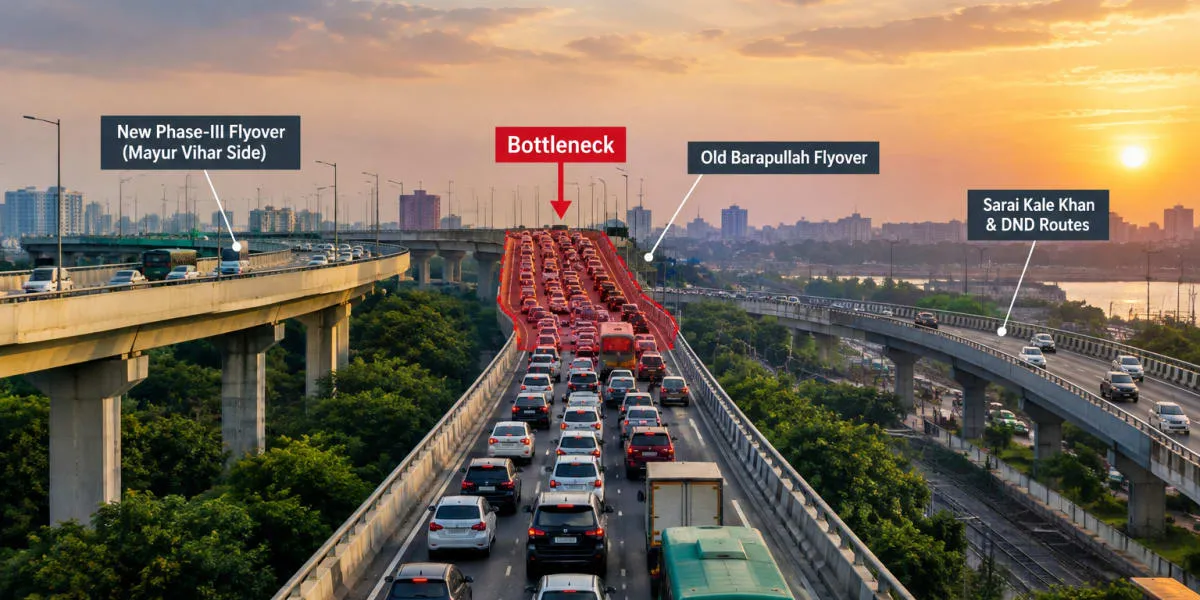
The Delhi Traffic Police has identified a structural bottleneck at the Old Barapullah Flyover as the primary cause of heavy congestion following the opening of Barapullah Phase-III. The department said traffic from several connecting routes was converging at a narrow section of the older flyover, creating severe delays near Barapullah Junction.

According to the police width analysis, the Old Barapullah Flyover, the new Phase-III flyover on the Mayur Vihar side, and the Sarai Kale Khan and DND side loops each provide about three lanes. As a result, traffic from approximately eight to nine lanes is merging into three lanes at a single point on the older structure. The department said the arrangement had created a capacity mismatch that was not adequately reflected on digital navigation platforms.

The police said Google Maps was continuing to show green traffic conditions despite the congestion, while personnel had been deployed at the merging points to regulate movement. As an immediate measure, traffic from Barapullah Phase-III was being diverted towards NH-24 and the DND. The action followed reports of a traffic jam stretching about 2 km from Mayur Vihar towards AIIMS, with an ambulance also reported to have been caught in the congestion.

The disruption comes as Delhi prepares to implement a technology-led traffic management programme. The Cabinet Committee on Economic Affairs has approved the Intelligent Traffic Management System at an estimated cost of Rs. 17.9 bn, inclusive of taxes. The project will cover 42 traffic corridors and be implemented in three phases over 24 months, followed by five years of operation and maintenance.

The system will replace fixed signal management with adaptive controls across 1,092 locations and support enforcement at 1,029 sites. It will use real-time data to detect congestion, coordinate signals, create priority routes for emergency vehicles and support quicker diversions. Delhi Police will implement the project through a master system integrator, while C-DAC will provide technical support. The programme is intended to improve use of the existing road network, which serves about 7,100,000 active registered vehicles.

The Delhi Traffic Police has identified a structural bottleneck at the Old Barapullah Flyover as the primary cause of heavy congestion following the opening of Barapullah Phase-III. The department said traffic from several connecting routes was converging at a narrow section of the older flyover, creating severe delays near Barapullah Junction. According to the police width analysis, the Old Barapullah Flyover, the new Phase-III flyover on the Mayur Vihar side, and the Sarai Kale Khan and DND side loops each provide about three lanes. As a result, traffic from approximately eight to nine lanes is merging into three lanes at a single point on the older structure. The department said the arrangement had created a capacity mismatch that was not adequately reflected on digital navigation platforms. The police said Google Maps was continuing to show green traffic conditions despite the congestion, while personnel had been deployed at the merging points to regulate movement. As an immediate measure, traffic from Barapullah Phase-III was being diverted towards NH-24 and the DND. The action followed reports of a traffic jam stretching about 2 km from Mayur Vihar towards AIIMS, with an ambulance also reported to have been caught in the congestion. The disruption comes as Delhi prepares to implement a technology-led traffic management programme. The Cabinet Committee on Economic Affairs has approved the Intelligent Traffic Management System at an estimated cost of Rs. 17.9 bn, inclusive of taxes. The project will cover 42 traffic corridors and be implemented in three phases over 24 months, followed by five years of operation and maintenance. The system will replace fixed signal management with adaptive controls across 1,092 locations and support enforcement at 1,029 sites. It will use real-time data to detect congestion, coordinate signals, create priority routes for emergency vehicles and support quicker diversions. Delhi Police will implement the project through a master system integrator, while C-DAC will provide technical support. The programme is intended to improve use of the existing road network, which serves about 7,100,000 active registered vehicles.

Related Stories

Gold Stories

Next Story
Infrastructure Transport

Madhya Pradesh Plans Airport Every 150 Km, Airstrip Every 75 Km

The Madhya Pradesh government plans to establish an airport every 150 km, an airstrip every 75 km and a helipad every 45 km, according to the state aviation department. Airports being developed in Ujjain and Shivpuri are expected to take the state’s airport count to 10. The government stated that Madhya Pradesh currently has eight airports in eight cities. The locations named by the department include Indore, Bhopal, Jabalpur, Gwalior, Khajuraho, Rewa and Satna. The state also has more than 20 airstrips and 220 helipads, while permanent helipads are planned in all 230 Assembly constituencies..

Next Story
Infrastructure Transport

West Bengal Plans Four Airports for 2028 Completion Under UDAN

West Bengal will develop four new airports under an agreement signed between the Union Civil Aviation Ministry and the state government, with all facilities targeted for completion by 2028. Union Civil Aviation Minister K Rammohan Naidu said the airports would be located at Charra in Purulia, Kalaikunda in Paschim Medinipur, Balurghat in Dakshin Dinajpur and Hasimara in Alipurduar. The project is part of the Centre’s regional connectivity UDAN programme. The Union government has committed Rs. 290 bn for West Bengal’s aviation sector over the next decade, while the state government will pro..

Next Story
Infrastructure Transport

Mumbai Airport Bars Russian Airlines as Agent Seeks Ministry Intervention

Mumbai airport has stopped accepting cargo booked on Russian flag carrier Aeroflot, disrupting shipments and prompting the airline’s cargo sales agent, Delmos Aviation, to seek intervention from the Ministry of Civil Aviation. The restrictions also affect cargo booked on Volga-Dnepr Airlines, according to a letter submitted by Delmos Aviation to the ministry on September 30. Aeroflot operates daily flights between Moscow and Delhi and runs a winter seasonal service to Goa. Bonded cargo from Mumbai and other cities is transported by road to Delhi before being flown to Russia. The agent said t..

Advertisement

Subscribe to Our Newsletter

Get daily newsletters around different themes from Construction world.

STAY CONNECTED

Advertisement

SPECIAL OFFER
QR Code