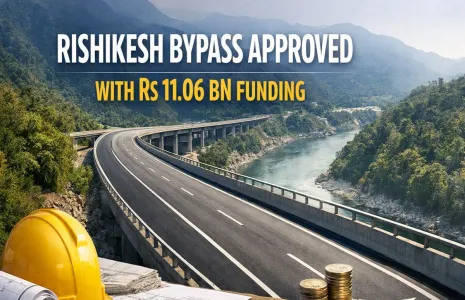
Rishikesh Bypass Approved at Rs 11,050 Mn for Four-Lane NH-7
ROADS & HIGHWAYS

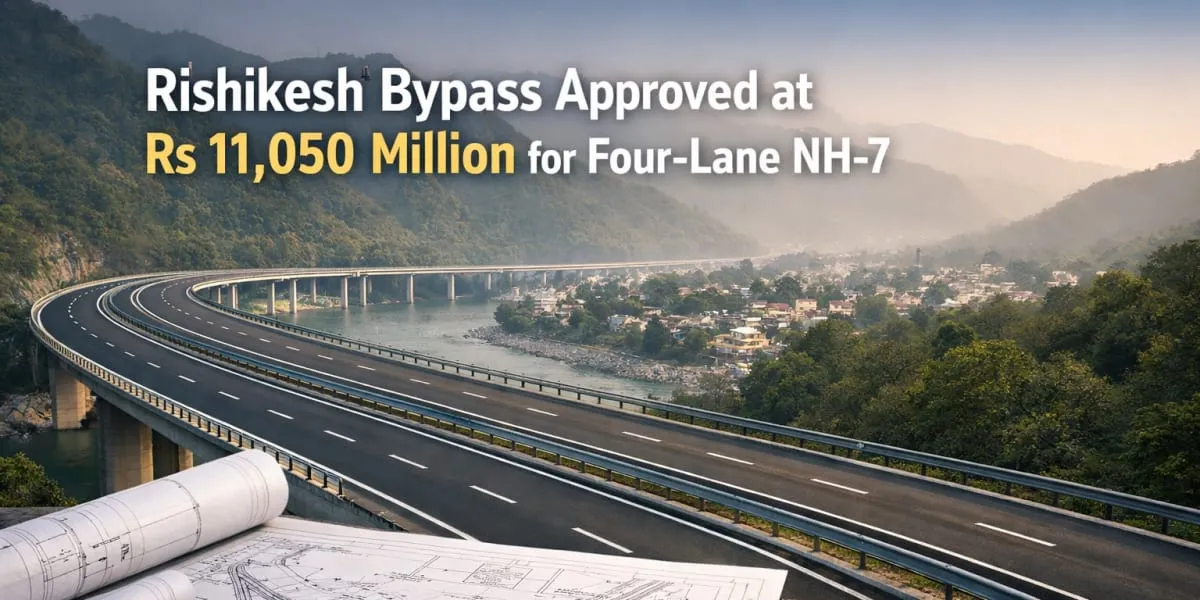
Rishikesh Bypass Approved at Rs 11,050 Mn for Four-Lane NH-7

The Ministry of Road Transport and Highways has approved the Rishikesh bypass project at an estimated cost of Rs 11,050 million (Rs 11,050 mn; Rs 11.05 bn) for a four-lane development on National Highway seven in Rishikesh. The sanction was granted on Wednesday, April one, 2026, with the stated objective of easing traffic congestion and improving regional connectivity. The project will be developed to provide an alternative route around the city and to enhance movement on a key corridor. The scheme is intended to improve safety and to accommodate increasing commercial traffic on the corridor.

The scheme will extend for 12.7 km from the Tinpani flyover to the Kharasote bridge and will pass through Bhattowala and Dhalwala villages. Authorities will implement the work under the engineering, procurement and construction mode, covering roadway construction and associated infrastructure. The plan envisages a four-lane highway corridor with necessary ancillary works.

The project is scheduled for completion within a timeline of three years and has been included in the 2025–26 budget allocation for road development. Officials expect the bypass to reduce inner-city traffic volumes and to improve travel efficiency for commuters and commercial vehicles. The development is intended to strengthen highway connectivity for regional movement and to support longer term infrastructure growth in Uttarakhand. Stakeholders will observe timelines and quality controls during implementation to ensure deliverables meet standards.

The undertaking will aim to address persistent congestion in Rishikesh by diverting through traffic away from urban stretches and by improving journey reliability. Project execution under the EPC model is intended to streamline responsibility for delivery and to facilitate coordination of design, procurement and construction activities. Biltrax Construction Data has been mentioned as tracking projects on its platform for clients and observers will monitor progress as the scheme advances. Funding disbursement and contractor selection will determine the pace of work.

The Ministry of Road Transport and Highways has approved the Rishikesh bypass project at an estimated cost of Rs 11,050 million (Rs 11,050 mn; Rs 11.05 bn) for a four-lane development on National Highway seven in Rishikesh. The sanction was granted on Wednesday, April one, 2026, with the stated objective of easing traffic congestion and improving regional connectivity. The project will be developed to provide an alternative route around the city and to enhance movement on a key corridor. The scheme is intended to improve safety and to accommodate increasing commercial traffic on the corridor. The scheme will extend for 12.7 km from the Tinpani flyover to the Kharasote bridge and will pass through Bhattowala and Dhalwala villages. Authorities will implement the work under the engineering, procurement and construction mode, covering roadway construction and associated infrastructure. The plan envisages a four-lane highway corridor with necessary ancillary works. The project is scheduled for completion within a timeline of three years and has been included in the 2025–26 budget allocation for road development. Officials expect the bypass to reduce inner-city traffic volumes and to improve travel efficiency for commuters and commercial vehicles. The development is intended to strengthen highway connectivity for regional movement and to support longer term infrastructure growth in Uttarakhand. Stakeholders will observe timelines and quality controls during implementation to ensure deliverables meet standards. The undertaking will aim to address persistent congestion in Rishikesh by diverting through traffic away from urban stretches and by improving journey reliability. Project execution under the EPC model is intended to streamline responsibility for delivery and to facilitate coordination of design, procurement and construction activities. Biltrax Construction Data has been mentioned as tracking projects on its platform for clients and observers will monitor progress as the scheme advances. Funding disbursement and contractor selection will determine the pace of work.

Next Story
Infrastructure Transport

Tunnelling Begins for Thane, Borivali twin tunnel project

Tunnelling work has commenced for the 11.84-km Thane–Borivali Twin Tunnel, set to be India’s longest urban road tunnel, marking a key milestone in Mumbai’s infrastructure development.As per a post shared by Mumbai Metropolitan Region Development Authority on social media platform X, the tunnel boring machine (TBM) ‘Nayak’—the country’s largest single-shield hard rock TBM for an urban tunnel—was launched by Devendra Fadnavis on Tuesday. The event was attended by Eknath Shinde and Sunetra Pawar, among other dignitaries. A second TBM, ‘Arjuna’, is expected to be launched so..

Next Story
Infrastructure Transport

Large Format Store Planned At M G Road Metro Station

M G Road station in Bengaluru is set to host the city’s first large-format commercial and experience space, with planning led by Bangalore Metro Rail Corporation Limited. BMRCL has invited proposals to develop and operate a central business district destination at the Purple?Pink Line interchange. The plan positions the station as a commercial hub designed to serve a broad commuter base across the city. The proposal is part of a broader effort to activate transit nodes commercially. Tender documents set a minimum monthly rental of Rs 0.944 million (mn), inclusive of GST, for the large-format..

Next Story
Infrastructure Energy

Government Cancels Auction Of Eleven Critical Mineral Blocks

The government has cancelled the auction of 11 critical and strategic mineral blocks after receiving a poor investor response and failing to attract a sufficient number of qualified bidders. The decision represents a setback to plans to ramp up domestic exploration and production of critical minerals amid global supply chain disruptions and rising demand for materials used in clean energy and advanced technologies. The mines ministry issued an annulment notice setting out the reasons for the cancellations. The annulment notice indicated that the auction process for five mineral blocks was canc..

Advertisement

Subscribe to Our Newsletter

Get daily newsletters around different themes from Construction world.

STAY CONNECTED

Advertisement

Advertisement

Advertisement