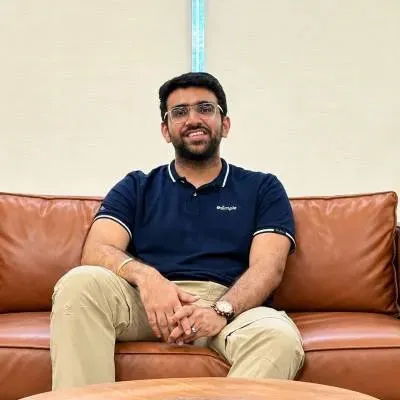
Interview with Vishesh Jain, Founder & CEO, Eximple
What gaps in India’s global trade ecosystem led you to build Eximple, and what problem did you see businesses struggling with most?
Eximple came out of a problem that all three founders had seen from different choke points in the trade ecosystem. India has millions of MSMEs and manufacturers, and many of them can make products that are genuinely competitive on quality. Yet only a small fraction is able to build meaningful international businesses. In our experience, the gap is usually not manufacturing capability; it is the ability to execute global trade with the same reliability as a large enterprise.
Before Eximple, I worked with more than 500 SMEs across procurement and financing and built a business vertical of approximately $500 million at one of India’s largest B2B startups. I saw excellent manufacturers win demand but struggle to fund raw material, manage long payment cycles or organise the many parties required to fulfil an export order. Arjun, our COO, led operations and exports and handled more than $200 million of export transactions. His vantage point was the physical execution layer: freight, customs, documentation, timelines and the reality that one small operational error can hold up an otherwise profitable transaction. Sushil, our CTO, is an AI/ML patent holder and previously built trade-finance products at one of India’s leading private-sector banks. He saw the same problem from the technology and capital side: highly fragmented data, manual workflows and limited transaction-level visibility.
When we put those experiences together, the conclusion was clear. India did not need another isolated point solution. A freight platform cannot solve working capital. A lender cannot ensure customs and documentation are executed correctly. An insurer cannot coordinate the shipment. And a visibility dashboard still leaves the SME to manage every stakeholder itself.
The real problem is orchestration. A large exporter can afford dedicated teams across treasury, logistics, compliance, customs, insurance and documentation. A smaller manufacturer often has the founder or a handful of people trying to coordinate all of this through phone calls, emails, spreadsheets and WhatsApp. That creates a structural disadvantage even when the product itself is world-class.
Eximple is being built to remove that disadvantage. We are creating an AI-native Global Trade OS that brings trade finance, freight and logistics, customs, documentation, compliance, insurance, shipment visibility and post-shipment workflows into one execution layer. Our operating philosophy is simple: the manufacturer should focus on making and selling; the platform should take responsibility for the execution, capital and resource orchestration required to complete the transaction.
The early customer behaviour has reinforced this thesis. Eximple has executed 100+ bulk shipments, handled more than Rs 50 crore of GMV, enabled more than Rs 30 crore of trade finance and generated approximately Rs 7 crore of revenue. More importantly, around 90 per cent of our customers are repeat customers, and many return with larger shipment volumes. In a high-trust activity like international trade, repeat usage is one of the strongest signals that an execution layer is solving a real problem.
What are the biggest challenges preventing Indian MSMEs from successfully entering and scaling in international markets?
The first challenge is that exporting is still far more complicated for an SME than it should be. India’s MSMEs contribute close to half of the country’s exports, but the capability to participate internationally is still concentrated among a relatively small set of firms. The gap between being a good manufacturer and being a good global supplier is much wider than most people realise.
I would group the bottlenecks into five areas: working capital, fragmented execution, opaque logistics, documentation and compliance, and lack of predictable market-level operating infrastructure.
Working capital is often the first constraint. An exporter may have to buy raw material today, manufacture for 30 to 45 days, pay logistics costs, ship the goods and then wait another 30 to 90 days for the overseas customer to pay. So growth itself can consume cash. A company can have a profitable order and still be unable to accept it because the balance sheet cannot support the cycle. This is why we believe trade finance should sit inside the transaction workflow rather than as a separate afterthought.
The second challenge is fragmentation. One shipment can involve a transporter, freight forwarder, shipping line or airline, customs broker, bank, insurer, certification agency, port, government systems and the overseas buyer. Each participant optimises its own piece; the SME is left to optimise the whole transaction. Large corporations solve this by creating internal teams. SMEs cannot economically recreate that infrastructure for every shipment.
Third, logistics and freight can be opaque. A smaller exporter may receive multiple quotations in different formats and still not know whether the price, routing, free days, surcharges or transit assumptions are truly competitive. In global trade, a few percentage points of avoidable logistics cost can eliminate the exporter’s margin.
Fourth, documentation and compliance remain heavily manual. The same information is entered repeatedly into invoices, packing lists, shipping documents, certificates and customs workflows. A mismatch in quantity, weight, description or classification can delay a shipment worth lakhs or crores. For sectors such as food, chemicals, pharmaceuticals, engineering or building materials, product-specific standards and destination-market rules add another layer of complexity.
Finally, MSMEs lack predictability. They want to know the complete landed economics of a transaction before committing: what will freight cost, what documents are required, what capital will be locked, what risks exist and when payment will return. Without that visibility, international growth becomes dependent on individual relationships rather than a repeatable operating system.
Technology can change this significantly. At Eximple, we use AI and automation for document intelligence, workflow orchestration, freight-rate comparison, compliance support, shipment communication and exception detection. The objective is not merely to digitise an old process. It is to make global trade execution more standardised, transparent and scalable so that an SME does not need to build a large export department before it can become a serious exporter.
As global supply chains diversify, which international markets or trade corridors do you see offering the strongest opportunities for Indian businesses?
The most important change in global trade today is that buyers are thinking much more actively about resilience, concentration risk and supplier diversification. That creates a significant opening for India, but it is important to remember that this opportunity is being competed for by Southeast Asia, Eastern Europe, Mexico and several other manufacturing locations. India has to win on execution, not just on intent.
We see four corridors as particularly important for Indian businesses over the next few years.
The first is India-Middle East, especially the UAE and the wider GCC. The region combines geographic proximity, strong Indian business networks, sophisticated logistics infrastructure and significant import demand. The UAE is also valuable as a distribution and re-export hub into the wider Middle East and Africa. For Indian food products, engineering goods, construction materials, electricals, chemicals, consumer products and industrial supplies, this corridor can be extremely important.
The second is India-Europe and the UK. India’s trade access into Europe is improving meaningfully, while European buyers are simultaneously looking for diversified sourcing. The opportunity is especially strong for engineering goods, auto components, electrical equipment, speciality chemicals, textiles, processed food, pharmaceuticals, machinery and increasingly sustainable manufacturing. But Europe is also a market where traceability, certifications, carbon requirements and delivery reliability matter significantly. That means execution infrastructure becomes a competitive advantage, not just a back-office function.
The third is India-Africa. We believe this corridor remains underpenetrated relative to India’s natural strengths. Indian companies are very good at designing products for value-conscious markets, whether in pharmaceuticals, agricultural equipment, pumps, electricals, two-wheelers, machinery, construction products or processed foods. India also has historical commercial relationships and a product-cost structure that can fit many African markets well.
The fourth is the Indo-Pacific, including Australia and Southeast Asia. These markets can play an important role in engineering, chemicals, food, intermediate goods and supply-chain diversification. India’s expanding trade agreements can reduce market-access friction, but an FTA by itself does not create exports. It creates access. Companies still need distribution, compliance, capital and reliable execution to convert that access into business.
At Eximple, we therefore think less in terms of ‘entering a country’ and more in terms of building repeatable corridors. A strong corridor means understanding the product categories, customs and documentation requirements, freight economics, payment behaviour, partners and risk structure deeply enough that an SME can execute the tenth transaction almost as predictably as the first. That is the model we want to scale.
What sectors among Indian MSMEs do you believe have the strongest potential to become globally competitive, and why?
India’s strongest opportunity is not one sector; it is the breadth of its manufacturing base. The sectors with the greatest potential are those where India already has manufacturing depth, skilled supplier clusters and improving international competitiveness, but where thousands of smaller firms have not yet been able to build a global distribution and execution capability.
Engineering goods are one of the clearest examples. India already exports well over $100 billion of engineering products annually, but beneath the large exporters sits a vast ecosystem of SMEs producing castings, forgings, fasteners, pumps, valves, machine parts, electrical components, fabrication and industrial equipment. Many of these companies have the technical ability to supply internationally but need stronger market access, certification support, working capital and export execution.
Construction and building-product categories are also particularly interesting. India has deep capabilities in ceramics, sanitaryware, natural stone, steel products, pipes, cables, electrical equipment, hardware, fabricated products, furniture and other building materials. Clusters such as Morbi, Rajkot, Jaipur, Jodhpur and numerous engineering hubs already have strong manufacturing ecosystems. As infrastructure spending expands across the Middle East, Africa and other emerging markets, Indian manufacturers can participate far more deeply if execution and financing are made easier.
Electronics is another major opportunity. India’s electronics exports have expanded rapidly over the last decade, demonstrating what can happen when manufacturing scale, supply-chain development and policy support come together. The next opportunity is to deepen domestic value addition and enable more component manufacturers and specialised SMEs to participate in international supply chains rather than limiting the success to final assembly.
Pharmaceuticals, chemicals and speciality chemicals remain natural strengths because India combines technical talent, manufacturing experience and a large supplier ecosystem. Here, regulatory compliance and documentation become particularly important, so technology-led execution can create significant value for SMEs.
Food and agriculture is another category we are close to at Eximple. India has huge production diversity, but the difference between selling a commodity domestically and becoming a reliable international food supplier is significant. Certifications, phytosanitary requirements, quality control, cold-chain considerations, packaging, documentation and working capital all have to work together. That makes it a high-potential sector where the right trade infrastructure can materially expand the number of successful exporters.
We also see strong potential in textiles and apparel, handicrafts, leather and furniture, where India has established clusters and design/manufacturing capabilities but many producers still depend on intermediaries for access to global markets.
The common thread across these sectors is important: India does not need to teach these companies how to manufacture. In many cases, they already know how. The opportunity is to give them the operating leverage, capital and cross-border infrastructure required to compete consistently with much larger global suppliers.
As India aims to significantly expand its share of global trade, what changes are needed across policy, infrastructure, and the broader business ecosystem to help more MSMEs become successful exporters?
India’s export ambition is now large enough that it cannot be achieved only by asking existing large exporters to sell more. India’s total exports reached a record $863.1 billion in FY2025–26, and MSMEs account for roughly 48.6 per cent of exports. The next phase of growth has to come from broadening the exporter base and helping many more SMEs become repeat, scalable global suppliers.
The first requirement is to shift from an export-promotion mindset to an export-execution mindset. Market access and buyer discovery are important, but they are only the beginning. Once an SME gets an order, it needs capital, logistics, documentation, compliance, insurance, customs support and payment infrastructure. Policy and industry platforms should increasingly be designed around the entire transaction journey rather than individual schemes or services.
Second, working capital has to become easier to access and more closely linked to verified trade data. Today, a strong order can still remain unfulfilled because the exporter cannot fund the cash cycle. As GST, customs, e-invoicing, banking and shipment data become more digital, lenders should increasingly be able to use transaction-level information alongside traditional balance-sheet assessment. This can be transformative for growing exporters that have genuine orders but limited collateral or operating history.
Third, logistics competitiveness must continue improving. India has made major progress in ports, highways, dedicated freight corridors, customs digitisation and multimodal infrastructure. The next step is to reduce unpredictability: faster cargo movement, transparent charges, smoother port processes, better first- and last-mile connectivity and stronger digital integration among ports, carriers, customs and private operators. An international buyer evaluates the Indian supplier on the final delivery, not on which domestic stakeholder caused the delay.
Fourth, compliance infrastructure needs to become dramatically more SME-friendly. Exporters should be able to understand destination-market standards, product certifications, documentation and duty treatment before committing to an order. We need digital tools that convert regulatory complexity into structured workflows rather than expecting every SME to maintain specialist teams for every market.
Fifth, India should focus not only on the number of first-time exporters but on the number of repeat exporters. A first shipment shows that a buyer exists. The fifth and tenth shipments show that the Indian company is globally competitive. Policies, finance and ecosystem support should therefore reward sustained export behaviour, reliability and value addition rather than only market entry.
Sixth, technology and AI can dramatically reduce the cost of serving smaller exporters. Much of trade today still relies on manual document preparation, emails, rate scouting and repetitive coordination. AI agents can increasingly extract and validate documents, monitor workflows, compare options, identify exceptions and keep stakeholders informed. That can give smaller businesses operating leverage that historically required large teams.
Finally, the public and private sectors need to think of export infrastructure as an integrated stack. A manufacturer should eventually be able to say, ‘I make this product and I want to sell internationally,’ and receive a clear answer on the best markets, certifications, landed cost, logistics, capital requirements and execution path.
That is also how we think about Eximple’s role. We do not want to be another participant in a fragmented ecosystem. We want to become the orchestration layer that allows an SME to focus on making and selling while we simplify everything required to execute globally. If India can give millions of capable manufacturer’s access to the same quality of trade infrastructure that large corporations already have, the country’s global trade opportunity can be far larger than simply increasing exports from the businesses that already export today.