India’s Diesel Exports Set to Ease Global Fuel Shortages in 2027
OIL & GAS

India’s Diesel Exports Set to Ease Global Fuel Shortages in 2027

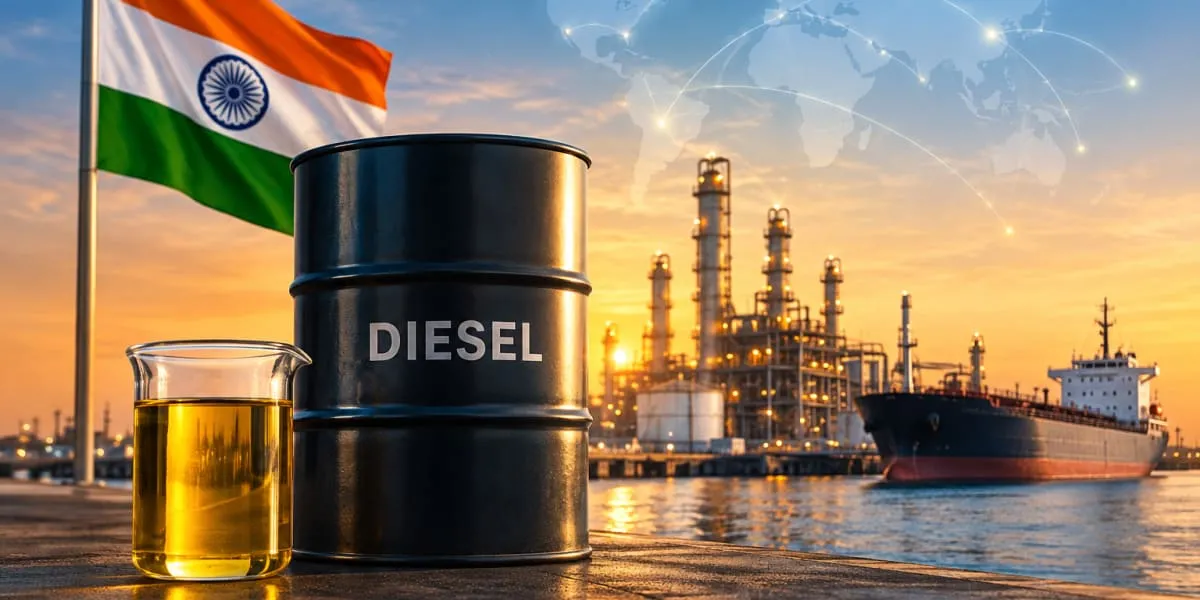
India’s expanding refining capacity is poised to lift diesel exports in 2027, easing shortages in global markets disrupted by geopolitical conflicts. State-owned refiners are due to add at least 15 mn t of annual diesel-making capacity through a new refinery and expansions at existing plants, Oil Minister Hardeep Singh Puri said at an industry conference in Goa.

The Middle East and Russia-Ukraine wars have disrupted crude and fuel flows, tightening supplies and pushing prices higher. Diesel availability has been particularly constrained since Russia halted exports in July to protect domestic supplies after attacks on its refineries and ports. The squeeze drove US diesel prices to a record and led Washington to consider export restrictions before an agreement between Donald Trump and Vladimir Putin to release more fuel.

India, already one of the world’s largest diesel suppliers, overtook Russia this year to become the second-largest exporter, according to Kpler data. The fuel is widely used by farms, factories and heavy transport. Goldman Sachs Group expects supplies to remain tight through 2027, creating an opportunity for Indian refiners to increase their share of international markets.

Indian Oil, the country’s largest refiner, expects to produce up to 9 mn t more diesel a year from 2027 after expansions add more than 17 mn t of crude-processing capacity across three refineries, Chairman Arvinder Singh Sahney said. Hindustan Petroleum will add about 4 mn t of diesel output as its 9 mn t-a-year Rajasthan refinery reaches full capacity, while Numaligarh Refinery will raise production to about 3 mn t. Bharat Petroleum expects to add 1.5 mn t from 2028.

In the first half of the financial year that began in April, Indian refiners produced 59 mn t of diesel, compared with domestic consumption of about 46 mn t, oil ministry data showed. National refining capacity is projected to rise to 300 mn t a year from about 267 mn t currently, and eventually reach 400 mn t, Puri said. The additional output could strengthen India’s role in meeting international diesel demand.

India’s expanding refining capacity is poised to lift diesel exports in 2027, easing shortages in global markets disrupted by geopolitical conflicts. State-owned refiners are due to add at least 15 mn t of annual diesel-making capacity through a new refinery and expansions at existing plants, Oil Minister Hardeep Singh Puri said at an industry conference in Goa. The Middle East and Russia-Ukraine wars have disrupted crude and fuel flows, tightening supplies and pushing prices higher. Diesel availability has been particularly constrained since Russia halted exports in July to protect domestic supplies after attacks on its refineries and ports. The squeeze drove US diesel prices to a record and led Washington to consider export restrictions before an agreement between Donald Trump and Vladimir Putin to release more fuel. India, already one of the world’s largest diesel suppliers, overtook Russia this year to become the second-largest exporter, according to Kpler data. The fuel is widely used by farms, factories and heavy transport. Goldman Sachs Group expects supplies to remain tight through 2027, creating an opportunity for Indian refiners to increase their share of international markets. Indian Oil, the country’s largest refiner, expects to produce up to 9 mn t more diesel a year from 2027 after expansions add more than 17 mn t of crude-processing capacity across three refineries, Chairman Arvinder Singh Sahney said. Hindustan Petroleum will add about 4 mn t of diesel output as its 9 mn t-a-year Rajasthan refinery reaches full capacity, while Numaligarh Refinery will raise production to about 3 mn t. Bharat Petroleum expects to add 1.5 mn t from 2028. In the first half of the financial year that began in April, Indian refiners produced 59 mn t of diesel, compared with domestic consumption of about 46 mn t, oil ministry data showed. National refining capacity is projected to rise to 300 mn t a year from about 267 mn t currently, and eventually reach 400 mn t, Puri said. The additional output could strengthen India’s role in meeting international diesel demand.

Related Stories

Gold Stories

Next Story
Building Material

PureSil Paints Develops Mineral Coatings from Industrial Waste

PureSil Paints, a brand of Relic Coatings LLP, has developed an indigenous mineral-based coating technology aimed at reducing dependence on petrochemical-derived raw materials in the paints and coatings industry. Its proprietary Silicification Technology uses agricultural and industrial by-products to manufacture architectural coatings as an alternative to conventional acrylic paints.Developed in-house by Dr Nikhil Dhote, Founder and Chief Technologist, Relic Coatings LLP, the technology uses silicate binders derived from upcycled rice husk ash and industrial coal fly ash. The formulation is d..

Next Story
Infrastructure Energy

Vedanta Eyes AI to Accelerate Mineral Exploration

Vedanta Group is exploring the use of artificial intelligence (AI) to significantly improve efficiency in mineral exploration, geological analysis and resource modelling. The company aims to reduce exploration processes that traditionally take three to four months to just six to seven days through AI-driven technologies.The proposed approach involves AI-led geological analysis and mineral block modelling to accelerate mineral resource assessment and support faster, more cost-efficient development of domestic mineral reserves. The initiative aligns with India's growing focus on critical mineral..

Next Story
Technology

NXP Launches Unified Robotics Platform for Physical AI

NXP Semiconductors has launched a unified robotics platform designed to accelerate the development and deployment of trusted physical artificial intelligence (AI) systems. Built on the company's neural axis architecture, the platform integrates AI processing, connectivity, motor control, security and energy management within a common hardware and software ecosystem.The platform combines an open-source, modular software development kit (SDK) with pre-validated reference designs, enabling developers to build robotic systems more efficiently. It supports development ranging from individual subsys..

Advertisement

Subscribe to Our Newsletter

Get daily newsletters around different themes from Construction world.

STAY CONNECTED

Advertisement

SPECIAL OFFER
QR Code