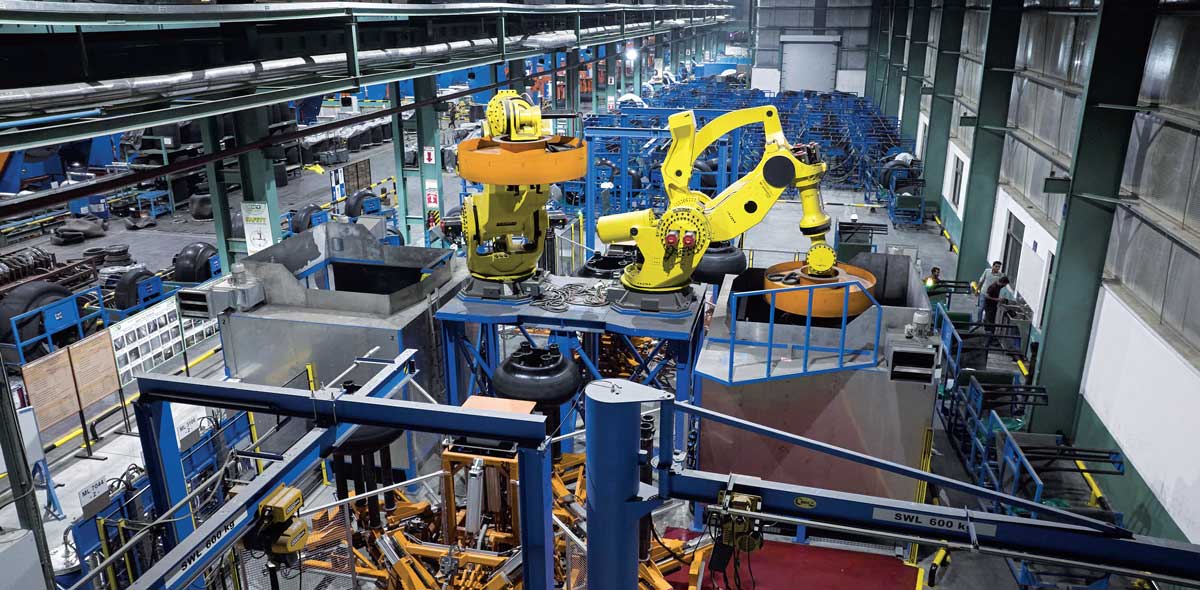
Infrastructure Today recently had the opportunity to visit BKT's cutting-edge manufacturing facility located in Bhuj, Gujarat. The visit left us awe-inspired as we witnessed a plant that is truly remarkable in terms of its advanced machinery and technology.
The plant in Bhuj was situated on a 123-hectare plot of land when the first tyre rolled off the assembly line in 2012. It represented a $500 million investment at the time in a region of the arid terrain of Gurjarat. The land was completely dry and had no electricity or water, but after many kilometres of water and power lines were laid, it rapidly expanded, growing from 126 hectares in 2016 to 131 in 2019 to 137 in 2021 to 258 in 2022. A total surface area of 323 hectares, of which 283 have already been purchased, is anticipated by the end of 2023.
A growing affair
The Bhuj site, at the centre of a well-thought-out growth strategy by BKT, consists of the state-of-the-art manufacturing facilities as it aims for an annual tyre production of 600,000 MT. More space implies more opportunity to add new equipment, accommodate additional testing areas, expand volumes, and everything else that comes with it. In comparison to pre-pandemic phase, the company's revenue has surged by almost 49 per cent. The company's claim that this bears witness to how the Indian multinational is always ready for new opportunities and challenges doesn't seem like just empty words. In real terms, the factory increased from 92 MT production per day in 2015 to a humungous 436 MT daily at the end of 2022, which was the best performance year by them ever.
In this plant there is very less product wastage, thus increasing the manufacturing sustainability, and resulting decrease in production costs. Additionally, processes are becoming more dependable, and most importantly for BKT, occupational risks are significantly decreased and worker comfort is reportedly improved.
The initiator effect
The carbon black plant's steel chimneys and pipes dominate the area. The first 65,000 MTPA of hard grade carbon black, the type of carbon black used exclusively in the tread of tyres, was produced at the factory in 2017, marking the start of operations. The next year, production rose from 65,000 to 110,000 MT, and soft grade carbon black production was added. This type of carbon black is utilised in the casing compound to strengthen and prolong its life while producing less heat. The combined annual production of the two varieties of carbon black increased to 165,600 MT last year from 138,000 MT in 2021.
A third variety of carbon black, called ‘specialty carbon black,’ will be added by the Research & Development department with a target of 198,600 MT. This particular sort of carbon black differs from that used in rubber compounds in that it has higher resistance to colouring, higher levels of purity, lower levels of ash, and lower levels of PAHs, making it appropriate for usage in particular products including paints, plastics, and inks.
Increased production capacity is a result of the plant's growth, but operational logistics have also greatly improved, enabling the hiring of new specialised staff and enhancing production and storage flow flexibility.
A humane touch
Speaking of work, BKT takes employee safety extremely seriously, and the development of new facilities contributed to an improvement in that area. The Bhuj site currently employs a sizable community; as of the end of December 2022, there were 4,776 people working there. Every year, BKT makes a sizable investment in the community's well-being. For instance, it expanded the area where employee families currently dwell (almost 1,000 people live there), took care of their health, and supported their children's education. In other words, a real all-around community factory that continues to be a sterling example among the best in the manufacturing industry.
According to BKT, environmental sustainability is an essential condition that today must be part of the strategies of all companies which define themselves as responsible. BKT also believes that human well-being includes environmental well-being.
The self-sustainable factors
In order to have a dependable and controllable source of electricity, an internal power plant was built in 2013. Self-generation of energy is now possible thanks to solar panels and the cogeneration plant. In 2022, the cogeneration plant's capacity was increased from 20 MW to 40 MW, and efforts are still being made to boost the strength of self-generated renewable resources.
Water is likewise crucial to BKT's journey towards sustainability. The zero liquid discharge (ZLD) principle, which prohibits the emission of liquid waste outside the plant, has been in place since 2019. Every drop of water utilised in the facility is cleaned, disinfected, and reused. The ZLD principle aims to increase the plant's overall sustainability and efficiency while also conserving water resources and reducing the environmental impact of wastewater discharge.
BKT has developed a novel method for producing carbon black in which the tyre manufacturing facility feeds the carbon plant using mobile silos, with material being pneumatically moved to storage. As a result, BKT will save on packaging over the following several years, amounting to 100,000 bulk bags.
Additionally, the entire transportation system is planned to use less energy, consume less, and improve quality. Each transfer mechanism is managed by weight and energy consumption. The long-term objective, which calls for cutting energy use by up to 70 per cent, is also difficult. This results in annual CO2 emissions savings of more than two million kilograms.
In addition, the gas used to produce carbon black is currently being recycled in a cogeneration facility that can use 75,000 cubic metres of gas annually. This results in a yearly coal saving of 215,000 MT.
Pushing the boundaries
The Bhuj site's development into what it is now was enabled by BKT's Research & Development section, which has also led the site's innovation and expansion, continuously pushing its boundaries and taking on new challenges as they present themselves.
This hub was established in 2017 to help the business maintain its position as a global leader by developing both goods and processes. It continues to be one of the most significant and modern research centres in the world for the tyre industry, led by a specialised staff of researchers and analysts.
Testing a solution is a necessary step in finding the best one. Due to this, a unique test track was established in 2017. This circuit has six distinct tracks, including an asphalt track, a sloping concrete track, and circuits for testing the performance of tyres in dry and rainy circumstances. Here, with the aid of high-precision machines and tools, a wide range of tests, many crucial qualities, including traction, handling, comfort, soil compaction, and much more, may be measured.
First-of-its-kind in India
To install automated strip winding machines for farm tyres
To manufacture tyres for all-terrain vehicles
To manufacture radial tyres for tractor
To manufacture all steel radial tyres for OTR
To manufacture all steel radial tyres for forklift
To install radial run-out machines for tractor & flotation tires
To build a dedicated testing track
To manufacture all steel radial giant OTR tires of 49” and above
To install shearography testing and x-ray machines for all steel radial giant OTR tyres
To manufacture rubber tracks for industrial and agriculture application
“Most of the major expansion works have been completed in our Bhuj plant. Within next 2-3 months we will be expanding our workshop where we make moulds. It will be an extension to our facility in Dombivali, Mumbai.”
- Rajiv Poddar, Joint MD, BKT