India to Add 51.1 Mn Sq Ft of Mall Space by 2031
Real Estate

India to Add 51.1 Mn Sq Ft of Mall Space by 2031

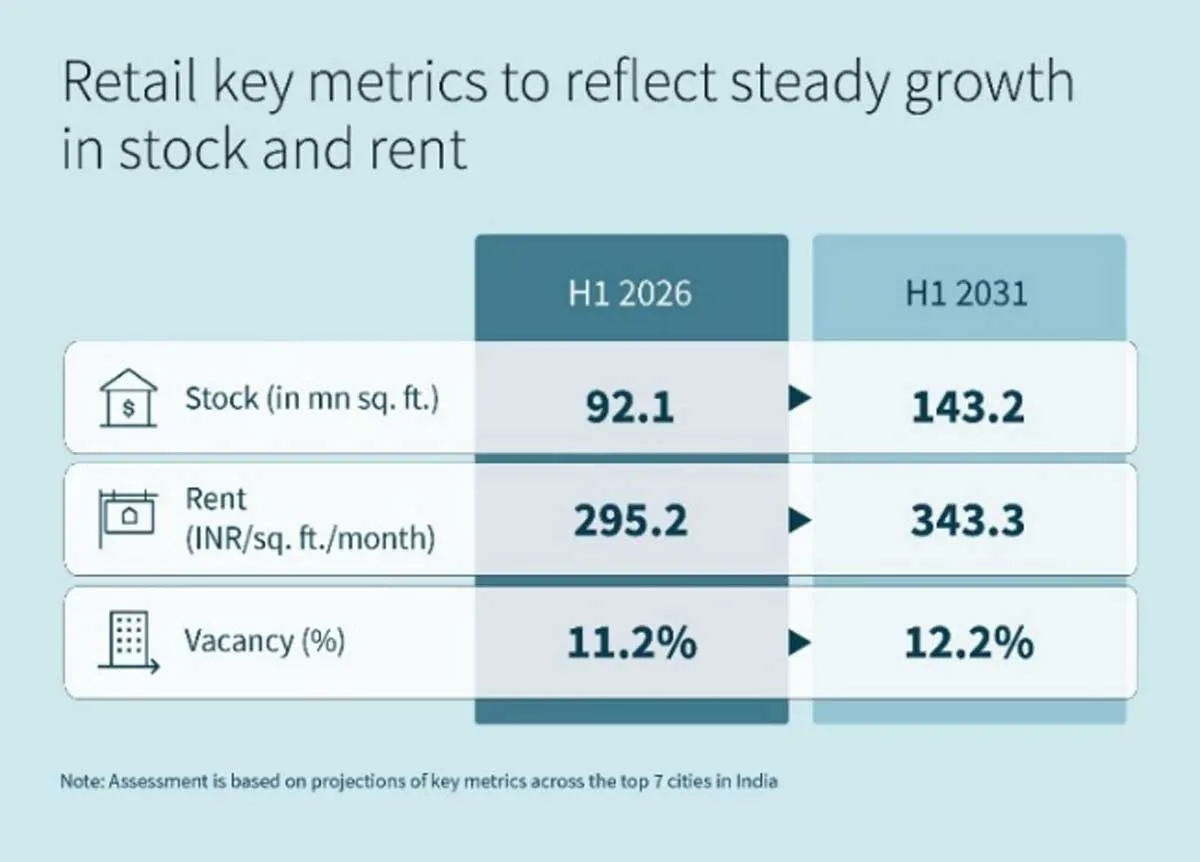
Indian real estate developers are expected to add nearly 51.1 million sq ft of new shopping mall space over the next five years, taking the country's total mall stock to 143.2 million sq ft by the end of 2031, according to JLL's report, Indian Retail 2031: Towards a Future-Ready Ecosystem.

The expansion is being driven by growing consumer demand, the entry of international brands and expansion by domestic retailers. In H1 2026, India recorded gross retail leasing volumes of 6.3 million sq ft. As of June 2026, retail stock across the top seven cities stood at 92.1 million sq ft, with a vacancy rate of 11.2 per cent.

Of the upcoming mall supply, nearly 56 per cent, or approximately 28.7 million sq ft, will comprise large-format malls focused on experiential and destination-led retail. These developments are expected to allocate around 30-35 per cent of their space to entertainment, food and beverage, and services, representing nearly 9-10 million sq ft.

“India's retail real estate sector is entering a new growth phase with significant scale, with 51.1 million sq. ft. of new mall space set to redefine the shopping experience by 2031. The shift toward large-format, experiential destinations, which will account for 56% of upcoming supply, signals a fundamental transformation in how consumers engage and how consumption patterns are evolving with changing generational preferences,” said Saket Amrit, Head of Retail Services, India, JLL.

Next-generation neighbourhood malls will account for another 15 per cent of the upcoming supply, representing approximately 7.9 million sq ft. Major listed developers are increasingly focusing on improving shopping experiences within key residential neighbourhoods.

Market consolidation is also expected to increase. India's top three listed developers owned approximately 14 per cent of operational retail stock in Tier-I markets as of H1 2026. Their share could rise to around 21 per cent by the end of 2031, while the top 10 developers are projected to account for 44 per cent of total shopping mall stock.

More than half of the upcoming retail supply is expected to be concentrated in Delhi NCR and Hyderabad. Delhi NCR led the market with 29 million sq ft of operational mall stock in H1 2026, followed by Mumbai at 15.1 million sq ft and Bengaluru at 14.4 million sq ft.

By 2031, Delhi NCR's mall stock is expected to reach 48.6 million sq ft, while Bengaluru and Mumbai are projected to reach 22 million sq ft and 21.6 million sq ft, respectively. Incremental demand for the new retail pipeline under construction stands at 45.9 million sq ft.

Indian real estate developers are expected to add nearly 51.1 million sq ft of new shopping mall space over the next five years, taking the country's total mall stock to 143.2 million sq ft by the end of 2031, according to JLL's report, Indian Retail 2031: Towards a Future-Ready Ecosystem.The expansion is being driven by growing consumer demand, the entry of international brands and expansion by domestic retailers. In H1 2026, India recorded gross retail leasing volumes of 6.3 million sq ft. As of June 2026, retail stock across the top seven cities stood at 92.1 million sq ft, with a vacancy rate of 11.2 per cent.Of the upcoming mall supply, nearly 56 per cent, or approximately 28.7 million sq ft, will comprise large-format malls focused on experiential and destination-led retail. These developments are expected to allocate around 30-35 per cent of their space to entertainment, food and beverage, and services, representing nearly 9-10 million sq ft.“India's retail real estate sector is entering a new growth phase with significant scale, with 51.1 million sq. ft. of new mall space set to redefine the shopping experience by 2031. The shift toward large-format, experiential destinations, which will account for 56% of upcoming supply, signals a fundamental transformation in how consumers engage and how consumption patterns are evolving with changing generational preferences,” said Saket Amrit, Head of Retail Services, India, JLL.Next-generation neighbourhood malls will account for another 15 per cent of the upcoming supply, representing approximately 7.9 million sq ft. Major listed developers are increasingly focusing on improving shopping experiences within key residential neighbourhoods.Market consolidation is also expected to increase. India's top three listed developers owned approximately 14 per cent of operational retail stock in Tier-I markets as of H1 2026. Their share could rise to around 21 per cent by the end of 2031, while the top 10 developers are projected to account for 44 per cent of total shopping mall stock.More than half of the upcoming retail supply is expected to be concentrated in Delhi NCR and Hyderabad. Delhi NCR led the market with 29 million sq ft of operational mall stock in H1 2026, followed by Mumbai at 15.1 million sq ft and Bengaluru at 14.4 million sq ft.By 2031, Delhi NCR's mall stock is expected to reach 48.6 million sq ft, while Bengaluru and Mumbai are projected to reach 22 million sq ft and 21.6 million sq ft, respectively. Incremental demand for the new retail pipeline under construction stands at 45.9 million sq ft.

Related Stories

Gold Stories
Next Story
Resources

Kalpataru Projects International elevates Amit Uplenchwar as Joint MD and CEO

Kalpataru Projects International (KPIL) has elevated Amit Uplenchwar as Joint Managing Director and CEO (designate), following approval by its board on 5 November 2026. He will take charge as Additional Director, Joint Managing Director and CEO from 1 January 2027 for a five-year term ending 31 December 2031, subject to shareholders' approval.Uplenchwar brings over three decades of experience in corporate strategy, business operations, business development, mergers and acquisitions, and international business management. His experience spans transportation, power, water, oil and gas, aerospace..
Next Story
Resources

HCC appoints Vivek Singhal as CEO

Hindustan Construction Company (HCC) has appointed Vivek Singhal as Chief Executive Officer, effective 5 November 2026. He brings over four decades of experience in infrastructure and engineering, procurement and construction (EPC), covering project execution, business leadership, business development and profit and loss management.Singhal has spent 16 years in international markets, delivering projects and managing assets worth approximately Rs 285 billion across five countries. His experience spans airports, metro rail, urban transport, hydropower, bridges and other infrastructure sectors.He..

Next Story
Infrastructure Energy

Essar Signs PPA for 300 MW Hybrid Renewable Energy Project

Essar Renewables, the renewable energy arm of Essar Power, has signed a Power Purchase Agreement (PPA) with NHPC for a 300 MW renewable energy project in Andhra Pradesh. The agreement follows the company’s successful bid for the project two years ago. Essar Power will invest approximately Rs. 45 bn in the development. The project will combine solar and wind generation with Battery Energy Storage Systems (BESS), enabling the supply of reliable and dispatchable renewable power. It forms part of Essar Power’s plan to build a diversified energy portfolio of approximately 5 GW across renewable,..

Advertisement

Subscribe to Our Newsletter

Get daily newsletters around different themes from Construction world.

STAY CONNECTED

Advertisement

SPECIAL OFFER
QR Code