Indian realty draws USD 85.5 billion in institutional investments: Vestian
Real Estate

Indian realty draws USD 85.5 billion in institutional investments: Vestian

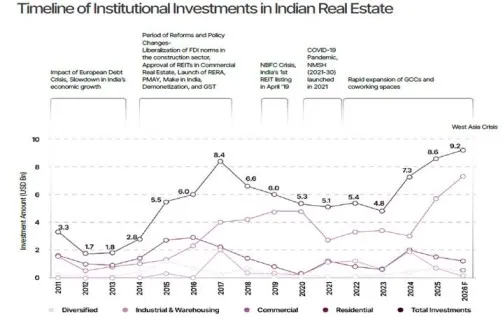
India's real estate sector attracted over USD 85.5 billion in institutional investments between 2011 and the first three quarters of 2026, with investor interest shifting from residential properties towards commercial, industrial and warehousing assets, according to a report by Vestian.

Residential assets accounted for 13 per cent of institutional investments in the first three quarters of 2026, compared with 55 per cent in 2011. In contrast, investments in revenue-generating assets, including commercial real estate and industrial and warehousing properties, increased from 37 per cent to nearly 79 per cent over the same period.

Equity accounted for 85 per cent of the capital deployed in these income-generating assets over the 16-year period. Vestian attributed the shift to investor preference for recurring income supported by multi-year leases, tenant visibility and long-term occupier relationships.

Domestic investors gain ground

Foreign investors accounted for 49 per cent of total institutional investments between 2011 and the first three quarters of 2026. However, their share fell to 25 per cent in the first nine months of 2026 amid global economic uncertainties. The US and Canada together contributed nearly 90 per cent of foreign investment flows during the period.

The report also highlighted the growing participation of domestic investors and co-investors in the market.

Investment spreads beyond major cities

The top seven metropolitan markets continued to attract more than 95 per cent of institutional investments between 2011 and the first three quarters of 2026. However, the share of non-metro markets increased from 0.4 per cent in 2011 to over 4.7 per cent in the first three quarters of 2026.

Vestian also noted a rise in multi-city transactions, through which investors gain exposure to multiple markets under a single investment strategy.

Premium housing and new-age assets attract capital

Premium and luxury housing accounted for 56 per cent of residential investments between 2011 and the first three quarters of 2026, while affordable and mid-income housing received the remaining 44 per cent.

New-age real estate segments, including flexible workspaces, co-living, student housing, senior living, data centres and proptech, attracted USD 4.3 billion in institutional investments since 2016. More than 88 per cent of this capital was deployed between 2020 and the first three quarters of 2026.

The report also highlighted the role of Real Estate Investment Trusts (REITs), introduced in India in 2019, in broadening access to institutional-grade commercial assets. Commercial real estate accounted for 66 per cent of green and sustainability-linked investments between 2020 and the first three quarters of 2026, with residential real estate accounting for the balance.

Shrinivas Rao, FRICS, CEO, Vestian, said the market's next phase of growth would be shaped by greater diversity in asset classes, locations and investment structures. He added that the shift towards commercial and warehousing assets, geographical diversification, REITs and new-age segments had contributed to a broader institutional investment ecosystem.

India's real estate sector attracted over USD 85.5 billion in institutional investments between 2011 and the first three quarters of 2026, with investor interest shifting from residential properties towards commercial, industrial and warehousing assets, according to a report by Vestian.Residential assets accounted for 13 per cent of institutional investments in the first three quarters of 2026, compared with 55 per cent in 2011. In contrast, investments in revenue-generating assets, including commercial real estate and industrial and warehousing properties, increased from 37 per cent to nearly 79 per cent over the same period.Equity accounted for 85 per cent of the capital deployed in these income-generating assets over the 16-year period. Vestian attributed the shift to investor preference for recurring income supported by multi-year leases, tenant visibility and long-term occupier relationships.Domestic investors gain groundForeign investors accounted for 49 per cent of total institutional investments between 2011 and the first three quarters of 2026. However, their share fell to 25 per cent in the first nine months of 2026 amid global economic uncertainties. The US and Canada together contributed nearly 90 per cent of foreign investment flows during the period.The report also highlighted the growing participation of domestic investors and co-investors in the market.Investment spreads beyond major citiesThe top seven metropolitan markets continued to attract more than 95 per cent of institutional investments between 2011 and the first three quarters of 2026. However, the share of non-metro markets increased from 0.4 per cent in 2011 to over 4.7 per cent in the first three quarters of 2026.Vestian also noted a rise in multi-city transactions, through which investors gain exposure to multiple markets under a single investment strategy.Premium housing and new-age assets attract capitalPremium and luxury housing accounted for 56 per cent of residential investments between 2011 and the first three quarters of 2026, while affordable and mid-income housing received the remaining 44 per cent.New-age real estate segments, including flexible workspaces, co-living, student housing, senior living, data centres and proptech, attracted USD 4.3 billion in institutional investments since 2016. More than 88 per cent of this capital was deployed between 2020 and the first three quarters of 2026.The report also highlighted the role of Real Estate Investment Trusts (REITs), introduced in India in 2019, in broadening access to institutional-grade commercial assets. Commercial real estate accounted for 66 per cent of green and sustainability-linked investments between 2020 and the first three quarters of 2026, with residential real estate accounting for the balance.Shrinivas Rao, FRICS, CEO, Vestian, said the market's next phase of growth would be shaped by greater diversity in asset classes, locations and investment structures. He added that the shift towards commercial and warehousing assets, geographical diversification, REITs and new-age segments had contributed to a broader institutional investment ecosystem.

Related Stories

Gold Stories

Next Story
Equipment

TIL Revenue Surges 143% to Rs 1.98 Billion in Q2 FY27

TIL Limited, a manufacturer of material handling and infrastructure equipment, has reported a 143 per cent year-on-year increase in consolidated revenue to Rs 1.98 billion for the second quarter of FY27, compared with Rs 814.5 million in the corresponding period last year. Consolidated EBITDA surged 433 per cent to Rs 173.7 million, while EBITDA margin improved to 8.8 per cent from 4 per cent.The performance was supported by equipment deliveries, defence contracts, aftermarket services and the contribution of Tulip Compression Private Limited (TCPL), which became a majority-owned subsidiary in..

Next Story
Infrastructure Transport

India to Develop Civil Aircraft Within Two Years, Build 100 Airports

India aims to develop its own civil aircraft within the next two years as it seeks to strengthen domestic aerospace capabilities and reduce dependence on foreign aircraft manufacturers, Civil Aviation Minister Ram Mohan Naidu said on November 12. He said the ambition extended beyond assembling aircraft to developing expertise in aircraft design and production. Speaking at the inaugural session of the Confederation of Indian Industry (CII) Partnership Summit 2026 in Visakhapatnam, Naidu said India wanted to establish itself as a major aerospace manufacturing hub. The government’s approach is ..

Next Story
Infrastructure Urban

Two Korean Firms to Invest Rs. 13.7 bn in Tamil Nadu

Two South Korean automotive component suppliers to Hyundai and Kia plan to invest a combined Rs. 13.7 bn in Tamil Nadu over the next five years, according to sources in the state industries department. The proposed investments come after a political dispute over the reported movement of some automotive investments to Andhra Pradesh. The state government has received letters of intent (LoIs) from Hwashin and Seoyon, while memorandums of understanding (MoUs) are expected to be signed shortly. Both companies communicated their investment plans in letters dated November 11, reaffirming their inten..

Advertisement

Subscribe to Our Newsletter

Get daily newsletters around different themes from Construction world.

STAY CONNECTED

Advertisement

SPECIAL OFFER
QR Code