Supreme Court gives a green signal to new parliament complex
Real Estate

Supreme Court gives a green signal to new parliament complex

Weeks after Prime Minister Narendra Modi and his team conducted a Bhumi Pujan-- groundbreaking--ceremony amidst a Supreme Court order staying the proceedings, a Bench of three judges has now voted 2:1 in favour of the construction.

Several petitions were filed challenging the construction of the Central Vista project and a number of questions were raised over the permissions given for the change in land use and the statutory authorities allowing such a change.

The three judge bench gave a go-ahead to the government for the construction of the central vista project on Tuesday and said, "We hold that there are no infirmities in clearances given, change in land use".

While Justice Sanjiv Khanna agreed with the other two judges on granting permission to the project he disagreed with the judgment on change of land use and on the grant of environmental clearance for the project. He was apprehensive of the change of land use as there was no disclosure for public participation and the prior approval of the heritage committee was also missing.

The Supreme Court’s permission, however, comes with certain caveats and recommendations like clearance from the heritage conservation committee. The three- judge bench in its verdict also mentioned “We, however, feel the need to record that the mitigating measures must be observed by the project proponent in letter and spirit during the construction and operational phase.”

The court ordered:
Waste management methods, inclusive of hazardous wastes, must be subject to regular monitoring.

Installation of permanent high-capacity smog tower as part of the Project and use an adequate number of smog guns to minimise pollution levels during the construction activity is in progress on the site.

Supreme Court on 7 December 2020 had allowed the government to go ahead with the foundation stone laying ceremony on the condition that no construction, demolition or felling of trees should take place.

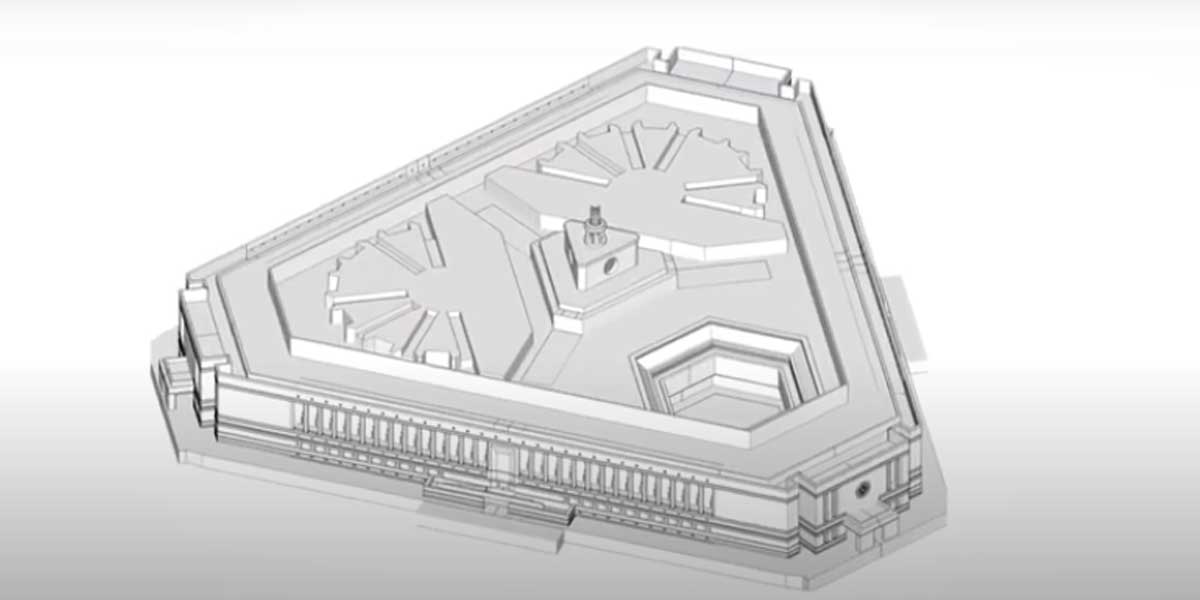
In this backdrop, on 10 December 2020, the Prime Minister laid the foundation stone for the new parliament building project which is a part of the Rs 20,000 crore Central Vista Project.

The government had defended the project in court, arguing that the current British-era Parliament House, opened in 1927, had inadequate space, and did not meet even the basic fire and earthquake safety norms. Additionally, had also contended that all central ministries need to be in one place to improve the efficiency of the government.

Click on the link to know more about the new parliament project:

Weeks after Prime Minister Narendra Modi and his team conducted a Bhumi Pujan-- groundbreaking--ceremony amidst a Supreme Court order staying the proceedings, a Bench of three judges has now voted 2:1 in favour of the construction. Several petitions were filed challenging the construction of the Central Vista project and a number of questions were raised over the permissions given for the change in land use and the statutory authorities allowing such a change. The three judge bench gave a go-ahead to the government for the construction of the central vista project on Tuesday and said, We hold that there are no infirmities in clearances given, change in land use. While Justice Sanjiv Khanna agreed with the other two judges on granting permission to the project he disagreed with the judgment on change of land use and on the grant of environmental clearance for the project. He was apprehensive of the change of land use as there was no disclosure for public participation and the prior approval of the heritage committee was also missing. The Supreme Court’s permission, however, comes with certain caveats and recommendations like clearance from the heritage conservation committee. The three- judge bench in its verdict also mentioned “We, however, feel the need to record that the mitigating measures must be observed by the project proponent in letter and spirit during the construction and operational phase.” The court ordered: Waste management methods, inclusive of hazardous wastes, must be subject to regular monitoring. Installation of permanent high-capacity smog tower as part of the Project and use an adequate number of smog guns to minimise pollution levels during the construction activity is in progress on the site. Supreme Court on 7 December 2020 had allowed the government to go ahead with the foundation stone laying ceremony on the condition that no construction, demolition or felling of trees should take place. In this backdrop, on 10 December 2020, the Prime Minister laid the foundation stone for the new parliament building project which is a part of the Rs 20,000 crore Central Vista Project. The government had defended the project in court, arguing that the current British-era Parliament House, opened in 1927, had inadequate space, and did not meet even the basic fire and earthquake safety norms. Additionally, had also contended that all central ministries need to be in one place to improve the efficiency of the government. Click on the link to know more about the new parliament project:

Next Story
Infrastructure Energy

Vedanta Aluminium Uses 1.57 bn Units of Green Energy in FY25

Vedanta Aluminium, India’s largest aluminium producer, recently reported consumption of 1.57 billion units of renewable energy in FY25, marking a significant milestone in its 2030 decarbonisation roadmap. The company also achieved an 8.96 per cent reduction in greenhouse gas (GHG) emissions intensity compared to FY21, reinforcing its leadership in India’s low-carbon manufacturing transition. During FY25, Vedanta Aluminium expanded its renewable energy portfolio through long-term power purchase agreements, strengthening its strategy to source nearly 1,500 MW of renewable power over the lon..

Next Story
Real Estate

Oberoi Group to Develop Luxury Resort at Makaibari Tea Estate

EIH Limited, the flagship company of The Oberoi Group, has announced the signing of a management agreement to develop an Oberoi luxury resort at the iconic Makaibari Tea Estate in Darjeeling. The project marks a key milestone in the Group’s long-term strategy of creating distinctive hospitality experiences in rare and environmentally significant locations. Established in 1859, Makaibari is one of the world’s oldest tea estates and is globally recognised for its Himalayan landscape, primary forests and exceptional biodiversity. Spread across 1,236 acres, the estate houses one of the world..

Next Story
Real Estate

GHV Infra Secures Rs 1.09 Bn EPC Order in Jamshedpur

GHV Infra Projects Ltd, a fast-growing EPC company in India’s infrastructure and construction sector, has recently secured a Rs 1.09 billion work order in Jamshedpur, Jharkhand. Awarded by a reputed group entity, the contract covers end-to-end civil construction, mechanical, electrical and plumbing (MEP) systems, along with high-quality finishing works for a large building development. The project will be executed over a 30-month period, with defined benchmarks for quality, safety and timely delivery. The order strengthens GHV Infra’s footprint in Jamshedpur, a key industrial hub known fo..

Advertisement

Subscribe to Our Newsletter

Get daily newsletters around different themes from Construction world.

STAY CONNECTED

Advertisement

Advertisement

Advertisement

Advertisement

Open In App