India–EFTA TEPA Marks Two Years of Trade and Technology Gains
Technology

India–EFTA TEPA Marks Two Years of Trade and Technology Gains

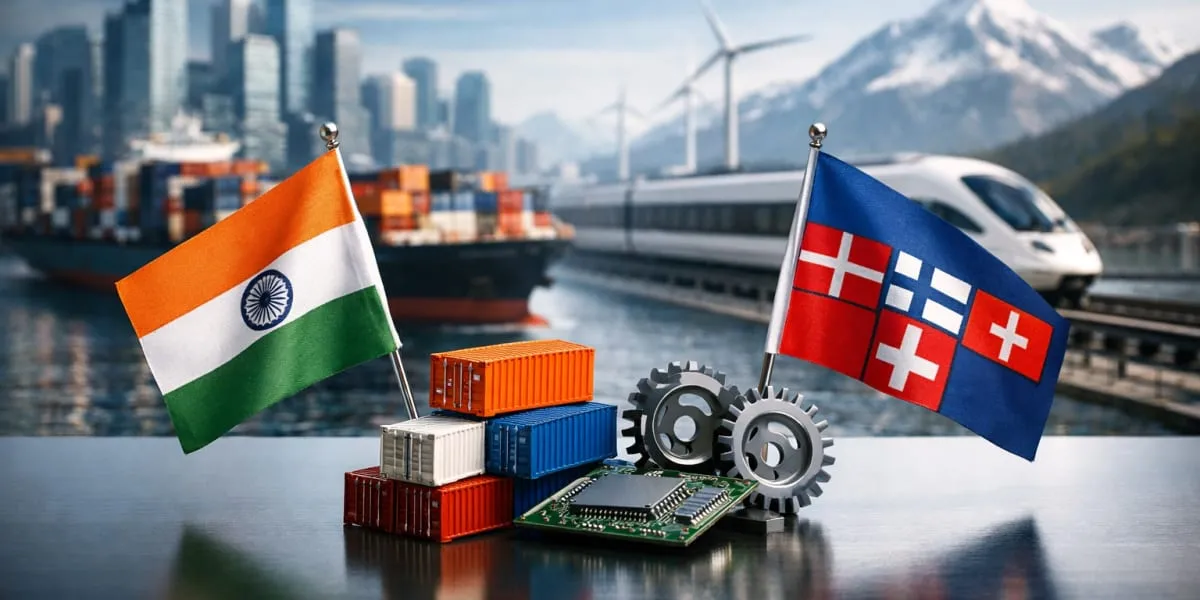
Two years after the signing of the Trade and Economic Partnership Agreement between India and the member states of the European Free Trade Association, the partnership moved from negotiation to implementation on one October 2025. The Agreement brings India together with four EFTA economies in a framework that supports trade, investment, services, technology collaboration and longer-term industrial growth. It is described as a strategic link to high-income European markets that can deepen export opportunities and supply chain integration.

The Prime Minister noted that India has secured free trade agreements with 38 partner nations, providing manufacturers and producers broader market access. He cited agreements that would remove tariffs on 99 per cent of exports in some cases and noted that merchandise trade with some partners has doubled post-FTA. The commentary emphasised benefits for the services sector, Global Capability Centres and manufacturing through greater regulatory certainty and mobility.

The Union Minister of Commerce and Industry characterised India–EFTA TEPA as a long-term instrument that gives Indian exporters access to high-income markets and creates an investment pathway of United States dollar (USD) 100 bn over 15 years. He argued that improved access to specialised machinery, quality inputs and technology partnerships can strengthen manufacturing, deepen value addition and support India’s 2030 exports ambition of USD 1 tn in merchandise and USD 1 tn in services. The Agreement is expected to foster research and development, renewable energy, life sciences and digital transformation collaboration.

TEPA shows EFTA commitments covering 92.2 per cent of tariff lines and accounting for 99.6 per cent of India’s exports, while India’s commitments cover 82.7 per cent and account for 95.3 per cent of EFTA exports. Sensitive sectors such as dairy, soya, coal and selected agricultural products are protected and the effective duty on gold is unchanged. The Agreement includes facilitation for one mn direct jobs and is intended to open pathways for MSMEs, start-ups and local producers. Implementation will rely on institutional mechanisms and stakeholder consultations to turn commitments into trade and investment and support the vision of Viksit Bharat by 2047.

Two years after the signing of the Trade and Economic Partnership Agreement between India and the member states of the European Free Trade Association, the partnership moved from negotiation to implementation on one October 2025. The Agreement brings India together with four EFTA economies in a framework that supports trade, investment, services, technology collaboration and longer-term industrial growth. It is described as a strategic link to high-income European markets that can deepen export opportunities and supply chain integration. The Prime Minister noted that India has secured free trade agreements with 38 partner nations, providing manufacturers and producers broader market access. He cited agreements that would remove tariffs on 99 per cent of exports in some cases and noted that merchandise trade with some partners has doubled post-FTA. The commentary emphasised benefits for the services sector, Global Capability Centres and manufacturing through greater regulatory certainty and mobility. The Union Minister of Commerce and Industry characterised India–EFTA TEPA as a long-term instrument that gives Indian exporters access to high-income markets and creates an investment pathway of United States dollar (USD) 100 bn over 15 years. He argued that improved access to specialised machinery, quality inputs and technology partnerships can strengthen manufacturing, deepen value addition and support India’s 2030 exports ambition of USD 1 tn in merchandise and USD 1 tn in services. The Agreement is expected to foster research and development, renewable energy, life sciences and digital transformation collaboration. TEPA shows EFTA commitments covering 92.2 per cent of tariff lines and accounting for 99.6 per cent of India’s exports, while India’s commitments cover 82.7 per cent and account for 95.3 per cent of EFTA exports. Sensitive sectors such as dairy, soya, coal and selected agricultural products are protected and the effective duty on gold is unchanged. The Agreement includes facilitation for one mn direct jobs and is intended to open pathways for MSMEs, start-ups and local producers. Implementation will rely on institutional mechanisms and stakeholder consultations to turn commitments into trade and investment and support the vision of Viksit Bharat by 2047.

Related Stories

Gold Stories

Next Story
Real Estate

WSB Real Estate Partners Exits Six Housing Investments

WSB Real Estate Partners recently announced the successful exit of six residential investments across Bengaluru, Mumbai Metropolitan Region (MMR) and National Capital Region (NCR), delivering an average internal rate of return (IRR) of 19–21 per cent and an overall investment return of 1.4 times.The real estate-focused investment firm invested approximately Rs 7 billion across six mid-affordable housing projects over the past four years. All six investments were fully repaid between April and November 2026, several months ahead of their original investment tenures.WSB collaborated with sever..

Next Story
Infrastructure Transport

Aluminium Industry Seeks Policy Support for Rs 4 Trillion Investment

The Aluminium Association of India (AAI) has recently urged the government to introduce supportive policy measures to safeguard the sector’s proposed Rs 4 trillion investment pipeline. The association highlighted the need for a predictable policy framework to strengthen domestic manufacturing, expand production capacity and reduce import dependence.AAI submitted its recommendations for the Union Budget 2027-28 to the Ministries of Finance, Commerce and Industry, and Mines, along with the Department for Promotion of Industry and Internal Trade (DPIIT).India’s aluminium demand is projected t..

Next Story
Technology

ABB Unveils Intelligent Motor to Accelerate Industrial AI Adoption

ABB recently launched Intelleqt, which it describes as the world’s first low-voltage motor with factory-integrated intelligence, at the SPS trade fair in Germany. Designed to deliver real-time operational insights from its first rotation, the motor enables industrial operators to integrate equipment-level data into existing digital platforms while retaining full ownership of their data.The launch addresses growing challenges in scaling artificial intelligence (AI) across industrial operations, particularly data quality and availability. According to Deloitte, while 84 per cent of manufacture..

Advertisement

Subscribe to Our Newsletter

Get daily newsletters around different themes from Construction world.

STAY CONNECTED

Advertisement

SPECIAL OFFER
QR Code