RBI says “real GDP growth” in FY21 is 2% higher
ECONOMY & POLICY

RBI says “real GDP growth” in FY21 is 2% higher

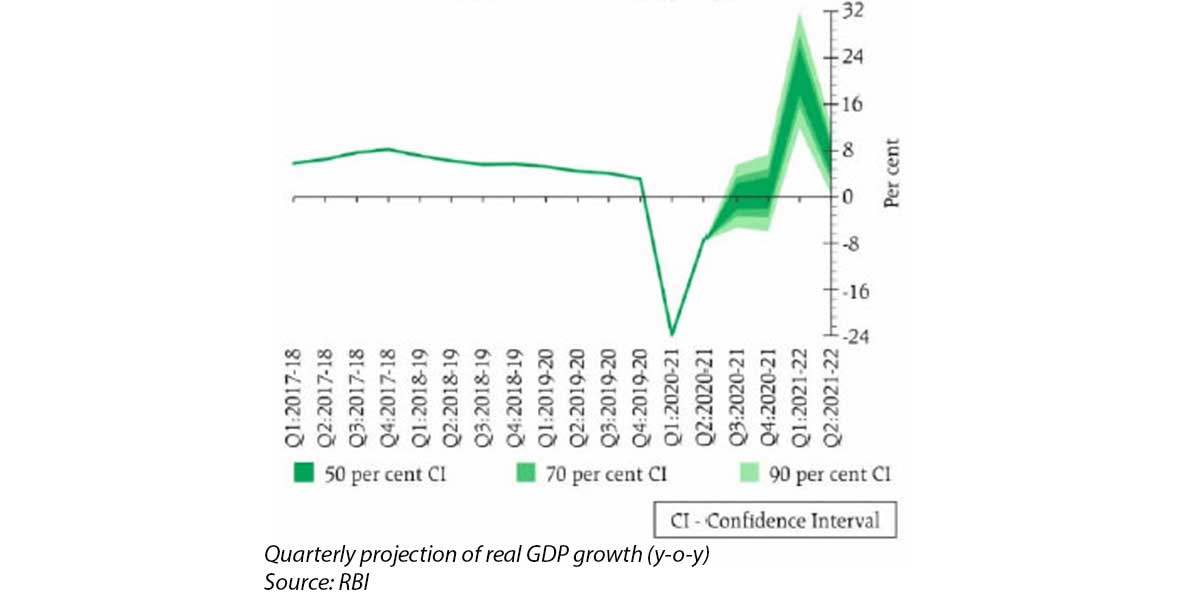
Reserve Bank of India (RBI) has kept its repo rate unchanged at 4%. RBI Governor Shaktikanta Das said the institution is committed to preserving depositors’ interest in the financial system, and that the Indian economy is recovering faster than expected. He projected a “real GDP growth” for FY2021 to -7.5% (up from an earlier projection of -9.5% earlier).

Das announced, “Growth impulses that have emerged augur well for the revitalisation of the Indian economy.” He also said, “The horizon has lighted up with a spate of positive news around vaccines and steady rise in recoveries. India's time has come to break free of the fetters of Covid-19 and reconfigure our destiny.”

Das pointed to the challenge that the year has been and the Bank addressed it: “RBI's role as debt manager and banker to government was tested to the hilt in 2020, marked by highest ever level of market borrowing, our policies resulted in lowest ever borrowing cost in 16 years.”

RBI Governor was announcing the bi-monthly monetary policy review for December. A six-member monetary policy committee (MPC) headed by Das met for two days from December 2. The committee unanimously voted in favour of keeping the rate unchanged and for staying with an “accommodative stance ... at least during the current financial year and into the next financial year to derive growth on a durable basis”

Inflation worries. On inflation, RBI’s outlook is that “Crude oil prices have picked up on optimism of demand recovery, continuation of OPEC plus production cuts and are expected to remain volatile in the near-term. Cost-push pressures continue to impinge on core inflation, which has remained sticky and could firm up as economic activity normalises and demand picks up. Taking into consideration all these factors, CPI inflation is projected at 6.8 per cent for Q3:2020-21, 5.8 per cent for Q4:2020-21; and 5.2 per cent to 4.6 per cent in H1:2021-22, with risks broadly balanced.”

Reactions. The BSE Sensex reacted with glee, breaching the 45,000 mark for the first time. Experts say the markets are enthused at the revised GDP growth estimates.

CARE Ratings, the risk analyst firm, does not foresee a rate cut this fiscal since “inflation is expected to remain at elevated levels and unlikely to cool below RBI’s target 6%”. On liquidity situation, the firm opines that “all the 26 stressed sectors to be eligible for liquidity support through on tap targeted long term repo operations (TLTROs). We could expect more TLTROs going forward ... There is a clear signal to align the TLTRO with the emergency line of credit with government guarantee which is a good step. Hence, banks can take money from RBI under the TLTRO and use these funds for lending to these sectors as identified by the Kamath Committee and also get a guarantee from the government based on the terms of the scheme.”

Industry practitioners seem positive about the statement. Kaushal Agarwal, Chairman, The Guardians Real Estate Advisory, said, “Owing to inflation concerns and steep reductions previously, the RBI was expected to keep rates unchanged. With commercial banks being asked to consolidate profits and not distribute dividends, it’s time the banks further sweeten the lending rates. With vaccine announcements around the corner and persistent recovery in the economy, the country can be expected to fully recover financially by the end of Q4 FY 20-21.”

“The constant vigil shown by the RBI is welcome,” Ankush Kaul, President (Sales & Marketing), Ambience Group, who pointed out the challenges. “The decision to leave the key policy rate unchanged comes on expected lines. While the government and the RBI has been doing a lot, rising inflation, especially for food items, commodities remain a big concern for people in general. There is a need to put a check on the spread of Covid and disruptions like the farmers’ protest etc. These may collectively dampen the festive spirit and the upswing in home buying that we witnessed a few months back. The industry and the government should strive to revive homebuyer’s sentiments.”

Niranjan Hiranandani, co-founder and MD of real estate giant Hiranandani Group and President of ASSOCHAM and NAREDCO believes that the RBI needs to be more hawkish to tame inflation “and try to taper it further in order to mitigate the supply-side pressure. The proactive stance of the government to tackle the supply side issues would be instrumental in reducing the food prices further.”

Also read: Why India’s GDP is leaking!

Reserve Bank of India (RBI) has kept its repo rate unchanged at 4%. RBI Governor Shaktikanta Das said the institution is committed to preserving depositors’ interest in the financial system, and that the Indian economy is recovering faster than expected. He projected a “real GDP growth” for FY2021 to -7.5% (up from an earlier projection of -9.5% earlier). Das announced, “Growth impulses that have emerged augur well for the revitalisation of the Indian economy.” He also said, “The horizon has lighted up with a spate of positive news around vaccines and steady rise in recoveries. India's time has come to break free of the fetters of Covid-19 and reconfigure our destiny.” Das pointed to the challenge that the year has been and the Bank addressed it: “RBI's role as debt manager and banker to government was tested to the hilt in 2020, marked by highest ever level of market borrowing, our policies resulted in lowest ever borrowing cost in 16 years.” RBI Governor was announcing the bi-monthly monetary policy review for December. A six-member monetary policy committee (MPC) headed by Das met for two days from December 2. The committee unanimously voted in favour of keeping the rate unchanged and for staying with an “accommodative stance ... at least during the current financial year and into the next financial year to derive growth on a durable basis” Inflation worries. On inflation, RBI’s outlook is that “Crude oil prices have picked up on optimism of demand recovery, continuation of OPEC plus production cuts and are expected to remain volatile in the near-term. Cost-push pressures continue to impinge on core inflation, which has remained sticky and could firm up as economic activity normalises and demand picks up. Taking into consideration all these factors, CPI inflation is projected at 6.8 per cent for Q3:2020-21, 5.8 per cent for Q4:2020-21; and 5.2 per cent to 4.6 per cent in H1:2021-22, with risks broadly balanced.” Reactions. The BSE Sensex reacted with glee, breaching the 45,000 mark for the first time. Experts say the markets are enthused at the revised GDP growth estimates.CARE Ratings, the risk analyst firm, does not foresee a rate cut this fiscal since “inflation is expected to remain at elevated levels and unlikely to cool below RBI’s target 6%”. On liquidity situation, the firm opines that “all the 26 stressed sectors to be eligible for liquidity support through on tap targeted long term repo operations (TLTROs). We could expect more TLTROs going forward ... There is a clear signal to align the TLTRO with the emergency line of credit with government guarantee which is a good step. Hence, banks can take money from RBI under the TLTRO and use these funds for lending to these sectors as identified by the Kamath Committee and also get a guarantee from the government based on the terms of the scheme.”Industry practitioners seem positive about the statement. Kaushal Agarwal, Chairman, The Guardians Real Estate Advisory, said, “Owing to inflation concerns and steep reductions previously, the RBI was expected to keep rates unchanged. With commercial banks being asked to consolidate profits and not distribute dividends, it’s time the banks further sweeten the lending rates. With vaccine announcements around the corner and persistent recovery in the economy, the country can be expected to fully recover financially by the end of Q4 FY 20-21.” “The constant vigil shown by the RBI is welcome,” Ankush Kaul, President (Sales & Marketing), Ambience Group, who pointed out the challenges. “The decision to leave the key policy rate unchanged comes on expected lines. While the government and the RBI has been doing a lot, rising inflation, especially for food items, commodities remain a big concern for people in general. There is a need to put a check on the spread of Covid and disruptions like the farmers’ protest etc. These may collectively dampen the festive spirit and the upswing in home buying that we witnessed a few months back. The industry and the government should strive to revive homebuyer’s sentiments.” Niranjan Hiranandani, co-founder and MD of real estate giant Hiranandani Group and President of ASSOCHAM and NAREDCO believes that the RBI needs to be more hawkish to tame inflation “and try to taper it further in order to mitigate the supply-side pressure. The proactive stance of the government to tackle the supply side issues would be instrumental in reducing the food prices further.” Also read: Why India’s GDP is leaking!

Related Stories

Gold Stories

Next Story
Real Estate

WSB Real Estate Partners Exits Six Housing Investments

WSB Real Estate Partners recently announced the successful exit of six residential investments across Bengaluru, Mumbai Metropolitan Region (MMR) and National Capital Region (NCR), delivering an average internal rate of return (IRR) of 19–21 per cent and an overall investment return of 1.4 times.The real estate-focused investment firm invested approximately Rs 7 billion across six mid-affordable housing projects over the past four years. All six investments were fully repaid between April and November 2026, several months ahead of their original investment tenures.WSB collaborated with sever..

Next Story
Infrastructure Transport

Aluminium Industry Seeks Policy Support for Rs 4 Trillion Investment

The Aluminium Association of India (AAI) has recently urged the government to introduce supportive policy measures to safeguard the sector’s proposed Rs 4 trillion investment pipeline. The association highlighted the need for a predictable policy framework to strengthen domestic manufacturing, expand production capacity and reduce import dependence.AAI submitted its recommendations for the Union Budget 2027-28 to the Ministries of Finance, Commerce and Industry, and Mines, along with the Department for Promotion of Industry and Internal Trade (DPIIT).India’s aluminium demand is projected t..

Next Story
Technology

ABB Unveils Intelligent Motor to Accelerate Industrial AI Adoption

ABB recently launched Intelleqt, which it describes as the world’s first low-voltage motor with factory-integrated intelligence, at the SPS trade fair in Germany. Designed to deliver real-time operational insights from its first rotation, the motor enables industrial operators to integrate equipment-level data into existing digital platforms while retaining full ownership of their data.The launch addresses growing challenges in scaling artificial intelligence (AI) across industrial operations, particularly data quality and availability. According to Deloitte, while 84 per cent of manufacture..

Subscribe to Our Newsletter

Get daily newsletters around different themes from Construction world.

STAY CONNECTED

Advertisement

SPECIAL OFFER
QR Code