Delhi Expands Air Network to 60 Stations, Flags Off 150 E-Buses
ECONOMY & POLICY

Delhi Expands Air Network to 60 Stations, Flags Off 150 E-Buses

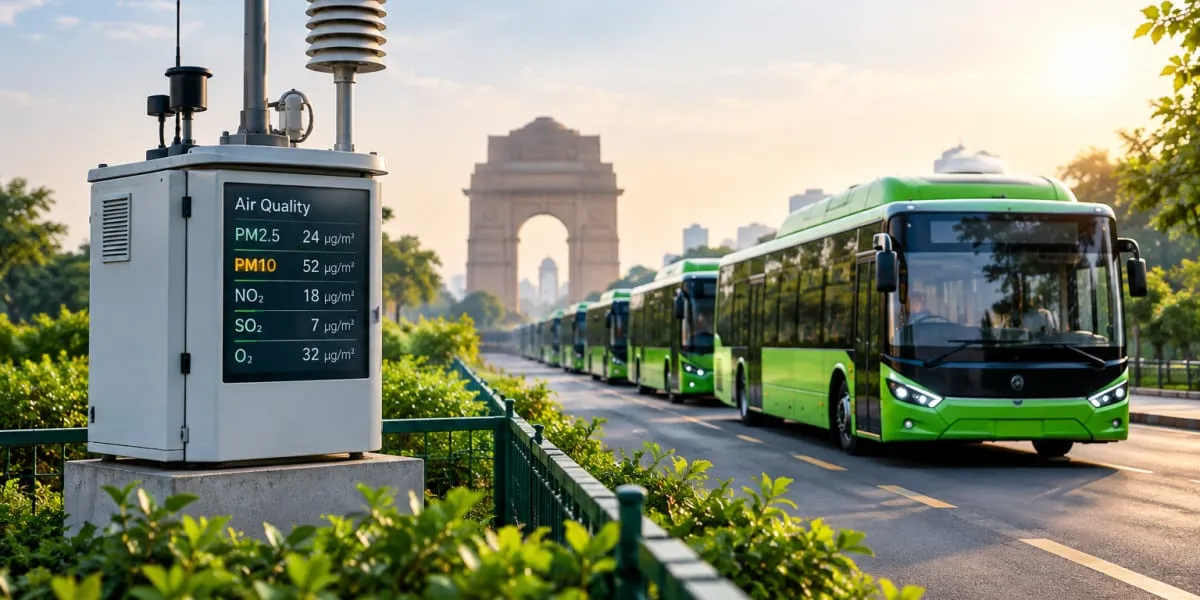
Delhi has expanded its air quality monitoring network to 60 stations after inaugurating 13 new Continuous Ambient Air Quality Monitoring Stations (CAAQMS), while 150 electric buses were flagged off to strengthen public transport and address air pollution. Union Environment, Forest and Climate Change Minister Bhupender Yadav and Delhi Chief Minister Rekha Gupta reviewed mitigation measures at the Anand Vihar hotspot on Tuesday.

The two leaders also visited the Delhi Pollution Control Committee’s (DPCC) artificial intelligence-enabled Integrated Command and Control Centre (ICCC) at Shastri Park. They virtually inaugurated public electric vehicle charging stations at ISBT Anand Vihar, Nand Nagri depot, Rohini Sector-37 depot, Nangloi depot and Keshopur depot before flagging off the buses from Swami Vivekanand ISBT, Anand Vihar.

The 13 new stations have been installed across the capital to provide continuous information on air quality and meteorological conditions. The data will support scientific assessment, regulatory enforcement and public dissemination of the Air Quality Index. Delhi’s network has consequently risen from 47 to 60 stations operated by agencies including DPCC, the Central Pollution Control Board (CPCB), the India Meteorological Department, the Indian Institute of Tropical Meteorology and the Ministry of Housing and Urban Affairs.

Real-time readings are available through the CPCB server and the SAMEER mobile application. At Anand Vihar, officials identified traffic congestion, road dust, unpaved surfaces, construction and demolition activity, and open burning and waste dumping as factors contributing to pollution. Mitigation measures assigned to 11 agencies include paving internal roads, removing encroachments and illegally dumped construction waste, enforcing dust controls at construction sites and undertaking greening work.

The ICCC platform is designed to integrate information on air quality, dust-control sites, ambient noise, industrial emissions, stubble burning, public grievances and enforcement vehicles. The government said it is intended to support real-time monitoring, data-led decisions and coordinated enforcement. Of 15 external data systems planned for integration, nine have been connected and the remaining six are being integrated in phases. Yadav credited coordinated action by Delhi government departments with containing pollution at the Anand Vihar hotspot and welcomed the expansion of electric mobility and monitoring infrastructure.

Delhi has expanded its air quality monitoring network to 60 stations after inaugurating 13 new Continuous Ambient Air Quality Monitoring Stations (CAAQMS), while 150 electric buses were flagged off to strengthen public transport and address air pollution. Union Environment, Forest and Climate Change Minister Bhupender Yadav and Delhi Chief Minister Rekha Gupta reviewed mitigation measures at the Anand Vihar hotspot on Tuesday. The two leaders also visited the Delhi Pollution Control Committee’s (DPCC) artificial intelligence-enabled Integrated Command and Control Centre (ICCC) at Shastri Park. They virtually inaugurated public electric vehicle charging stations at ISBT Anand Vihar, Nand Nagri depot, Rohini Sector-37 depot, Nangloi depot and Keshopur depot before flagging off the buses from Swami Vivekanand ISBT, Anand Vihar. The 13 new stations have been installed across the capital to provide continuous information on air quality and meteorological conditions. The data will support scientific assessment, regulatory enforcement and public dissemination of the Air Quality Index. Delhi’s network has consequently risen from 47 to 60 stations operated by agencies including DPCC, the Central Pollution Control Board (CPCB), the India Meteorological Department, the Indian Institute of Tropical Meteorology and the Ministry of Housing and Urban Affairs. Real-time readings are available through the CPCB server and the SAMEER mobile application. At Anand Vihar, officials identified traffic congestion, road dust, unpaved surfaces, construction and demolition activity, and open burning and waste dumping as factors contributing to pollution. Mitigation measures assigned to 11 agencies include paving internal roads, removing encroachments and illegally dumped construction waste, enforcing dust controls at construction sites and undertaking greening work. The ICCC platform is designed to integrate information on air quality, dust-control sites, ambient noise, industrial emissions, stubble burning, public grievances and enforcement vehicles. The government said it is intended to support real-time monitoring, data-led decisions and coordinated enforcement. Of 15 external data systems planned for integration, nine have been connected and the remaining six are being integrated in phases. Yadav credited coordinated action by Delhi government departments with containing pollution at the Anand Vihar hotspot and welcomed the expansion of electric mobility and monitoring infrastructure.

Related Stories

Gold Stories

Next Story
Resources

Kalpataru Projects International elevates Amit Uplenchwar as Joint MD and CEO

Kalpataru Projects International (KPIL) has elevated Amit Uplenchwar as Joint Managing Director and CEO (designate), following approval by its board on 5 November 2026. He will take charge as Additional Director, Joint Managing Director and CEO from 1 January 2027 for a five-year term ending 31 December 2031, subject to shareholders' approval.Uplenchwar brings over three decades of experience in corporate strategy, business operations, business development, mergers and acquisitions, and international business management. His experience spans transportation, power, water, oil and gas, aerospace..

Next Story
Resources

HCC appoints Vivek Singhal as CEO

Hindustan Construction Company (HCC) has appointed Vivek Singhal as Chief Executive Officer, effective 5 November 2026. He brings over four decades of experience in infrastructure and engineering, procurement and construction (EPC), covering project execution, business leadership, business development and profit and loss management.Singhal has spent 16 years in international markets, delivering projects and managing assets worth approximately Rs 285 billion across five countries. His experience spans airports, metro rail, urban transport, hydropower, bridges and other infrastructure sectors.He..

Next Story
Infrastructure Energy

Essar Signs PPA for 300 MW Hybrid Renewable Energy Project

Essar Renewables, the renewable energy arm of Essar Power, has signed a Power Purchase Agreement (PPA) with NHPC for a 300 MW renewable energy project in Andhra Pradesh. The agreement follows the company’s successful bid for the project two years ago. Essar Power will invest approximately Rs. 45 bn in the development. The project will combine solar and wind generation with Battery Energy Storage Systems (BESS), enabling the supply of reliable and dispatchable renewable power. It forms part of Essar Power’s plan to build a diversified energy portfolio of approximately 5 GW across renewable,..

Advertisement

Subscribe to Our Newsletter

Get daily newsletters around different themes from Construction world.

STAY CONNECTED

Advertisement

SPECIAL OFFER
QR Code