India, Canada Close In On USD 2.8bn Uranium Supply Deal
ECONOMY & POLICY

India, Canada Close In On USD 2.8bn Uranium Supply Deal

India and Canada are nearing a USD 2.8 billion agreement for long-term uranium supplies to Indian nuclear power plants, soon after launching negotiations on a Comprehensive Economic Partnership Agreement (CEPA). According to a report in the Globe and Mail, the proposed deal could run for a decade and may form part of a broader nuclear co-operation framework between the two countries.

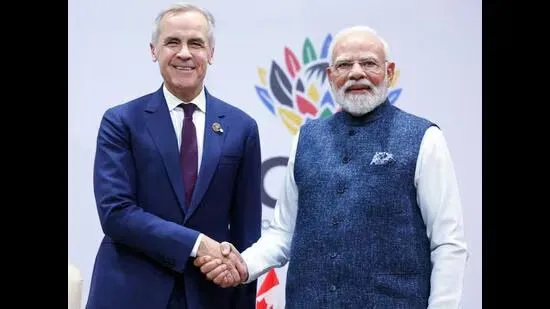
Following a meeting between Prime Ministers Narendra Modi and Mark Carney on the sidelines of the G20 Leaders’ Summit in Johannesburg, the Ministry of External Affairs said both leaders had reaffirmed their longstanding civil nuclear partnership. They also agreed to expand this collaboration, including through long-term uranium supply arrangements. The uranium is expected to be supplied by Cameco Inc, the Saskatchewan-based nuclear fuel company.

Cameco previously supplied uranium to India under an agreement with the Department of Atomic Energy that began after Modi’s 2015 visit to Canada and expired in 2020. Canadian uranium exports to India for electricity generation were authorised under the Canada–India Nuclear Co-operation Agreement, which came into effect in September 2013.

A broader nuclear co-operation agreement may also be under consideration, with India expressing interest in small modular reactors, a senior official indicated earlier. The uranium deal would follow the Australia–Canada–India Technology and Innovation (ACITI) Partnership, announced in Johannesburg on Saturday after a trilateral meeting involving Modi, Carney and Australian Prime Minister Anthony Albanese. Modi said the initiative will strengthen collaboration across emerging technologies, diversify supply chains, support clean energy and help boost AI adoption across three continents.

India and Canada are nearing a USD 2.8 billion agreement for long-term uranium supplies to Indian nuclear power plants, soon after launching negotiations on a Comprehensive Economic Partnership Agreement (CEPA). According to a report in the Globe and Mail, the proposed deal could run for a decade and may form part of a broader nuclear co-operation framework between the two countries. Following a meeting between Prime Ministers Narendra Modi and Mark Carney on the sidelines of the G20 Leaders’ Summit in Johannesburg, the Ministry of External Affairs said both leaders had reaffirmed their longstanding civil nuclear partnership. They also agreed to expand this collaboration, including through long-term uranium supply arrangements. The uranium is expected to be supplied by Cameco Inc, the Saskatchewan-based nuclear fuel company. Cameco previously supplied uranium to India under an agreement with the Department of Atomic Energy that began after Modi’s 2015 visit to Canada and expired in 2020. Canadian uranium exports to India for electricity generation were authorised under the Canada–India Nuclear Co-operation Agreement, which came into effect in September 2013. A broader nuclear co-operation agreement may also be under consideration, with India expressing interest in small modular reactors, a senior official indicated earlier. The uranium deal would follow the Australia–Canada–India Technology and Innovation (ACITI) Partnership, announced in Johannesburg on Saturday after a trilateral meeting involving Modi, Carney and Australian Prime Minister Anthony Albanese. Modi said the initiative will strengthen collaboration across emerging technologies, diversify supply chains, support clean energy and help boost AI adoption across three continents.

Next Story
Infrastructure Urban

Rosatom Delivers Nuclear Fuel for Kudankulam Unit 3

Rosatom has recently supplied nuclear fuel for the initial loading of the VVER-1000 reactor core at Unit 3 of the Kudankulam Nuclear Power Plant, marking a key milestone in the second stage of the Russian-designed nuclear power project in southern India.The fuel was supplied by Rosatom’s Nuclear Fuel Division, managed by TVEL, and manufactured at the Novosibirsk Chemical Concentrates Plant. The delivery includes the initial reactor load along with reserve fuel assemblies and is part of a long-term contract covering the entire operational life of Units 3 and 4.Building on operational experien..

Next Story
Infrastructure Transport

CBL International Enables First LNG Bunkering at Xiaomo Port

CBL International recently completed the first-ever LNG bunkering operation at Xiaomo Port, supplying liquefied natural gas to vessels operated by BYD in support of its maritime decarbonisation strategy. The operation was facilitated through a physical supplier in collaboration with China National Offshore Oil Corporation (CNOOC), which supported the port’s inaugural LNG bunkering activity. The milestone represents a strategic expansion of CBL International's sustainable fuel offerings beyond biofuels, while also diversifying revenue streams. As global shipping intensifies efforts to cut em..

Next Story
Infrastructure Urban

Aimtron, Aurassure Partner for IoT Weather Systems

Aimtron Electronics has recently entered into an OEM manufacturing engagement with Aurassure to produce new-age, IoT-enabled weather and environmental monitoring systems in India. The collaboration supports the growing demand for real-time environmental intelligence across urban, industrial and infrastructure applications. The engagement comes as global focus on climate-risk management and data-driven planning accelerates. The global weather monitoring systems market, valued at around USD 2.1 billion in 2024, is projected to reach nearly USD 4.8 billion by 2034, driven by the rapid adoption o..

Advertisement

Subscribe to Our Newsletter

Get daily newsletters around different themes from Construction world.

STAY CONNECTED

Advertisement

Advertisement

Advertisement

Advertisement

Open In App