



TASMAC Tests QR Bottle Return Machines
ECONOMY & POLICY

TASMAC Tests QR Bottle Return Machines

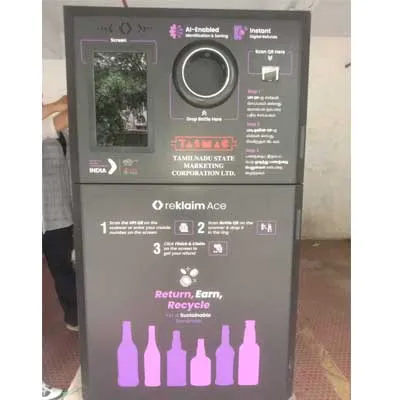
The Tamil Nadu State Marketing Corporation has recently reported an encouraging response to its pilot deployment of automated QR-enabled bottle return machines at select retail locations across the state. The initiative aims to improve glass bottle recovery, reduce littering and digitise deposit refunds.

Consumers participating in the trial appreciated the ease of returning empty glass bottles and metal cans, along with receiving instant digital refunds through bank transfer or UPI-enabled payment mechanisms. Many welcomed the move as a progressive step towards cleaner neighbourhoods and responsible disposal of beverage containers.

The pilot was implemented through cooperation between TASMAC retail outlet administrators and reverse vending machine technology experts. The teams worked together to support smooth operations, customer onboarding and real-time troubleshooting during the trial phase.

The bottle return process requires customers to verify their mobile number through OTP authentication, scan the QR code affixed to the bottle and deposit the empty bottle into the machine. Once authenticity is confirmed, the refundable deposit amount of Rs 10 is credited digitally to the consumer.

Officials noted that the success of the pilot is not measured only by the number of bottles and cans collected, but also by citizen participation and practical insights gained through on-ground implementation.

The pilot has generated important learnings on consumer behaviour, transaction flows, machine operations, outlet-level processes and customer engagement. These insights are expected to help refine the model and support an efficient framework for expansion across Tamil Nadu.

TASMAC will continue gathering data on participation levels, operational efficiency and recycling outcomes. Based on the findings, the corporation will evaluate expanding the QR-enabled bottle return ecosystem to additional outlets, supporting Tamil Nadu’s efforts to create cleaner public spaces and improve glass recycling rates.

"Join industry leaders at RAHSTA Expo, India's premier platform for roads, highways and traffic infrastructure. Register now to explore innovations, network with experts and shape the future of mobility."

The Tamil Nadu State Marketing Corporation has recently reported an encouraging response to its pilot deployment of automated QR-enabled bottle return machines at select retail locations across the state. The initiative aims to improve glass bottle recovery, reduce littering and digitise deposit refunds.Consumers participating in the trial appreciated the ease of returning empty glass bottles and metal cans, along with receiving instant digital refunds through bank transfer or UPI-enabled payment mechanisms. Many welcomed the move as a progressive step towards cleaner neighbourhoods and responsible disposal of beverage containers.The pilot was implemented through cooperation between TASMAC retail outlet administrators and reverse vending machine technology experts. The teams worked together to support smooth operations, customer onboarding and real-time troubleshooting during the trial phase.The bottle return process requires customers to verify their mobile number through OTP authentication, scan the QR code affixed to the bottle and deposit the empty bottle into the machine. Once authenticity is confirmed, the refundable deposit amount of Rs 10 is credited digitally to the consumer.Officials noted that the success of the pilot is not measured only by the number of bottles and cans collected, but also by citizen participation and practical insights gained through on-ground implementation.The pilot has generated important learnings on consumer behaviour, transaction flows, machine operations, outlet-level processes and customer engagement. These insights are expected to help refine the model and support an efficient framework for expansion across Tamil Nadu.TASMAC will continue gathering data on participation levels, operational efficiency and recycling outcomes. Based on the findings, the corporation will evaluate expanding the QR-enabled bottle return ecosystem to additional outlets, supporting Tamil Nadu’s efforts to create cleaner public spaces and improve glass recycling rates.

Next Story
Infrastructure Urban

Hindustan Zinc Adds HZDA 5 To BIS Alloy Portfolio

Hindustan Zinc has expanded its BIS-certified alloy portfolio after extending its BIS licence scope to include Hindustan Zinc Die-Casting Alloy 5, or HZDA 5. The certification confirms compliance with recognised quality standards and offers customers greater assurance on product consistency, reliability and performance.With both HZDA 3 and HZDA 5 now covered under BIS certification, the company has widened its certified zinc alloy offering for domestic and international customers. The certification is expected to support industrial buyers seeking materials backed by recognised quality controls..

Next Story
Infrastructure Urban

Liebherr Launches LMC 80 Soil Mixing Cutter

Liebherr has expanded its deep foundation portfolio with the launch of the LMC 80 cutter soil mixer, designed for noise-reduced and low-vibration ground improvement applications. The solution uses Liebherr’s LRB 23 or LRB 355 piling and drilling rigs as carrier machines, offering customers an integrated package from a single source.The LMC 80 can be used in all mixable soil types to install load-bearing or sealing elements. Its four cutting wheels are driven by a maximum torque of 2x 80 kilonewton metres and can reach a maximum rotational speed of 30 revolutions per minute, depending on grou..

Next Story
Real Estate

Gurugram Corridors Drive NCR Housing Investment

Magicbricks Research has reported that Delhi-NCR has the most centralised housing investment pattern among India’s four largest urban markets, with Gurugram emerging as the region’s primary investment hub.According to the analysis, Gurugram accounts for nine of NCR’s 15 most-invested localities and contributes more than 50 per cent of their cumulative market value. The Dwarka Expressway and Sector 79 together represent around 20 per cent of the top 15 investment value, strengthening south-southwest Gurugram as a key centre for new residential launches.The report also highlights a strong ..

Advertisement

Subscribe to Our Newsletter

Get daily newsletters around different themes from Construction world.

STAY CONNECTED

Advertisement

Advertisement

Advertisement














