Steel Industry Seeks Stronger Action to Curb Rising Imports
Steel

Steel Industry Seeks Stronger Action to Curb Rising Imports

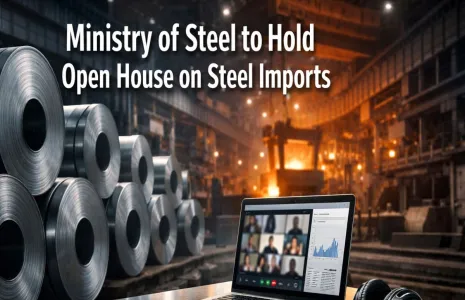
India’s steel producers have called for stronger government intervention to curb rising steel imports, particularly from China, which produced 746.3 million tonnes (MT) of crude steel between January and September 2025 — over six times India’s output.
According to the World Steel Association, India produced 122.4 MT during the same period. In September alone, China’s production of 73.5 MT was more than fivefold India’s 13.6 MT.
The stainless steel sector continues to face pressure from imports, operating at just 60 per cent of its 7.5 MT installed capacity. Industry representatives warned that unless measures are strengthened, domestic utilisation and investment plans could suffer.
Over the past few years, the Ministry of Steel has introduced over 100 Quality Control Orders (QCOs) to prevent non-BIS-compliant steel products from entering the Indian market. The June 2025 QCO even imposed restrictions on importing certain steel inputs.
“The validity of QCOs can be extended to prevent sub-standard and cheap material from entering the country,” said an industry executive, calling for further protective measures aligned with the government’s Atmanirbhar Bharat vision.
In March 2025, the Directorate General of Trade Remedies (DGTR) recommended a 12 per cent provisional safeguard duty for 200 days on select steel products to counter a surge in imports. However, the stainless steel industry later sought a broader probe, as its concerns were not fully covered by the duty.
A high-level committee of NITI Aayog is expected to meet steel industry leaders next week to discuss the issue, sources indicated.
Data from BigMint show that domestic steel prices fell to a five-year low in October due to higher import inflows. The Reserve Bank of India (RBI) has also flagged the rise in imports — largely driven by lower prices — and called for policy support to strengthen domestic competitiveness.
India imported 0.79 MT of finished steel in September 2025, up from 0.69 MT in August, marking the sixth consecutive month as a net steel importer. Imports from Korea, Russia, and Indonesia rose, while those from China, Japan, Vietnam, Thailand, and Taiwan declined year-on-year.
During the first half of FY26, inbound shipments exceeded exports by 0.47 MT despite a 40 per cent rise in export volumes to 4.43 MT, underscoring the growing import imbalance faced by the domestic steel industry.

India’s steel producers have called for stronger government intervention to curb rising steel imports, particularly from China, which produced 746.3 million tonnes (MT) of crude steel between January and September 2025 — over six times India’s output.According to the World Steel Association, India produced 122.4 MT during the same period. In September alone, China’s production of 73.5 MT was more than fivefold India’s 13.6 MT.The stainless steel sector continues to face pressure from imports, operating at just 60 per cent of its 7.5 MT installed capacity. Industry representatives warned that unless measures are strengthened, domestic utilisation and investment plans could suffer.Over the past few years, the Ministry of Steel has introduced over 100 Quality Control Orders (QCOs) to prevent non-BIS-compliant steel products from entering the Indian market. The June 2025 QCO even imposed restrictions on importing certain steel inputs.“The validity of QCOs can be extended to prevent sub-standard and cheap material from entering the country,” said an industry executive, calling for further protective measures aligned with the government’s Atmanirbhar Bharat vision.In March 2025, the Directorate General of Trade Remedies (DGTR) recommended a 12 per cent provisional safeguard duty for 200 days on select steel products to counter a surge in imports. However, the stainless steel industry later sought a broader probe, as its concerns were not fully covered by the duty.A high-level committee of NITI Aayog is expected to meet steel industry leaders next week to discuss the issue, sources indicated.Data from BigMint show that domestic steel prices fell to a five-year low in October due to higher import inflows. The Reserve Bank of India (RBI) has also flagged the rise in imports — largely driven by lower prices — and called for policy support to strengthen domestic competitiveness.India imported 0.79 MT of finished steel in September 2025, up from 0.69 MT in August, marking the sixth consecutive month as a net steel importer. Imports from Korea, Russia, and Indonesia rose, while those from China, Japan, Vietnam, Thailand, and Taiwan declined year-on-year.During the first half of FY26, inbound shipments exceeded exports by 0.47 MT despite a 40 per cent rise in export volumes to 4.43 MT, underscoring the growing import imbalance faced by the domestic steel industry.

Next Story
Infrastructure Transport

India Becomes First to Produce Bio-Bitumen for Roads

India has become the first country in the world to commercially produce bio-bitumen for use in road construction, according to Road, Transport and Highways Minister Nitin Gadkari. Bitumen, a black and viscous hydrocarbon derived from crude oil, is a key binding material in road building, and the bio-based alternative is expected to significantly improve the sector’s environmental footprint.Addressing the CSIR Technology Transfer Ceremony in New Delhi, Mr Gadkari congratulated Council of Scientific and Industrial Research on achieving the milestone, noting that the initiative would help curb ..

Next Story
Infrastructure Urban

HILT Policy Seen Boosting Telangana Revenue Sharply

The Hyderabad Industrial Land Transformation (HILT) Policy is expected to generate around Rs 1.08 billion in revenue for the Telangana state exchequer, according to Deputy Chief Minister Bhatti Vikramarka Mallu. Speaking in the Telangana Legislative Assembly, he said the policy would be implemented within a six-month timeframe in a transparent manner, with uniform rules applicable to all stakeholders. Mr Vikramarka noted that without the HILT Policy, the state would have earned only about Rs 1.2 million per acre. Under the new framework, however, revenue is projected to rise sharply to Rs 70 ..

Next Story
Infrastructure Urban

India Post, MoRD Tie Up to Boost Rural Inclusion

The Department of Posts and the Ministry of Rural Development have signed a Memorandum of Understanding to accelerate rural transformation and expand financial, digital and logistics services for Self-Help Groups (SHGs) and rural households across India. The agreement was signed in the presence of Union Minister of Communications and Development of North Eastern Region Jyotiraditya M. Scindia and Union Minister of Rural Development and Agriculture and Farmers’ Welfare Shivraj Singh Chouhan. The collaboration aligns with the government’s “Dak Sewa, Jan Sewa” vision and seeks to repositi..

Advertisement

Subscribe to Our Newsletter

Get daily newsletters around different themes from Construction world.

STAY CONNECTED

Advertisement

Advertisement

Advertisement

Advertisement

Open In App