Jeh Aerospace To Build Rs 4.2 Billion AI-Led Plant In Hyderabad
AVIATION & AIRPORTS

Jeh Aerospace To Build Rs 4.2 Billion AI-Led Plant In Hyderabad

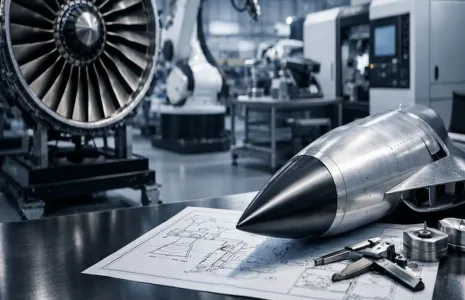
Jeh Aerospace is setting up a 200,000 sq ft manufacturing facility in Kothur, Hyderabad, to expand capacity, accelerate automation and strengthen digital supply-chain resilience for its international customers. The company said on Thursday that the new site has been designed from scratch as a software-defined, AI-powered factory integrating autonomous machining, digital twins and closed-loop quality systems.

The new facility, named Mach 2, will be located at Horizon Industrial Park and is scheduled to be operational in 2026. It will supplement the company’s existing 50,000 sq ft unit. “Our new Hyderabad facility is being engineered as a software-defined, AI-augmented system that can think, adapt and execute with precision at scale,” said Jeh founder and CEO Vishal Sanghavi.

The firm is investing around USD 50 million (approximately Rs 4.2 billion) in the project. Mach 2 will focus on producing advanced, flight-critical aero-engine and aerostructure components on a significantly larger scale. The facility aims to manufacture complex components more quickly, with higher precision and far greater consistency—driven by rising global aerospace demand and the need for suppliers capable of supporting higher production rates with strong reliability.

The company noted that its customers are ramping up significantly and require partners with increased capacity, faster lead times and stronger digital process control. Mach 2 will enable Jeh to meet this demand proactively, the firm told The Hindu.

Jeh Aerospace currently employs just over 120 people. With the new facility, the workforce is expected to “at least double”, requiring additional staff across engineering, manufacturing, quality, automation and digital operations.

Headquartered in Atlanta, the company counts General Catalyst, Elevation Capital and IndiGo Ventures among its investors and has an order book of USD 150 million.

“Our Kothur park showcases the next generation of industrial infrastructure that is sustainable, connected and globally competitive,” said Horizon CEO Urvish Rambhia.

Jeh Aerospace is setting up a 200,000 sq ft manufacturing facility in Kothur, Hyderabad, to expand capacity, accelerate automation and strengthen digital supply-chain resilience for its international customers. The company said on Thursday that the new site has been designed from scratch as a software-defined, AI-powered factory integrating autonomous machining, digital twins and closed-loop quality systems. The new facility, named Mach 2, will be located at Horizon Industrial Park and is scheduled to be operational in 2026. It will supplement the company’s existing 50,000 sq ft unit. “Our new Hyderabad facility is being engineered as a software-defined, AI-augmented system that can think, adapt and execute with precision at scale,” said Jeh founder and CEO Vishal Sanghavi. The firm is investing around USD 50 million (approximately Rs 4.2 billion) in the project. Mach 2 will focus on producing advanced, flight-critical aero-engine and aerostructure components on a significantly larger scale. The facility aims to manufacture complex components more quickly, with higher precision and far greater consistency—driven by rising global aerospace demand and the need for suppliers capable of supporting higher production rates with strong reliability. The company noted that its customers are ramping up significantly and require partners with increased capacity, faster lead times and stronger digital process control. Mach 2 will enable Jeh to meet this demand proactively, the firm told The Hindu. Jeh Aerospace currently employs just over 120 people. With the new facility, the workforce is expected to “at least double”, requiring additional staff across engineering, manufacturing, quality, automation and digital operations. Headquartered in Atlanta, the company counts General Catalyst, Elevation Capital and IndiGo Ventures among its investors and has an order book of USD 150 million. “Our Kothur park showcases the next generation of industrial infrastructure that is sustainable, connected and globally competitive,” said Horizon CEO Urvish Rambhia.

Next Story
Infrastructure Transport

Dhalbhumgarh Airport Faces 150-km Rule Hurdle

The issue has resurfaced following a recent statement by Union Civil Aviation Minister Ram Mohan Naidu, who said that under existing aviation policy, a new greenfield airport is generally not permitted within an aerial distance of 150 kilometres of an operational civilian airport. He added, however, that if a formal proposal is submitted, its impact on the existing airport can be examined and relaxations may be considered on a case-by-case basis. While the clarification has revived some hope for Dhalbhumgarh, it has also underlined the scale of the technical challenge facing the project. Unde..

Next Story
Infrastructure Transport

Stakeholders Seek Parallel Ops For Vizag Airports

With road and metro rail links to Bhogapuram still several years away, stakeholders in north Andhra Pradesh have renewed demands to continue civil operations at INS Dega even after the commissioning of Bhogapuram International Airport. The new airport is expected to begin commercial operations from June. Officials said close to 80 per cent of the airport infrastructure at Bhogapuram, including the terminal building and internal approach roads, has already been completed. However, inadequate external connectivity remains a key concern. Making a case for parallel operations, Andhra Pradesh Air ..

Next Story
Infrastructure Transport

Govt To Roll Out V2V Tech To Cut Road Crashes

In an effort to curb road accidents, particularly in low-visibility conditions such as dense fog, the government is set to roll out vehicle-to-vehicle (V2V) communication technology that will allow cars to exchange real-time data and alert drivers to potential dangers. The announcement was made by Union Road Transport and Highways Minister Nitin Gadkari after the 43rd meeting of the Transport Development Council. The technology involves installing an on-board unit (OBU) in vehicles, enabling wireless data exchange between nearby cars. This will allow vehicles to share information such as spee..

Advertisement

Subscribe to Our Newsletter

Get daily newsletters around different themes from Construction world.

STAY CONNECTED

Advertisement

Advertisement

Advertisement

Advertisement

Open In App