Gujarat to Use Fibre-Based Technology in Road Construction
ROADS & HIGHWAYS

Gujarat to Use Fibre-Based Technology in Road Construction

Gujarat is taking up 20 climate-resilient road projects under a Rs. 11.47 bn infrastructure programme. The works will cover districts across the state and combine fibre-based reinforcement, recycled construction materials and modern pavement techniques to improve road strength and durability.

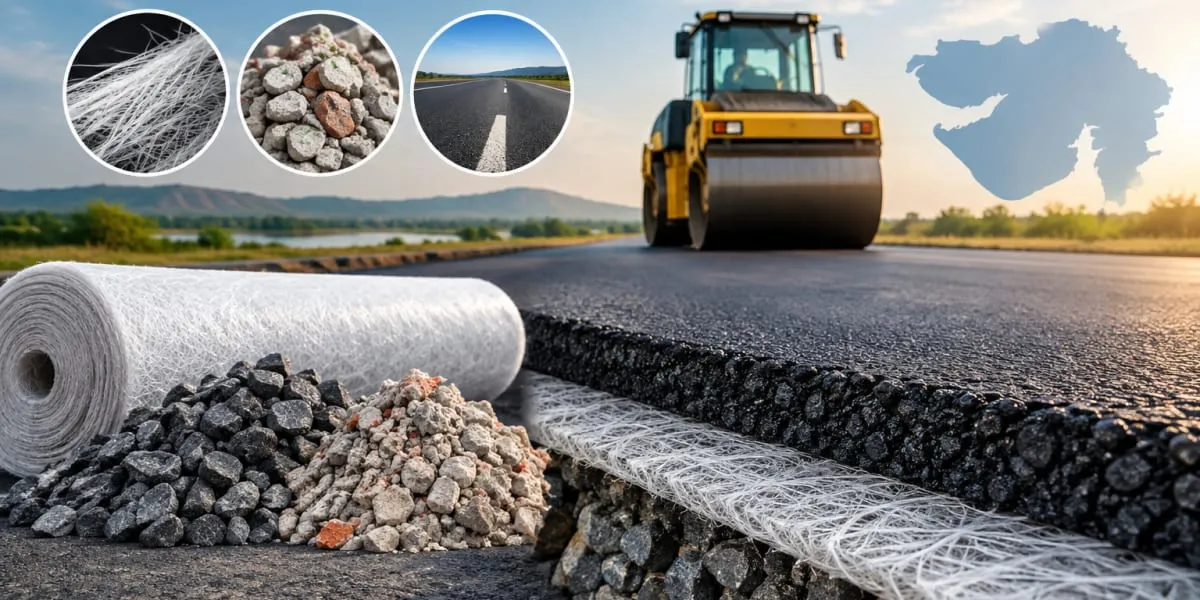
A key method included in the programme is Stress Absorbing Membrane Interlayer (SAMI), a fibre mat placed beneath the asphalt. The material is intended to absorb stresses caused by vehicle movement, temperature variation and moisture, thereby reducing the risk of premature surface deterioration and limiting the spread of cracks through the pavement.

The construction process will also reuse materials recovered from existing roads. Old pavement will be excavated, treated with lime and stabilised through pulverising and rolling before the material is spread and compacted. Cement application and chemical stabilisation will follow, with the surface levelled and compacted before the next construction stage.

After a seven-day period, the SAMI fibre sheet will be laid before asphalt application. The programme includes road widening, resurfacing, four-laning, protection works, side shoulders, rumble strips and drainage improvements. White topping and glass grid technology are also included, depending on the requirements of individual road sections.

The projects are located in districts including Patan, Gir Somnath, Mahisagar, Bharuch, Morbi, Surendranagar, Surat, Vadodara, Chhota Udepur, Anand, Mehsana, Kutch, Bhavnagar, Jamnagar and Narmada. Identified stretches include the Lanwa-Manund-Sander-Balisana Road, Radhanpur-Mashali-Madhapura Road, Bhidiya Somnath Road, Dindoli-Karadwa-Iklera Road, Surendranagar Bypass Road, Manglej-Nareshwar Road and Talaja-Gopnath Road.

Other construction methods being considered include waste plastics in asphalt, fly ash, cement stabilisation, cold mix asphalt and geogrids. Fibreglass glass grids can help distribute traffic loading across pavement layers, while the reuse of existing materials can reduce demand for fresh resources. The performance of these approaches will depend on material quality, road-base preparation and construction practices over the roads’ operating life.

Gujarat is taking up 20 climate-resilient road projects under a Rs. 11.47 bn infrastructure programme. The works will cover districts across the state and combine fibre-based reinforcement, recycled construction materials and modern pavement techniques to improve road strength and durability. A key method included in the programme is Stress Absorbing Membrane Interlayer (SAMI), a fibre mat placed beneath the asphalt. The material is intended to absorb stresses caused by vehicle movement, temperature variation and moisture, thereby reducing the risk of premature surface deterioration and limiting the spread of cracks through the pavement. The construction process will also reuse materials recovered from existing roads. Old pavement will be excavated, treated with lime and stabilised through pulverising and rolling before the material is spread and compacted. Cement application and chemical stabilisation will follow, with the surface levelled and compacted before the next construction stage. After a seven-day period, the SAMI fibre sheet will be laid before asphalt application. The programme includes road widening, resurfacing, four-laning, protection works, side shoulders, rumble strips and drainage improvements. White topping and glass grid technology are also included, depending on the requirements of individual road sections. The projects are located in districts including Patan, Gir Somnath, Mahisagar, Bharuch, Morbi, Surendranagar, Surat, Vadodara, Chhota Udepur, Anand, Mehsana, Kutch, Bhavnagar, Jamnagar and Narmada. Identified stretches include the Lanwa-Manund-Sander-Balisana Road, Radhanpur-Mashali-Madhapura Road, Bhidiya Somnath Road, Dindoli-Karadwa-Iklera Road, Surendranagar Bypass Road, Manglej-Nareshwar Road and Talaja-Gopnath Road. Other construction methods being considered include waste plastics in asphalt, fly ash, cement stabilisation, cold mix asphalt and geogrids. Fibreglass glass grids can help distribute traffic loading across pavement layers, while the reuse of existing materials can reduce demand for fresh resources. The performance of these approaches will depend on material quality, road-base preparation and construction practices over the roads’ operating life.

Related Stories

Gold Stories

Next Story
Infrastructure Urban

Jupiter Wagons Wins Rs. 3.24 bn ACT2 Wagon Orders from Private Firms

Jupiter Wagons has secured private-sector orders worth more than Rs. 3.24 bn from GATX India and Chetak International for its ACT2 automobile carrier wagons. The company announced the orders on 2 November 2026, saying the contracts would strengthen its business with private wagon-leasing and logistics operators. GATX India has issued a Letter of Intent (LOI) for the manufacture and supply of 10 rakes comprising 270 ACT2 wagons. The LOI is valued at Rs. 2.15 bn and covers the production and delivery of the company’s new-design automobile carrier platform. Chetak International has separately p..

Next Story
Infrastructure Urban

Tata Motors Takes Control of Iveco with 89.42 Per Cent Stake

Tata Motors has taken control of Italian commercial-vehicle maker Iveco after acquiring an 89.42 per cent stake for approximately €3.43 bn, or Rs. 363.87 bn. The transaction gives India’s largest commercial-vehicle manufacturer control of a European business with annual revenue of Rs. 1.42 tn, while shifting attention to integration, cash-flow generation and repayment of acquisition debt. TML CV Holdings B.V., Tata Motors’ indirect wholly owned subsidiary, acquired 238.16 mn common shares at €14.40 apiece. The holding represents 89.42 per cent of Iveco’s common share capital, excludi..

Next Story
Building Material

Ambuja Cements to Invest Rs. 145 bn to Raise Capacity by FY30

Ambuja Cements will invest Rs. 145 bn to expand its cement capacity to 155 mn tonnes per annum by fiscal 2030. The planned investment, equivalent to $1.53 bn, will increase production capacity from the company’s current level of 113.5 MTPA. The company expects capacity to reach 119 MTPA by March 2027, with the wider expansion programme adding facilities across several major cement markets. The investment is intended to support the company’s long-term growth and strengthen its manufacturing network in India. The new capacity will be developed across Assam, Bihar, Jharkhand, Gujarat, Maharas..

Advertisement

Subscribe to Our Newsletter

Get daily newsletters around different themes from Construction world.

STAY CONNECTED

Advertisement

SPECIAL OFFER
QR Code