Jayadev Vihar–Nandankanan Road Choked as Soil Testing Begins
ROADS & HIGHWAYS

Jayadev Vihar–Nandankanan Road Choked as Soil Testing Begins

Traffic congestion along the Jayadev Vihar–Nandankanan corridor, one of the busiest stretches in the capital, has reached a breaking point. Thousands of office?goers, IT professionals, students and even ambulances have been held in prolonged gridlock and commuters have reported delays of 40–50 minutes to cover just a few kilometres. The sustained jams have disrupted schedules, delayed services and increased travel stress across North Bhubaneswar. Authorities have acknowledged high levels of congestion during peak hours.

The government had earlier planned parallel roads on both sides of the corridor to ease pressure, but delays in administrative clearances, eviction processes and incomplete construction have left those routes non?functional. With the parallel arteries unavailable, virtually all traffic continues to depend on the main carriageway and congestion has intensified during morning and evening peaks. Commuters have described the situation as untenable for daily travel and businesses have flagged productivity losses. Local transport operators have adjusted schedules in response.

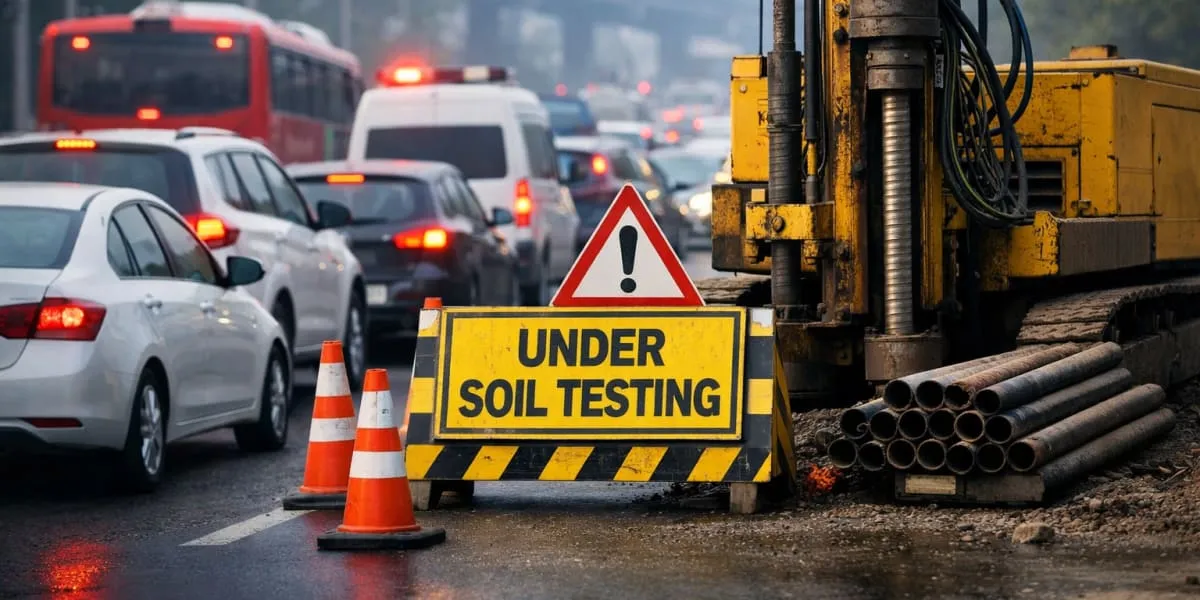
The situation worsened after the commencement of soil testing for the proposed Rs 5.79 billion (Rs 5.79 bn) elevated corridor and eight?lane road project, which has required barricading at key junctions. Works at Jayadev Vihar, Kalinga Hospital, Damana and KIIT Square have further restricted traffic flow and narrowed available lanes at pinch points. Contractors conducting the site surveys have placed safety barriers and equipment close to the carriageway, reducing peak?hour capacity. Roadspace constraints have increased journey times and complicated emergency vehicle movements.

Local residents and daily commuters have urged the government to make the parallel roads operational on a war footing before proceeding further with the elevated corridor scheme, arguing that diversion of traffic would immediately relieve the main road. They have called for interim traffic management measures, clearer signage and regulated works to prioritise free flow during peak periods. City planners and civic agencies have been asked to coordinate to minimise disruption while ensuring that preparatory works progress. The balance between infrastructure delivery and day?to?day mobility remains a critical challenge for Bhubaneswar authorities.

Traffic congestion along the Jayadev Vihar–Nandankanan corridor, one of the busiest stretches in the capital, has reached a breaking point. Thousands of office?goers, IT professionals, students and even ambulances have been held in prolonged gridlock and commuters have reported delays of 40–50 minutes to cover just a few kilometres. The sustained jams have disrupted schedules, delayed services and increased travel stress across North Bhubaneswar. Authorities have acknowledged high levels of congestion during peak hours. The government had earlier planned parallel roads on both sides of the corridor to ease pressure, but delays in administrative clearances, eviction processes and incomplete construction have left those routes non?functional. With the parallel arteries unavailable, virtually all traffic continues to depend on the main carriageway and congestion has intensified during morning and evening peaks. Commuters have described the situation as untenable for daily travel and businesses have flagged productivity losses. Local transport operators have adjusted schedules in response. The situation worsened after the commencement of soil testing for the proposed Rs 5.79 billion (Rs 5.79 bn) elevated corridor and eight?lane road project, which has required barricading at key junctions. Works at Jayadev Vihar, Kalinga Hospital, Damana and KIIT Square have further restricted traffic flow and narrowed available lanes at pinch points. Contractors conducting the site surveys have placed safety barriers and equipment close to the carriageway, reducing peak?hour capacity. Roadspace constraints have increased journey times and complicated emergency vehicle movements. Local residents and daily commuters have urged the government to make the parallel roads operational on a war footing before proceeding further with the elevated corridor scheme, arguing that diversion of traffic would immediately relieve the main road. They have called for interim traffic management measures, clearer signage and regulated works to prioritise free flow during peak periods. City planners and civic agencies have been asked to coordinate to minimise disruption while ensuring that preparatory works progress. The balance between infrastructure delivery and day?to?day mobility remains a critical challenge for Bhubaneswar authorities.

Related Stories

Gold Stories

Next Story
Real Estate

LML Realty Sells Out Jhirka Valley Industrial Park in Haryana

LML Realty, the real estate arm of LML Group, recently announced the complete sell-out of its Jhirka Valley Industrial Park in Haryana, with over 1.17 million sq ft of industrial space acquired by more than 50 companies. With utilities and internal infrastructure in place, the company has commenced plot handovers, enabling buyers to begin construction and establish their operations.The industrial park has attracted companies across diverse sectors, including chemicals, metals and alloys, textiles, electrical equipment, energy, logistics, construction, polymers and engineering. Key buyers inclu..

Next Story
Real Estate

WSB Real Estate Partners Exits Six Housing Investments

WSB Real Estate Partners recently announced the successful exit of six residential investments across Bengaluru, Mumbai Metropolitan Region (MMR) and National Capital Region (NCR), delivering an average internal rate of return (IRR) of 19–21 per cent and an overall investment return of 1.4 times.The real estate-focused investment firm invested approximately Rs 7 billion across six mid-affordable housing projects over the past four years. All six investments were fully repaid between April and November 2026, several months ahead of their original investment tenures.WSB collaborated with sever..

Next Story
Infrastructure Transport

Aluminium Industry Seeks Policy Support for Rs 4 Trillion Investment

The Aluminium Association of India (AAI) has recently urged the government to introduce supportive policy measures to safeguard the sector’s proposed Rs 4 trillion investment pipeline. The association highlighted the need for a predictable policy framework to strengthen domestic manufacturing, expand production capacity and reduce import dependence.AAI submitted its recommendations for the Union Budget 2027-28 to the Ministries of Finance, Commerce and Industry, and Mines, along with the Department for Promotion of Industry and Internal Trade (DPIIT).India’s aluminium demand is projected t..

Advertisement

Subscribe to Our Newsletter

Get daily newsletters around different themes from Construction world.

STAY CONNECTED

Advertisement

SPECIAL OFFER
QR Code