NHAI And National Road Safety Board Strengthen Highway Safety
ROADS & HIGHWAYS

NHAI And National Road Safety Board Strengthen Highway Safety

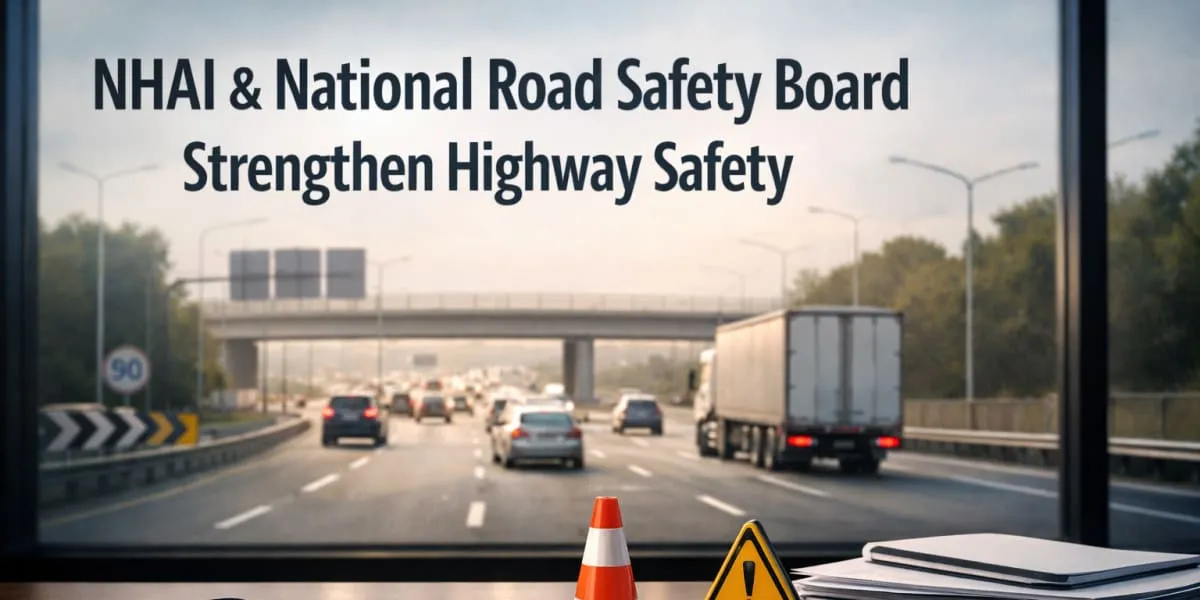
The National Highways Authority of India (NHAI) and the National Road Safety Board (NRSB) met at NHAI headquarters in New Delhi to review safety across the National Highway network and explore measures to reduce accidents. The meeting was attended by NRSB Chairman Dr Nitin R. Gokarn and NHAI Chairman Santosh Kumar Yadav, with members of NRSB, Ministry officials, state administrators and road safety experts. The interaction initiated plans to establish a structured institutional framework for sustained collaboration on governance and safety standards.

NHAI presented an overview of the road safety management system, covering safety performance, institutional arrangements, highway engineering and operations, road safety audits and black spot management. The presentation also addressed speed management, Intelligent Transport Systems and other technology enabled interventions alongside emergency response, post crash care and monitoring and performance management. Citizen engagement, commercial vehicle safety and driver welfare were outlined as priorities alongside key challenges and future focus areas.

Participants reviewed institutional arrangements, engineering practices and operational systems and identified opportunities to strengthen road safety through adoption of a Safe System approach. The approach was framed around strategic areas including risk identification and prevention by safe highway engineering, safe operations, commercial vehicle safety, Intelligent Transport Systems, emergency response and digital safety management with monitoring and decision support. Performance monitoring, governance and institutional accountability were defined as central to a strategic roadmap for National Highway safety.

NHAI and the NRSB will continue engagement through periodic review meetings to address emerging challenges and to strengthen interventions across the network. The meeting included a diagnostic review of the road safety ecosystem with emphasis on technology enabled measures and emergency response mechanisms, and it noted NHAI adoption of Advanced Traffic Management Systems, predictive artificial intelligence solutions and digital mapping of ambulances to improve incident response. The NRSB chairman emphasised identifying the top 10 accident prone locations and strengthening first response capabilities at toll plazas through first aid training for toll personnel, together with closer coordination between NHAI field offices and state administrations.

The National Highways Authority of India (NHAI) and the National Road Safety Board (NRSB) met at NHAI headquarters in New Delhi to review safety across the National Highway network and explore measures to reduce accidents. The meeting was attended by NRSB Chairman Dr Nitin R. Gokarn and NHAI Chairman Santosh Kumar Yadav, with members of NRSB, Ministry officials, state administrators and road safety experts. The interaction initiated plans to establish a structured institutional framework for sustained collaboration on governance and safety standards. NHAI presented an overview of the road safety management system, covering safety performance, institutional arrangements, highway engineering and operations, road safety audits and black spot management. The presentation also addressed speed management, Intelligent Transport Systems and other technology enabled interventions alongside emergency response, post crash care and monitoring and performance management. Citizen engagement, commercial vehicle safety and driver welfare were outlined as priorities alongside key challenges and future focus areas. Participants reviewed institutional arrangements, engineering practices and operational systems and identified opportunities to strengthen road safety through adoption of a Safe System approach. The approach was framed around strategic areas including risk identification and prevention by safe highway engineering, safe operations, commercial vehicle safety, Intelligent Transport Systems, emergency response and digital safety management with monitoring and decision support. Performance monitoring, governance and institutional accountability were defined as central to a strategic roadmap for National Highway safety. NHAI and the NRSB will continue engagement through periodic review meetings to address emerging challenges and to strengthen interventions across the network. The meeting included a diagnostic review of the road safety ecosystem with emphasis on technology enabled measures and emergency response mechanisms, and it noted NHAI adoption of Advanced Traffic Management Systems, predictive artificial intelligence solutions and digital mapping of ambulances to improve incident response. The NRSB chairman emphasised identifying the top 10 accident prone locations and strengthening first response capabilities at toll plazas through first aid training for toll personnel, together with closer coordination between NHAI field offices and state administrations.

Related Stories

Gold Stories

Next Story
Infrastructure Urban

Bajaj Auto to Raise Monthly Electric 2W Capacity to 80,000 by March

Bajaj Auto plans to raise monthly production capacity for electric two-wheelers to around 80,000 units by the end of March, as demand for its Chetak electric scooter continues to exceed available output. The company currently has capacity for around 60,000 electric two-wheelers a month. Joint Managing Director Rakesh Sharma said production had returned to the existing full capacity after a supply chain disruption affected output. The issue had reduced recent production to around 40,000 units, resulting in a shortfall of 20,000 vehicles despite strong demand. The company expects to remove produ..

Next Story
Infrastructure Transport

India’s Domestic Air Passenger Traffic Falls 6.5% in September

India’s domestic air passenger traffic declined 6.49 per cent month on month to 11.8 mn in September, according to data released by the Directorate General of Civil Aviation (DGCA). IndiGo retained its leading position, carrying nearly two-thirds of domestic passengers, while the Air India Group remained the second-largest operator. IndiGo held a 65.4 per cent market share and transported 7.73 mn passengers during the month. The Air India Group accounted for 26.8 per cent of the market, carrying 3.165 mn passengers, based on data from the aviation regulator. Akasa Air ranked third with a 5.6..

Next Story
Infrastructure Urban

DPIIT Advances Trust-Based Governance Across India

The Department for Promotion of Industry and Internal Trade (DPIIT), under the Ministry of Commerce and Industry, is shifting India’s regulatory approach from permission-based administration to trust-based governance. The reforms seek to reduce business compliance, support startups, attract investment and simplify approvals across the country. According to an official statement, 47,957 compliance requirements have been reduced across Central Ministries and States and Union Territories. Of these, 22,290 have been digitised, 16,141 simplified, 5,255 decriminalised and 4,271 eliminated. The Jan..

Advertisement

Subscribe to Our Newsletter

Get daily newsletters around different themes from Construction world.

STAY CONNECTED

Advertisement

SPECIAL OFFER
QR Code