


Signature Bridge Set For Overhaul
ROADS & HIGHWAYS

Signature Bridge Set For Overhaul

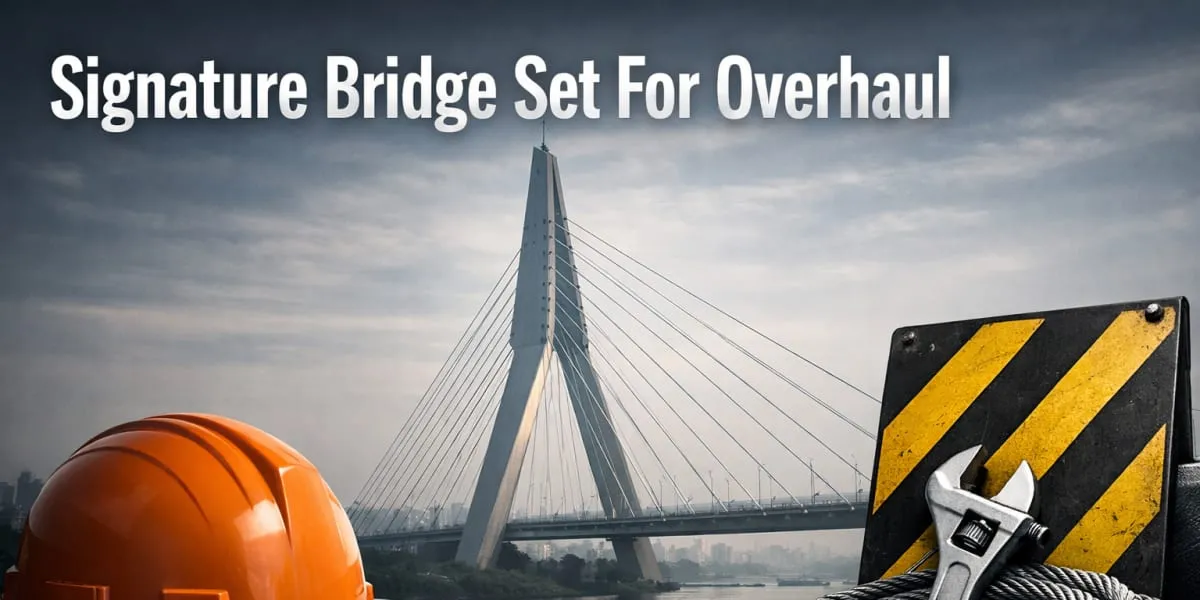
The Delhi government has initiated a comprehensive maintenance and rehabilitation plan for the Signature Bridge after a detailed inspection and condition assessment in July, officials said. The assessment identified several areas requiring immediate preventive action, specialised investigation and planned corrective maintenance to secure the bridge’s long term safety, durability and serviceability. The bridge was handed over to the Public Works Department only a few months ago and the administration has begun addressing maintenance requirements systematically.

Inspectors examined all major components of the cable stayed structure, including the superstructure, foundations, bearings, expansion joints, steel deck, the 154-metre pylon, stay cables, approach structures, skywalk ramp and glass façade, as well as the Bridge Health Monitoring System (BHMS). The assessment found the BHMS largely non functional, with several sensors damaged, missing or operating in passive mode, prompting plans for its restoration. The proposed overhaul will cover temperature, strain, wind, displacement, acceleration, inclination, corrosion, traffic and force sensors, together with a new data acquisition system and a control room setup.

Delhi PWD Minister Parvesh Sahib Singh indicated that the Signature Bridge is one of the city’s most important landmarks and a critical part of the transport network, and that the government’s priority is to ensure every component remains safe and properly maintained. He added that the administration will not allow past gaps in maintenance to become future risks and that work will proceed in a systematic manner. Officials said the programme will combine technical inspections, sensor restoration and targeted civil repairs.

The assessment also identified erosion and deterioration of foundation protection around riverside foundations, which will be addressed through corrective maintenance and specialist engineering works. Restoring the BHMS is expected to provide real time monitoring and enable engineers to detect potential issues well before they pose serious hazards. The ministry has outlined a staged plan that prioritises safety critical elements while scheduling broader rehabilitation to preserve the structure’s long term serviceability.

The Delhi government has initiated a comprehensive maintenance and rehabilitation plan for the Signature Bridge after a detailed inspection and condition assessment in July, officials said. The assessment identified several areas requiring immediate preventive action, specialised investigation and planned corrective maintenance to secure the bridge’s long term safety, durability and serviceability. The bridge was handed over to the Public Works Department only a few months ago and the administration has begun addressing maintenance requirements systematically. Inspectors examined all major components of the cable stayed structure, including the superstructure, foundations, bearings, expansion joints, steel deck, the 154-metre pylon, stay cables, approach structures, skywalk ramp and glass façade, as well as the Bridge Health Monitoring System (BHMS). The assessment found the BHMS largely non functional, with several sensors damaged, missing or operating in passive mode, prompting plans for its restoration. The proposed overhaul will cover temperature, strain, wind, displacement, acceleration, inclination, corrosion, traffic and force sensors, together with a new data acquisition system and a control room setup. Delhi PWD Minister Parvesh Sahib Singh indicated that the Signature Bridge is one of the city’s most important landmarks and a critical part of the transport network, and that the government’s priority is to ensure every component remains safe and properly maintained. He added that the administration will not allow past gaps in maintenance to become future risks and that work will proceed in a systematic manner. Officials said the programme will combine technical inspections, sensor restoration and targeted civil repairs. The assessment also identified erosion and deterioration of foundation protection around riverside foundations, which will be addressed through corrective maintenance and specialist engineering works. Restoring the BHMS is expected to provide real time monitoring and enable engineers to detect potential issues well before they pose serious hazards. The ministry has outlined a staged plan that prioritises safety critical elements while scheduling broader rehabilitation to preserve the structure’s long term serviceability.

Related Stories

Gold Stories
Next Story
Infrastructure Urban

Bajaj Auto to Raise Monthly Electric 2W Capacity to 80,000 by March

Bajaj Auto plans to raise monthly production capacity for electric two-wheelers to around 80,000 units by the end of March, as demand for its Chetak electric scooter continues to exceed available output. The company currently has capacity for around 60,000 electric two-wheelers a month. Joint Managing Director Rakesh Sharma said production had returned to the existing full capacity after a supply chain disruption affected output. The issue had reduced recent production to around 40,000 units, resulting in a shortfall of 20,000 vehicles despite strong demand. The company expects to remove produ..

Next Story
Infrastructure Transport

India’s Domestic Air Passenger Traffic Falls 6.5% in September

India’s domestic air passenger traffic declined 6.49 per cent month on month to 11.8 mn in September, according to data released by the Directorate General of Civil Aviation (DGCA). IndiGo retained its leading position, carrying nearly two-thirds of domestic passengers, while the Air India Group remained the second-largest operator. IndiGo held a 65.4 per cent market share and transported 7.73 mn passengers during the month. The Air India Group accounted for 26.8 per cent of the market, carrying 3.165 mn passengers, based on data from the aviation regulator. Akasa Air ranked third with a 5.6..

Next Story
Infrastructure Urban

DPIIT Advances Trust-Based Governance Across India

The Department for Promotion of Industry and Internal Trade (DPIIT), under the Ministry of Commerce and Industry, is shifting India’s regulatory approach from permission-based administration to trust-based governance. The reforms seek to reduce business compliance, support startups, attract investment and simplify approvals across the country. According to an official statement, 47,957 compliance requirements have been reduced across Central Ministries and States and Union Territories. Of these, 22,290 have been digitised, 16,141 simplified, 5,255 decriminalised and 4,271 eliminated. The Jan..

Advertisement

Subscribe to Our Newsletter

Get daily newsletters around different themes from Construction world.

STAY CONNECTED

Advertisement

SPECIAL OFFER
QR Code