In comprehensive investigations and weathering tests conducted over the years, iron oxide pigments have demonstrated their suitability for use in various concrete construction materials. Their use in new concrete formulations, however, requires knowledge of construction chemistry and of the interactions between the various constituents of formulations, including the pigments used. With increasing application of new concrete technologies, the relevant influencing factors of pigments are also coming into focus,” says Oliver Fleschentraeger, Technical Service for Construction Materials in the LANXESS Inorganic Pigments Business Area, who gives insights into current projects.
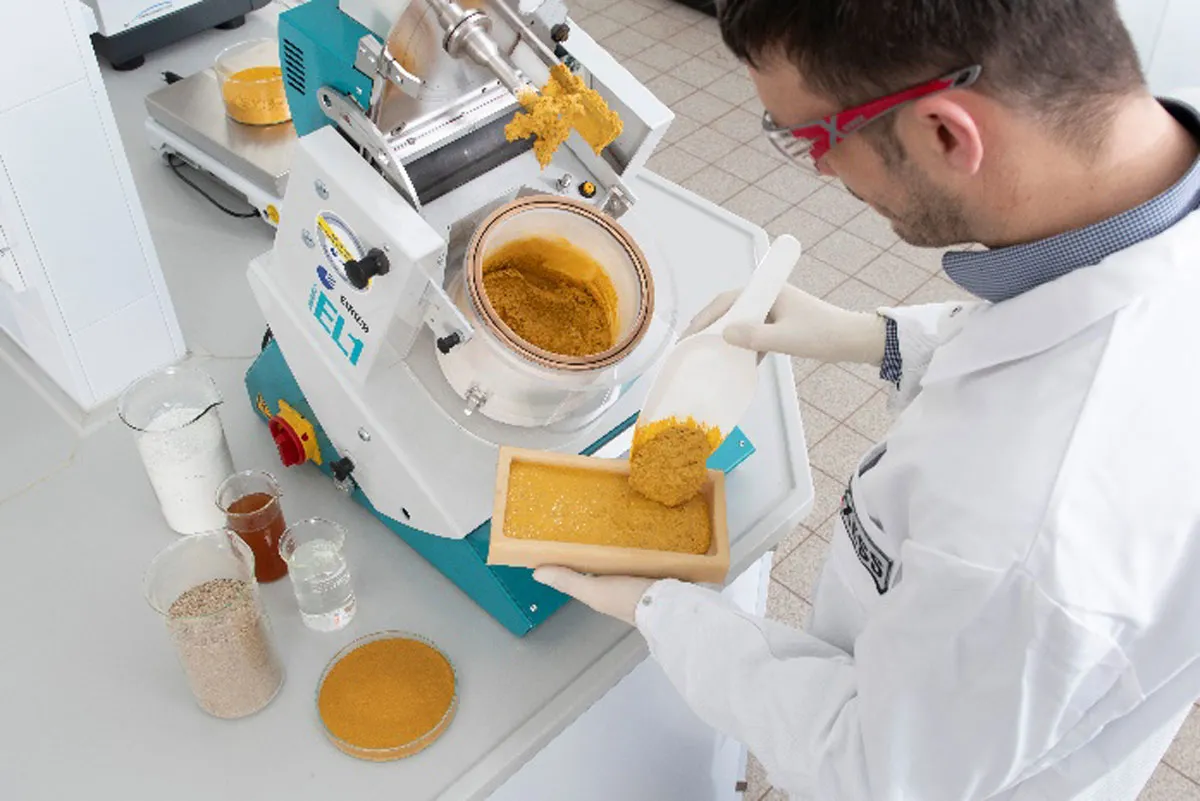
For this reason, colour experts at LANXESS proactively accompany the development of new concrete technologies, with a view to the use and processing of iron oxide pigments in close collaboration with customers, manufacturers of additives and universities. In their work they are supported by an application- engineering construction material laboratory and by a technical center for pigment applications. These facilities enable comprehensive testing and analysis of physical pigment properties and their influence on concrete-specific properties.
Homogenous coloring for self-compacting concretes
Self-compacting concrete (SCC) is the material of choice for manufacturing construction elements with highly complex reinforcement – or wherever especially stringent requirements apply for the visual appearance of concrete surfaces and for their haptics. Outstanding flowability and the accompanying self-ventilation of SCC play a decisive role here. These characteristics ensure that SCC surfaces – given proper processing and correct formulation – satisfy the strictest demands of the desired architectural concrete class. They are free of pores and are homogenous. “Some of our customers, however, have experienced cases in which coloration with inorganic pigments is associated with nonhomogeneous coloration,” reports Oliver Fleschentraeger, Technical Service for Construction Materials in the LANXESS Inorganic Pigments Business Unit.
After intensive testing, LANXESS experts determined that the reason for this problem was the use of the plasticizer polycarboxylate ether (PCE). To ensure satisfactory flow characteristics of SCC, it is necessary to adjust the concrete mix of standard formulas. Plasticizers are absolutely necessary to achieve the specified enhancement of concrete-rheological properties. Polycarboxylate ether is frequently used today in such cases. Plasticizers reduce inner friction forces and ensure, when appropriately dosed, the desired properties. But LANXESS experts discovered that the more PCE and water are added to the concrete mix, the greater the problems with pigment coloring. Use of PCE strongly influences the homogenous distribution of iron oxide pigments in the cement paste. This arises from the ettringite phases that are partly enriched on the surface, which lead in turn to massive color deviations.
After comprehensive laboratory analyses, the pigment experts at LANXESS, in collaboration with external institutes, have found a way to optimise SCC formulas and to enable uniform colouring.
Geopolymers instead of cement – a challenge for color pigments
Another example of an ongoing research project at LANXESS is the use of cement-reduced clinker, which can be generated by means of alternative binders. These binders enable less CO2- intensive production than is possible with conventional cement. Possible alternatives include, in addition to the already known alkali-activated materials, the group of geopolymers, to which metakaolin and clay belong. Fleschentraeger explains the problem statement as follows: metakaolin, as well as clay, is a fine material, and the geopolymers produced from it vary as a result of processing with iron oxide pigments. The difference: alkali-activated materials such as granulated blast-furnace slag and ashes are characterized by their pozzolanic properties. These are properties that possess classic CSH reactions (calcium silicate hydrate phases) known to exist in concrete. Owing to their electric potential, the iron oxide pigments can durably bind themselves to the CSH phases that form.
The geopolymers, in contrast, in a kind of condensation reaction, form a network-like structure without charge potential. This results in a negative effect with regard to the durable bond formed by the iron oxide pigment in the concrete. The pigments are then only sterically retarded in the neutral network of the geopolymer reaction and accordingly possess no durable fixation in the concrete. As part of a study, pigment specialists from LANXESS, in collaboration with partners from industry and external institutes, are currently working on a solution for this problem.
Additive production in the concrete industry – 3D print in color
Additive production in the concrete industry – 3D print in color Likewise, color is also becoming a key issue in the relatively young field of 3D-printed concrete applications. “Currently, gray is the predominant color. Well-founded experience on the influence of iron oxide pigments within the context of this process technology is often lacking,” says Fleschentraeger. This is because, in the field of additive production, complex concrete formulations are often used with new additives. Here, too, the following applies: iron oxide pigments, due to their physical and chemical properties, interact with the system.
In a joint project with researchers of TU Dresden, LANXESS is currently investigating the general suitability of its iron oxide pigments for application in layer-to-layer printing processes. The focus of the first, and now completed, research phase was on evaluation of general concrete-specific technological aspects, as well as on properties specifically required for 3D concretes such as flow behavior, curing, compressive strength and setting. TU Dresden performed testing, with commonly used 3D concrete formulations for high resolution 3D printing and for 3D printing with concrete in accordance with DIN specifications. Testing took place with red pigments that LANXESS manufactures by the Laux process developed in-house. “Within the scope of joint research collaboration, these red pigments, due to their colour constancy, color development and homogeneity, demonstrated that they were especially well-suited for production of 3D printable concrete,” reported Fleschentraeger.