+
Bamboo Bio Ethanol Plant In Assam To Be Fully Operational In March
OIL & GAS

Bamboo Bio Ethanol Plant In Assam To Be Fully Operational In March

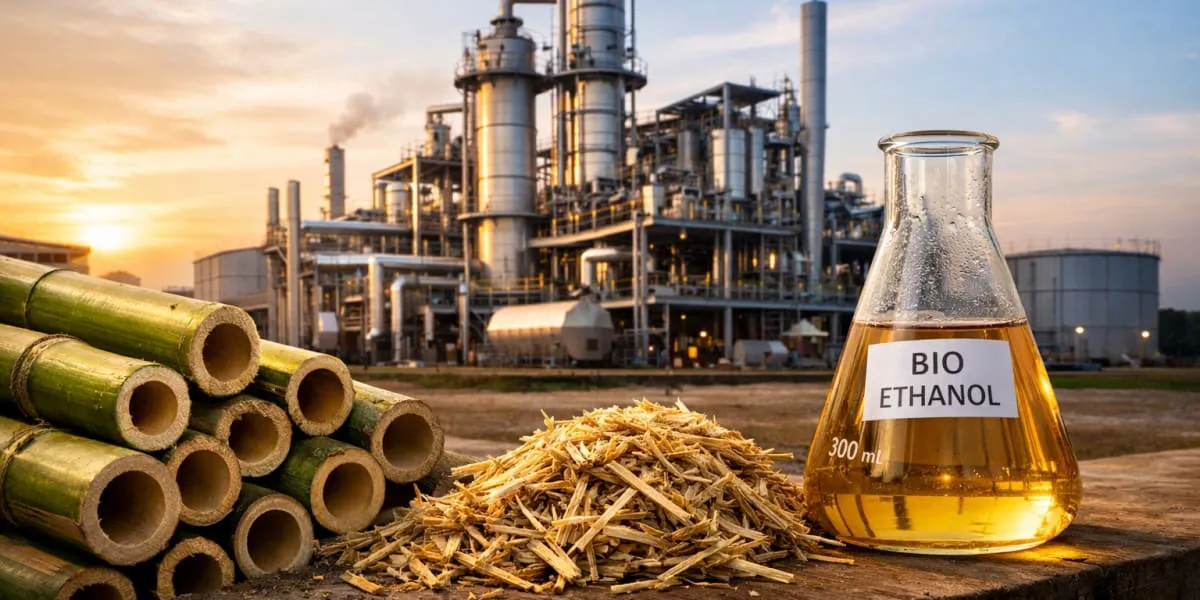
The second generation (2G) bamboo based bio ethanol plant at Numaligarh in Golaghat district of Assam is set to become fully operational in March. The facility, described by partners as the world's first 2G bamboo based unit, will produce ethanol from non food farm waste and residue rather than edible crops. It will convert bamboo chips into fermentable sugars and then process those sugars through fermentation and distillation to yield fuel grade ethanol. The plant is intended to supply ethanol for blending and to reduce pressure on food stocks.

A senior official of Assam Bio Ethanol Private Limited (ABEPL) said that trial production had yielded fuel grade ethanol with 99.7 per cent purity on September three, 2025 and that the first consignment had been supplied to Numaligarh Refinery Limited (NRL) on September nine, 2025. The official noted that the plant had been inaugurated by the prime minister on September 14, 2025 and that full commercial operations would begin within two weeks. The company was reported to be preparing for sustained production and quality assurance at full capacity.

Assam Bio Ethanol Private Limited is a joint venture of Numaligarh Refinery Limited, a Navaratna public sector undertaking, and Finnish firms Chempolis and Fortum. The project was established on the basis of research and trial work carried out by the Finland based partners who provided technology and process design for bamboo conversion. The use of bamboo chips as feedstock demonstrates an alternative value chain and points to potential for scaling second generation ethanol production using non food biomass.

Observers noted that second generation ethanol from non food resources offers an environmentally friendly option that can lower greenhouse gas emissions compared with fossil fuels and reduce competition with edible crops. Local sourcing of bamboo is expected to create economic opportunities in collection and preprocessing and to support employment in the region while supplying ethanol to refinery networks. Industry contacts said that the move to full capacity operation would mark a milestone for biofuel deployment in India and could encourage further investment in similar units.

The second generation (2G) bamboo based bio ethanol plant at Numaligarh in Golaghat district of Assam is set to become fully operational in March. The facility, described by partners as the world's first 2G bamboo based unit, will produce ethanol from non food farm waste and residue rather than edible crops. It will convert bamboo chips into fermentable sugars and then process those sugars through fermentation and distillation to yield fuel grade ethanol. The plant is intended to supply ethanol for blending and to reduce pressure on food stocks. A senior official of Assam Bio Ethanol Private Limited (ABEPL) said that trial production had yielded fuel grade ethanol with 99.7 per cent purity on September three, 2025 and that the first consignment had been supplied to Numaligarh Refinery Limited (NRL) on September nine, 2025. The official noted that the plant had been inaugurated by the prime minister on September 14, 2025 and that full commercial operations would begin within two weeks. The company was reported to be preparing for sustained production and quality assurance at full capacity. Assam Bio Ethanol Private Limited is a joint venture of Numaligarh Refinery Limited, a Navaratna public sector undertaking, and Finnish firms Chempolis and Fortum. The project was established on the basis of research and trial work carried out by the Finland based partners who provided technology and process design for bamboo conversion. The use of bamboo chips as feedstock demonstrates an alternative value chain and points to potential for scaling second generation ethanol production using non food biomass. Observers noted that second generation ethanol from non food resources offers an environmentally friendly option that can lower greenhouse gas emissions compared with fossil fuels and reduce competition with edible crops. Local sourcing of bamboo is expected to create economic opportunities in collection and preprocessing and to support employment in the region while supplying ethanol to refinery networks. Industry contacts said that the move to full capacity operation would mark a milestone for biofuel deployment in India and could encourage further investment in similar units.

Next Story
Real Estate

Supreme Court Clears NBCC to Complete 16 Stalled Supertech Projects

In a significant relief to thousands of homebuyers, the Supreme Court of India has upheld the order of the National Company Law Appellate Tribunal (NCLAT) directing NBCC to complete 16 stalled residential projects of debt-ridden Supertech Ltd.The apex court, in its final order delivered on February 5, 2026, restrained all courts and tribunals from passing any directions that could stall or obstruct the execution of the NBCC-led completion plan. The decision impacts nearly 51,000 homebuyers who have been awaiting possession of their flats for over a decade.Years of delaySupertech launched and p..

Next Story
Infrastructure Urban

Telecom Underpins India's AI Revolution, MoS Says

At the India AI Impact Summit, the Minister of State for Communications and Rural Development said that telecom infrastructure constitutes the foundational layer of the country's artificial intelligence ecosystem and described connectivity as a form of sovereignty. He argued that inclusive digital connectivity is central to India's technological leadership and the empowerment of citizens. The address framed telecom as essential not merely for communication but for enabling AI-driven opportunities across sectors. He noted that broadband subscribers rose from 60 million (60 mn) in 2014 to one bi..

Next Story
Infrastructure Urban

India and Ireland Deepen Digital and Telecom Cooperation

India and Ireland held a bilateral meeting in New Delhi in which the Union Minister for Communications, Jyotiraditya Scindia, led the Indian delegation and Jack Chambers led the Irish delegation. The meeting at Sanchar Bhawan sought to deepen cooperation in telecommunications, digital infrastructure, emerging technologies and regulatory collaboration. Senior officials from the Department of Telecommunications and Ireland's Commission for Communications Regulation attended to chart a roadmap for future networks. Both sides noted complementarities between India's scale and rapid deployment capab..

Advertisement

Subscribe to Our Newsletter

Get daily newsletters around different themes from Construction world.

STAY CONNECTED

Advertisement

Advertisement

Advertisement

Open In App