Battery PLI Scheme Develops 1.4 GWh Capacity Against 50 GWh Target
POWER & RENEWABLE ENERGY

Battery PLI Scheme Develops 1.4 GWh Capacity Against 50 GWh Target

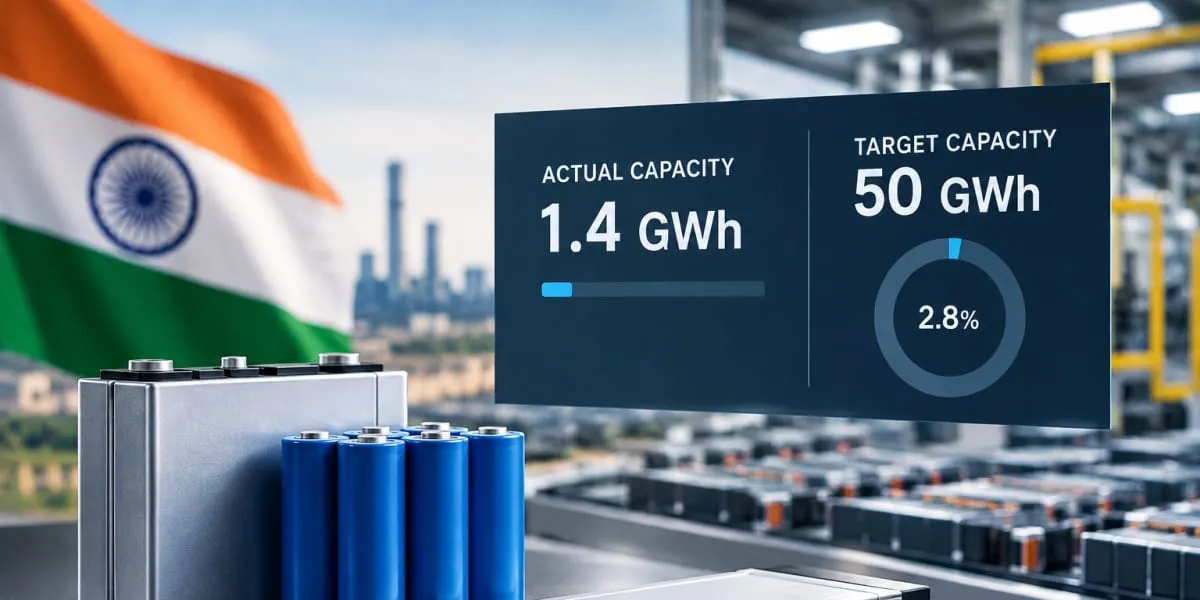
India’s Production Linked Incentive (PLI) scheme for Advanced Chemistry Cell (ACC) batteries has developed only 1.4 gigawatt-hours (GWh) of manufacturing capacity against its 50 GWh target, with commercial production yet to begin, according to a report by NITI Aayog and IIM Ahmedabad. The assessment said the Rs. 181 bn scheme had progressed slowly because of technological limitations, import dependence and delays in establishing manufacturing facilities.

The scheme is intended to create domestic manufacturing capacity for advanced batteries used in electric vehicles and energy storage systems. It also seeks to reduce India’s dependence on imported battery technologies. Cumulative investment under the scheme reached Rs. 45.7 bn by March 2026, while employment generation stood at 1,245.

No incentive disbursements have been reported because commercial production has not commenced. NITI Aayog said India’s limited capabilities in advanced battery manufacturing had sustained dependence on foreign technology and expertise, while the absence of a developed domestic supply chain had made it difficult for manufacturers to meet localisation requirements.

Critical components, including cathodes, anodes and minerals such as lithium and cobalt, remain key supply-chain constraints. Beneficiary companies are required to achieve at least 25 per cent domestic value addition by the end of the second year and 60 per cent by the fifth year, requirements the report considered difficult under current manufacturing conditions.

The assessment attributed weak execution to limited capacity addition, the lack of incentive payments and slower growth in electric vehicle demand, which had reduced the pace of investment. It also said one beneficiary company had been disqualified for suppressing material facts. Despite the delays, the report maintained a positive long-term outlook, noting that advanced battery investments require substantial time before resulting in production and measurable impact.

India’s Production Linked Incentive (PLI) scheme for Advanced Chemistry Cell (ACC) batteries has developed only 1.4 gigawatt-hours (GWh) of manufacturing capacity against its 50 GWh target, with commercial production yet to begin, according to a report by NITI Aayog and IIM Ahmedabad. The assessment said the Rs. 181 bn scheme had progressed slowly because of technological limitations, import dependence and delays in establishing manufacturing facilities. The scheme is intended to create domestic manufacturing capacity for advanced batteries used in electric vehicles and energy storage systems. It also seeks to reduce India’s dependence on imported battery technologies. Cumulative investment under the scheme reached Rs. 45.7 bn by March 2026, while employment generation stood at 1,245. No incentive disbursements have been reported because commercial production has not commenced. NITI Aayog said India’s limited capabilities in advanced battery manufacturing had sustained dependence on foreign technology and expertise, while the absence of a developed domestic supply chain had made it difficult for manufacturers to meet localisation requirements. Critical components, including cathodes, anodes and minerals such as lithium and cobalt, remain key supply-chain constraints. Beneficiary companies are required to achieve at least 25 per cent domestic value addition by the end of the second year and 60 per cent by the fifth year, requirements the report considered difficult under current manufacturing conditions. The assessment attributed weak execution to limited capacity addition, the lack of incentive payments and slower growth in electric vehicle demand, which had reduced the pace of investment. It also said one beneficiary company had been disqualified for suppressing material facts. Despite the delays, the report maintained a positive long-term outlook, noting that advanced battery investments require substantial time before resulting in production and measurable impact.

Related Stories

Gold Stories

Next Story
Technology

Motherson to Bring Global Technologies to India to Drive Growth

Samvardhana Motherson International (SAMIL) plans to use technologies acquired through its global expansion to pursue opportunities in India’s automotive market, where improving product standards and stricter emission norms are increasing demand for advanced solutions. The company’s strategy forms part of its Vision 2030 ambition to achieve USD 108 bn in topline gross revenue by 2029-30. Pankaj Mital, whole-time director and president, and Gandharv Tongia, group chief financial officer, said the company intended to bring technologies from its international portfolio to India. They said ris..

Next Story
Infrastructure Transport

GMR Group to Develop 500-Acre Aviation Hub in Andhra Pradesh

GMR Group is developing an aviation city and a 500-acre aviation and aerospace ecosystem in Andhra Pradesh, Chairman G M Rao said at the Confederation of Indian Industry Partnership Summit. The project will be developed alongside airport infrastructure and is intended to create a broader aviation-focused economic hub in the state. Rao said airports had become new engines of economic growth as commercial activity evolved from ports and railway stations towards urban centres and, increasingly, airports. He described the airport as a platform around which new businesses, services and supporting i..

Next Story
Building Material

Cement Companies May See Earnings Recovery in Q3 FY27

Cement companies may record an earnings recovery in the third quarter of FY27 as recent price increases and a seasonal revival in demand support operating performance, although cost inflation and new capacity could restrict the improvement, according to a research report by Dolat Capital. The brokerage estimates that earnings before interest, tax, depreciation and amortisation (EBITDA) per tonne will rise by Rs. 135, or 16.2 per cent, sequentially in Q3 FY27. The improvement is expected to be supported by a 2.1 per cent increase in blended realisations and a 0.3 per cent decline in operating e..

Advertisement

Subscribe to Our Newsletter

Get daily newsletters around different themes from Construction world.

STAY CONNECTED

Advertisement

SPECIAL OFFER
QR Code