Delhi To Offer Free Three Kilowatt Rooftop Solar To 0.23 Million
POWER & RENEWABLE ENERGY

Delhi To Offer Free Three Kilowatt Rooftop Solar To 0.23 Million

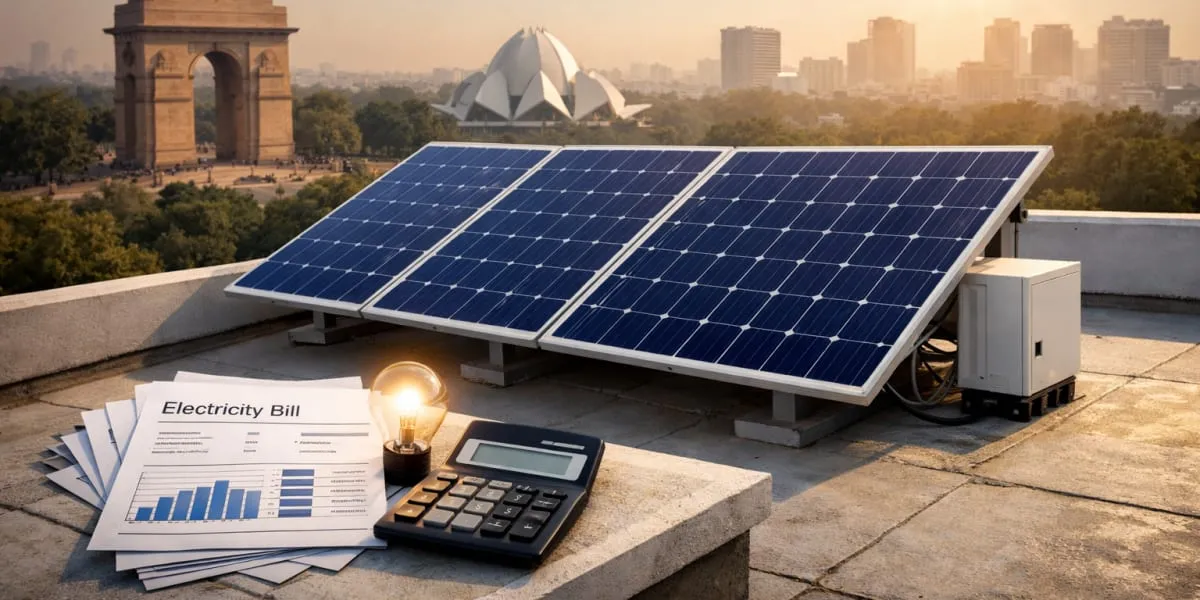
The Delhi government has set a target to distribute free three kilowatt (kW) rooftop solar panels to 0.23 million (0.23 mn) households with monthly electricity consumption of up to 400 units by March 2027, the chief minister said after the Cabinet approved a revised Delhi Solar Policy. The policy directs that eligible domestic consumers will be provided rooftop solar systems of up to three kW at zero upfront cost, subject to technical feasibility. The move is intended to reduce electricity bills and lower upfront barriers to installation.

The government plans to install systems on 0.23 mn rooftops and add 500 MW of rooftop capacity by March 2027. The Delhi administration will provide a capital subsidy of Rs 78,000 alongside an equal Central subsidy, with a top-up to cover any gap with the tendered cost. Financial assistance will be paid as a one-time generation-based incentive rather than in instalments, and existing electricity subsidies will continue for eligible consumers.

Households will benefit from both the subsidy and savings generated by rooftop systems. A three kW system can generate around 300 units, enabling families to meet needs or export surplus to the grid. Payment for exported electricity will be made at the average power purchase cost of the distribution company. Consumers with consumption of up to 200 units will continue to receive the existing 100 per cent electricity subsidy and may also earn incentives against saved electricity.

The policy removes upfront installation costs, with vendors required to operate and maintain systems free of charge for five years, after which consumers may opt for maintenance and insurance via distribution companies. The net metering process has been accelerated from around 75 days to 25 days, and application and registration fees for systems up to 10 kW have been waived. Implementation will follow a utility-led aggregation model in which Indraprastha Power Generation Company Limited will select vendors via competitive bidding and handle installation, coordination and grievance redressal.

The Delhi government has set a target to distribute free three kilowatt (kW) rooftop solar panels to 0.23 million (0.23 mn) households with monthly electricity consumption of up to 400 units by March 2027, the chief minister said after the Cabinet approved a revised Delhi Solar Policy. The policy directs that eligible domestic consumers will be provided rooftop solar systems of up to three kW at zero upfront cost, subject to technical feasibility. The move is intended to reduce electricity bills and lower upfront barriers to installation. The government plans to install systems on 0.23 mn rooftops and add 500 MW of rooftop capacity by March 2027. The Delhi administration will provide a capital subsidy of Rs 78,000 alongside an equal Central subsidy, with a top-up to cover any gap with the tendered cost. Financial assistance will be paid as a one-time generation-based incentive rather than in instalments, and existing electricity subsidies will continue for eligible consumers. Households will benefit from both the subsidy and savings generated by rooftop systems. A three kW system can generate around 300 units, enabling families to meet needs or export surplus to the grid. Payment for exported electricity will be made at the average power purchase cost of the distribution company. Consumers with consumption of up to 200 units will continue to receive the existing 100 per cent electricity subsidy and may also earn incentives against saved electricity. The policy removes upfront installation costs, with vendors required to operate and maintain systems free of charge for five years, after which consumers may opt for maintenance and insurance via distribution companies. The net metering process has been accelerated from around 75 days to 25 days, and application and registration fees for systems up to 10 kW have been waived. Implementation will follow a utility-led aggregation model in which Indraprastha Power Generation Company Limited will select vendors via competitive bidding and handle installation, coordination and grievance redressal.

Related Stories

Gold Stories

Next Story
Real Estate

LML Realty Sells Out Jhirka Valley Industrial Park in Haryana

LML Realty, the real estate arm of LML Group, recently announced the complete sell-out of its Jhirka Valley Industrial Park in Haryana, with over 1.17 million sq ft of industrial space acquired by more than 50 companies. With utilities and internal infrastructure in place, the company has commenced plot handovers, enabling buyers to begin construction and establish their operations.The industrial park has attracted companies across diverse sectors, including chemicals, metals and alloys, textiles, electrical equipment, energy, logistics, construction, polymers and engineering. Key buyers inclu..

Next Story
Real Estate

WSB Real Estate Partners Exits Six Housing Investments

WSB Real Estate Partners recently announced the successful exit of six residential investments across Bengaluru, Mumbai Metropolitan Region (MMR) and National Capital Region (NCR), delivering an average internal rate of return (IRR) of 19–21 per cent and an overall investment return of 1.4 times.The real estate-focused investment firm invested approximately Rs 7 billion across six mid-affordable housing projects over the past four years. All six investments were fully repaid between April and November 2026, several months ahead of their original investment tenures.WSB collaborated with sever..

Next Story
Infrastructure Transport

Aluminium Industry Seeks Policy Support for Rs 4 Trillion Investment

The Aluminium Association of India (AAI) has recently urged the government to introduce supportive policy measures to safeguard the sector’s proposed Rs 4 trillion investment pipeline. The association highlighted the need for a predictable policy framework to strengthen domestic manufacturing, expand production capacity and reduce import dependence.AAI submitted its recommendations for the Union Budget 2027-28 to the Ministries of Finance, Commerce and Industry, and Mines, along with the Department for Promotion of Industry and Internal Trade (DPIIT).India’s aluminium demand is projected t..

Advertisement

Subscribe to Our Newsletter

Get daily newsletters around different themes from Construction world.

STAY CONNECTED

Advertisement

SPECIAL OFFER
QR Code