India Re-elected as ISA President for Third Consecutive Term
POWER & RENEWABLE ENERGY

India Re-elected as ISA President for Third Consecutive Term

India has been re-elected as President of the International Solar Alliance (ISA) for a third consecutive term at the alliance’s ninth session, held during the Bharat Renewable Energy Summit 2026 in New Delhi, New and Renewable Energy Minister Pralhad Joshi said on Tuesday.

France was re-elected as co-President of the ISA. Joshi congratulated France and thanked member countries for continuing to place their confidence in India’s leadership. He said the alliance’s latest session reaffirmed the importance of ensuring that the benefits of progress are shared widely.

Joshi reiterated India’s commitment to advancing international solar cooperation under the vision of Power to Empower and the principle of One Sun, One World, One Grid. India and France co-founded the ISA in 2015, and the alliance has since grown to include 130 signatory and member countries, becoming an important platform for cooperation, particularly among countries in the Global South.

The Bharat Renewable Energy Summit and Expo 2026 was inaugurated by Prime Minister Narendra Modi on 2 November and will conclude on 5 November. Discussions at the event are focused on translating solar commitments into investments, partnerships into projects and broader ambitions into measurable impact.

Joshi highlighted financing initiatives including the $200 mn Africa Solar Facility and India’s commitment of about Rs. 2.25 bn to expand affordable solar access. The $300 mn Nigeria Distributed Renewable Energy Fund was cited as a scalable model. ISA-supported projects in Fiji, Madagascar, Comoros and Seychelles are supplying power to healthcare facilities, schools, clean water systems and agricultural cold storage. Solar and storage opportunities for Small Island Developing States are being developed, beginning with Mauritius.

The minister also outlined plans to empower 3 mn farmers through solar energy and agri-photovoltaics, drawing on India’s PM-KUSUM scheme. The model is being adapted for other member countries, especially in Africa. Capacity-building initiatives include 17 Solar Technology Application Resource Centres, the Global Capability Centre–SHINE and an artificial intelligence-enabled ISA Academy.

India has been re-elected as President of the International Solar Alliance (ISA) for a third consecutive term at the alliance’s ninth session, held during the Bharat Renewable Energy Summit 2026 in New Delhi, New and Renewable Energy Minister Pralhad Joshi said on Tuesday. France was re-elected as co-President of the ISA. Joshi congratulated France and thanked member countries for continuing to place their confidence in India’s leadership. He said the alliance’s latest session reaffirmed the importance of ensuring that the benefits of progress are shared widely. Joshi reiterated India’s commitment to advancing international solar cooperation under the vision of Power to Empower and the principle of One Sun, One World, One Grid. India and France co-founded the ISA in 2015, and the alliance has since grown to include 130 signatory and member countries, becoming an important platform for cooperation, particularly among countries in the Global South. The Bharat Renewable Energy Summit and Expo 2026 was inaugurated by Prime Minister Narendra Modi on 2 November and will conclude on 5 November. Discussions at the event are focused on translating solar commitments into investments, partnerships into projects and broader ambitions into measurable impact. Joshi highlighted financing initiatives including the $200 mn Africa Solar Facility and India’s commitment of about Rs. 2.25 bn to expand affordable solar access. The $300 mn Nigeria Distributed Renewable Energy Fund was cited as a scalable model. ISA-supported projects in Fiji, Madagascar, Comoros and Seychelles are supplying power to healthcare facilities, schools, clean water systems and agricultural cold storage. Solar and storage opportunities for Small Island Developing States are being developed, beginning with Mauritius. The minister also outlined plans to empower 3 mn farmers through solar energy and agri-photovoltaics, drawing on India’s PM-KUSUM scheme. The model is being adapted for other member countries, especially in Africa. Capacity-building initiatives include 17 Solar Technology Application Resource Centres, the Global Capability Centre–SHINE and an artificial intelligence-enabled ISA Academy.

Related Stories

Gold Stories

Next Story
Real Estate

IGBC Green Building Congress 2026 advances India’s net-zero agenda

The Indian Green Building Council (IGBC), part of the Confederation of Indian Industry (CII), opened the 24th edition of the Green Building Congress 2026 at the Jio World Convention Centre, Mumbai, with a focus on accelerating India's green and net-zero building movement. The three-day event, being held from 26 to 28 November, brought together policymakers, industry leaders and sustainability experts to discuss green buildings, climate-resilient infrastructure and sustainable communities.A key highlight of the inaugural session was the launch of five pilot rating systems: Green Retail, DigiBui..
Next Story
Real Estate

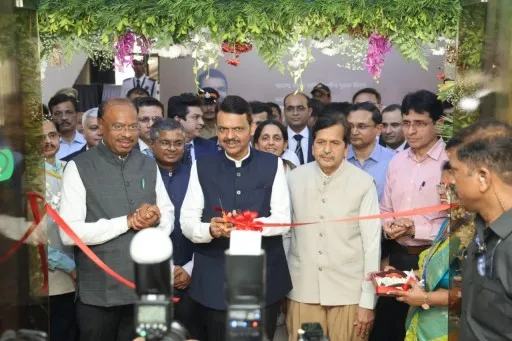
Maharashtra CM inaugurates fifth Model Sub-Registrar Office in Mumbai

Maharashtra Chief Minister Devendra Fadnavis has inaugurated a Model Sub-Registrar Office (SRO) in Lower Parel, Mumbai, taking the number of such centres launched in the state to five. The initiative aims to modernise property registration services through technology-enabled infrastructure and citizen-centric processes.Developed by the Government of Maharashtra in association with VFS Global and WE Excel Software, the Lower Parel centre follows the launch of Model SROs in Pune, Bandra Kurla Complex in Mumbai, Navi Mumbai and Nagpur.The centres provide facilities for registering property-relate..

Next Story
Infrastructure Transport

NHBF hails Indian Army aircraft operations on Amritsar–Jamnagar corridor

The National Highways Builders Federation (NHBF) has welcomed the successful landing and take-off of four Indian Army microlight aircraft on the Amritsar–Jamnagar Economic Corridor (NH-754K) in Gujarat. The exercise demonstrated the potential of highway infrastructure to support defence operations and emergency response. The expressway was developed by CDS Infra Projects, an NHBF member company.Developed under the Bharatmala Pariyojana, the six-lane greenfield corridor is described as India's second-longest expressway. The operation was conducted by the Indian Army's Team Mountain Eagles as ..

Subscribe to Our Newsletter

Get daily newsletters around different themes from Construction world.

STAY CONNECTED

Advertisement

SPECIAL OFFER
QR Code