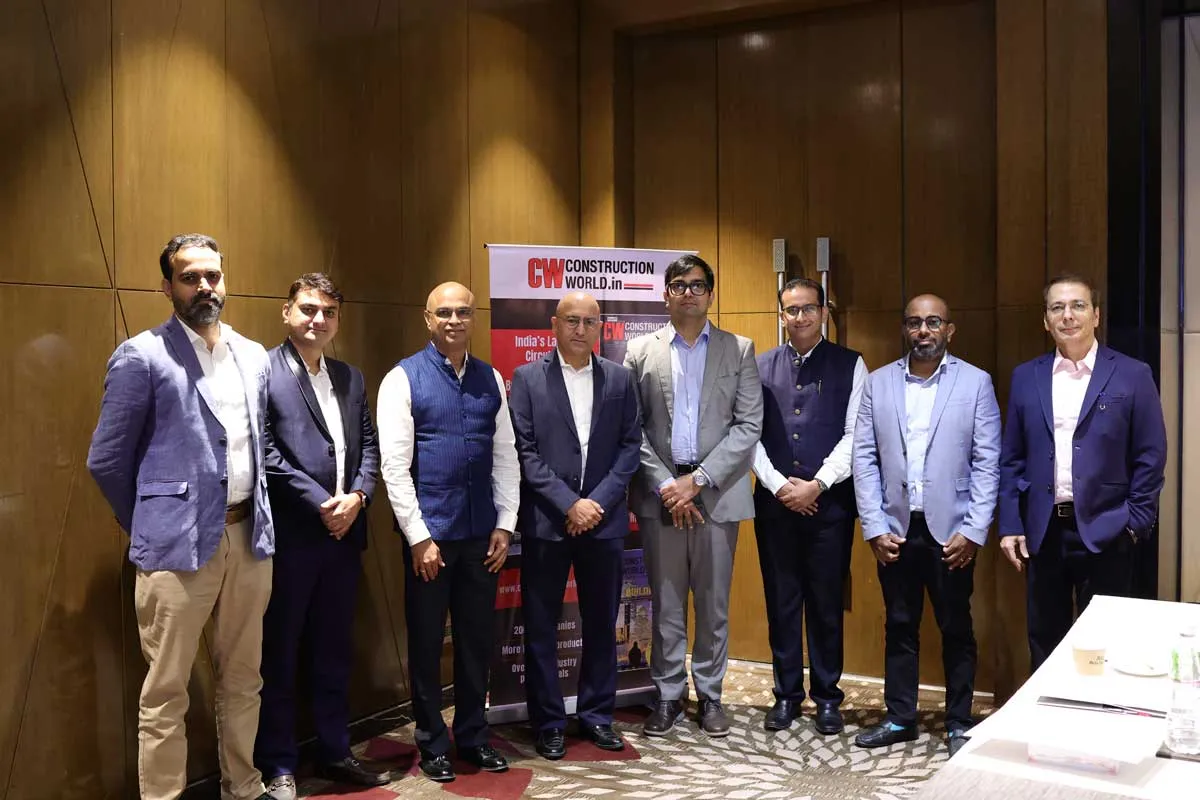
The First Construction Council (FCC), in association with CW magazine and supported by Autodesk as the Presenting Partner, recently convened an exclusive CXO roundtable titled “Building Faster, Cleaner and More Profitably: The Growth Playbook for Construction Leaders.”Held as part of a multi-city dialogue series spanning Mumbai, Bengaluru and Delhi, the roundtable brought together senior industry leaders to deliberate on the challenges and opportunities shaping India's construction and real-estate sectors.The discussion witnessed participation from Vinayak Pai, Managing Director & CEO, Tata Projects; Vinod Rohira, Managing Director and CEO - Commercial Real Estate, K Raheja Corp; Dr Santosh Sundararajan, Group Chief Executive Officer, Vascon Engineers; Dr Sanjay Vaghamshi, Vice President, Isprava Group; Phani Prasad Mandalaparthy, Practice Leader and Associate Director - Transport, Logistics and Mobility, CRISIL; Nikhil Bagalkotkar, Director - Technical Sales, Autodesk; and Shubham Mukherjee, Country Sales Manager – ACS, India & SAARC, Autodesk.Setting the context for the discussion, FCC Founder and President Pratap Padode highlighted India's unique position as one of the world's fastest-growing economies while underlining the need for the industry to embrace disruptive technologies, improve productivity and prepare for the country's demographic transition.Growth vs. profitability: The new balancing actParticipants observed that while project scale and order books continue to expand, profitability remains under pressure owing to rising input costs, labour shortages, execution complexities and increasing stakeholder expectations.Mandalaparthy noted that organisational size measured in terms of square footage or revenue does not necessarily translate into profitability. As projects become larger and more complex, even seemingly minor inefficiencies – such as delayed approvals, change requests or poor information flow – can significantly erode margins.The discussion highlighted that future growth must be supported by stronger project controls, better capital allocation, integrated planning and technology-led decision-making to ensure sustainable profitability.Labour shortages the biggest constraintLabour availability and productivity emerged as the most pressing concern across the construction ecosystem. Participants noted that while capital availability has improved significantly over the years, securing and retaining skilled labour continues to remain a major challenge.Pai emphasised that the industry's approach towards labour welfare requires a fundamental shift. “If we have to attract and retain people, we have to upgrade their lives,” he said. “We need to provide better living conditions, training opportunities, recreation facilities and, most important, treat labour with dignity and respect.” Sharing Tata Projects’ initiatives, Pai spoke about integrated labour camps equipped with improved amenities, family accommodation, skill development programmes and structured career progression pathways aimed at enhancing worker retention and productivity.Echoing similar sentiments, Rohira observed that labour availability and productivity are now among the biggest determinants of project success. “The biggest spoilers in the room today are the cost and availability of labour,” he noted. “As a country, we will have to move towards greater dependence on technology and faster methods of construction if we are to maintain growth momentum.”Participants agreed that merely complying with labour regulations is no longer sufficient and that organisations must go beyond statutory requirements by investing in worker welfare, education, healthcare and living conditions.Managing cost volatility through smarter contracting and procurementThe panel also deliberated upon the impact of inflation, supply chain disruptions and input cost volatility on project margins.Dr Sundararajan pointed out that while fluctuations in steel and cement prices remain important, labour costs and productivity losses arising from project delays now represent a much larger concern. “Design is not merely about optimising steel or cement quantities,” he said. “It is equally about optimising labour and constructability because labour cost has become one of the most significant cost components in construction today.” Dr Sundararajan advocated design-and-build contracting models, arguing that they provide contractors greater flexibility to optimise engineering, improve constructability and mitigate cost pressures.From the luxury housing segment, Dr Vaghamshi shared that Isprava Group is increasingly adopting predictive procurement strategies and strengthening long-term vendor partnerships. “We are moving away from project-level transactions and building strategic relationships with vendors,” he explained. “This allows us to leverage economies of scale and absorb a portion of the cost volatility.”Participants also highlighted the importance of localisation of sourcing, early procurement planning and stronger collaboration between developers and contractors to protect project margins.Tackling operational leakages through better planningParticipants unanimously agreed that some of the most significant margin leakages occur owing to design changes, delayed decision-making, fragmented workflows and inadequate project controls.Dr Sundararajan observed that many project delays originate long before construction begins. “The biggest reasons for delays stem right at the top – from changing client requirements, delayed decisions and incomplete design development,” he remarked. “By the time these issues reach site, the cost implications become substantial.”The panellists laid stress upon the importance of early-stage planning, constructability reviews and integrated delivery models involving developers, consultants and contractors from project inception.Bagalkotkar noted that organisations adopting BIM-led constructability reviews are able to identify risks much earlier, thereby significantly reducing rework and schedule overruns.BIM and connected construction gain momentumIndeed, technology adoption emerged as a key theme during the discussions, with industry leaders acknowledging the transformative role of BIM, connected construction platforms, digital twins and AI.Bagalkotkar noted that organisations that use BIM merely as a visualisation tool fail to unlock its full value. “The real benefits emerge when BIM is used as a constructability and decision-making platform,” he pointed out. “Organisations that move critical decisions earlier into the design cycle are seeing significant improvements in productivity, reduced rework and better project outcomes.”According to Bagalkotkar, early-stage coordination and clash detection can substantially reduce material wastage and prevent costly onsite rework.Building on this perspective, Mukherjee emphasised upon the need to eliminate information silos across stakeholders. “Connected construction enables all stakeholders – from consultants and planners to contractors and site teams – to access real-time information on a common platform,” he observed. “This significantly improves collaboration, transparency and decision-making.”Mukherjee further noted that AI-enabled platforms are increasingly helping teams derive actionable insights from project data, thereby accelerating decision-making and improving operational efficiency.Industrialised construction needs policy pushThe discussion also explored the potential of industrialised construction methods such as precast, modular construction and prefabrication. While participants acknowledged the productivity and quality advantages offered by these approaches, they also pointed to several barriers limiting widespread adoption in India, including logistics constraints, cost considerations, fragmented project requirements and regulatory challenges.Rohira observed that complete standardisation remains difficult in residential developments owing to customer preferences, design differentiation and market-specific requirements. Meanwhile, Dr Sundararajan highlighted the need for stronger integration between architects, consultants and contractors from the earliest stages of project planning.Participants agreed that large-scale adoption of industrialised construction would require policy support, standardisation frameworks and a concerted push from both public and private-sector stakeholders.Looking beyond construction towards lifecycle valueThe roundtable concluded with a discussion on lifecycle asset management and the growing role of digital twins in enhancing operational efficiency.Mandalaparthy, who moderated the discussion, observed that project success should no longer be measured solely in terms of construction scale or revenue, but also in terms of profitability, operational efficiency and lifecycle performance.Participants agreed that digital handover, data-driven facility management and intelligent asset monitoring would increasingly become differentiators in the future. Summing up the deliberations, the participants unanimously agreed that India's construction sector stands at an inflection point. While challenges relating to labour shortages, cost pressures and productivity persist, technology adoption, integrated project delivery models and collaborative ecosystems offer a clear roadmap towards building faster, cleaner and more profitably.The insights from this and subsequent city roundtables will culminate in a comprehensive industry white paper to be unveiled at the Construction Technology Summit later this year.Key takeawaysLabour availability and productivity continue to be the industry's biggest constraints, necessitating greater investment in workforce welfare, skill development and retention.The sector must move beyond compliance and adopt a people-first approach to labour management.Design-and-build models, early-stage planning and constructability reviews are critical to improving project profitability.Operational leakages arising from fragmented workflows, delayed decisions and design changes remain significant margin eroders.BIM adoption is evolving from visualisation to a strategic decision-making and constructability platform.Connected construction platforms can eliminate information silos and improve collaboration across stakeholders.AI is expected to significantly improve design automation, project coordination and data-driven decision-making.Wider adoption of precast and industrialised construction will require policy support, standardisation and ecosystem readiness.Lifecycle thinking, digital twins and data-driven facility management will increasingly define long-term asset value.Collaboration among developers, contractors, consultants, technology providers and policymakers will be essential to building a faster, leaner and more profitable construction ecosystem.