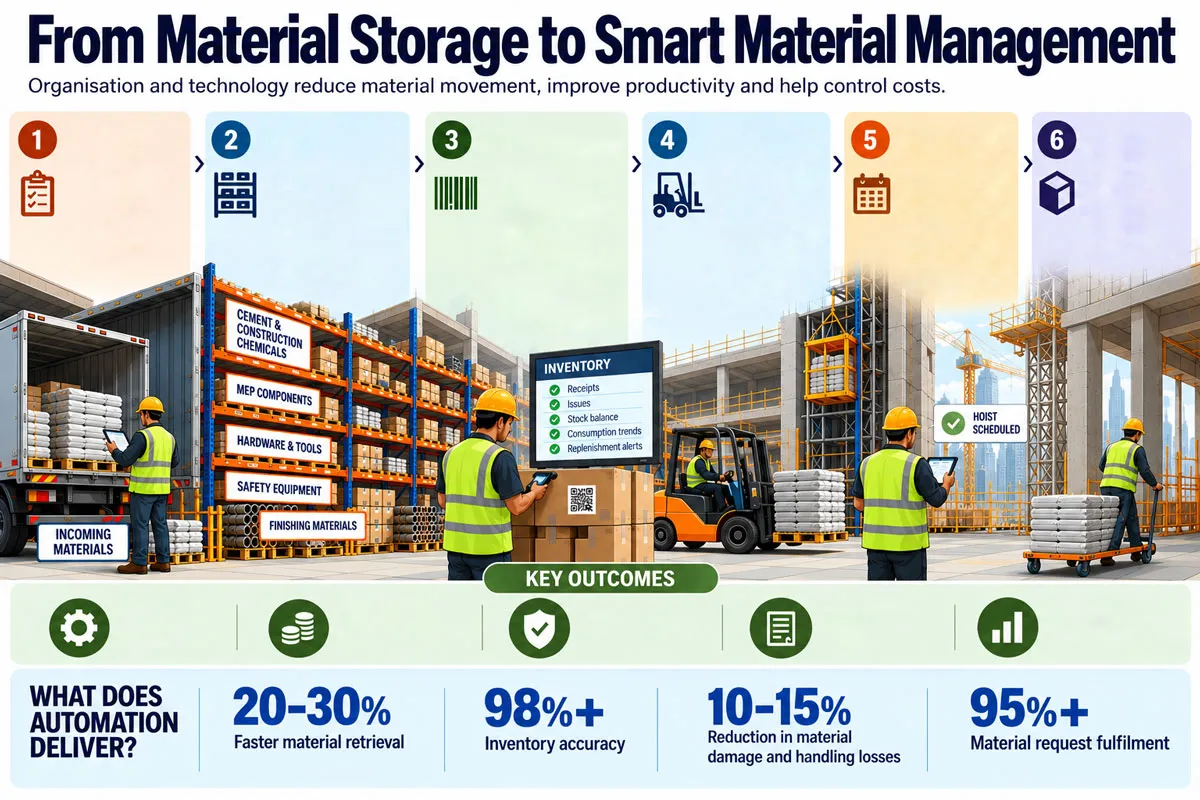
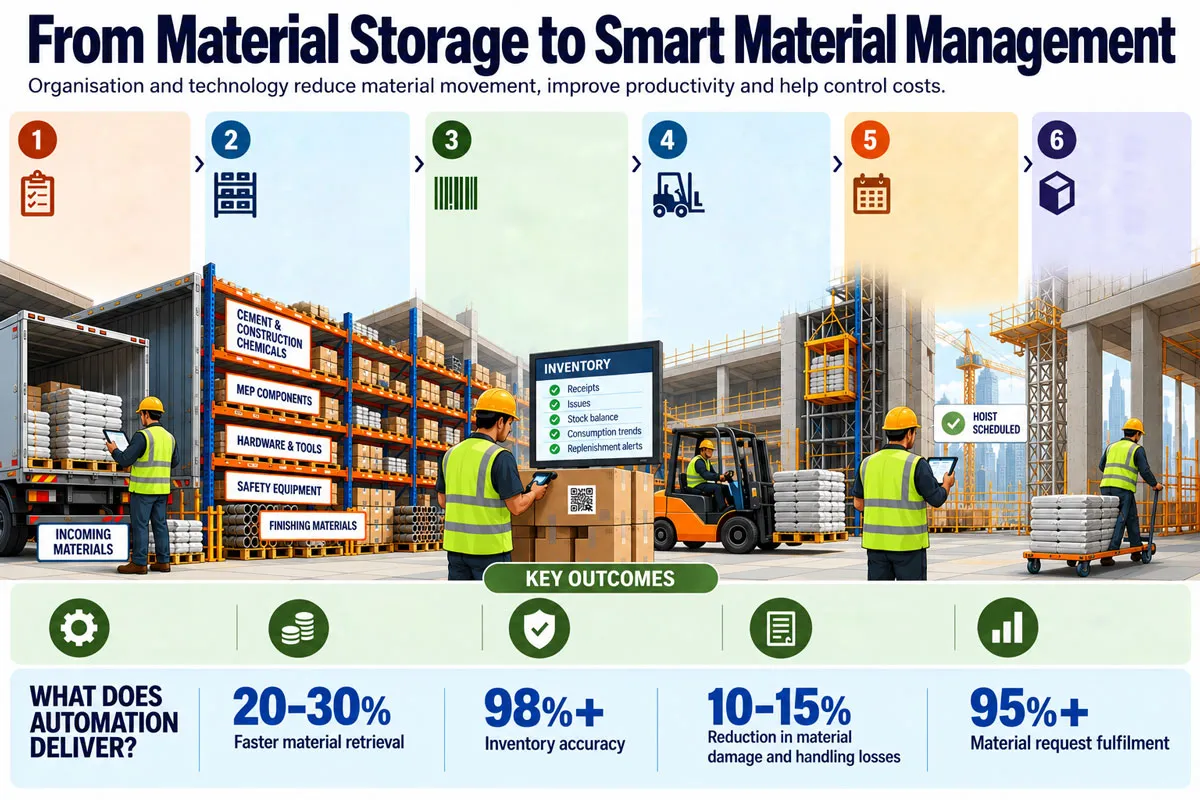
On high-rise sites in Mumbai, until a few years ago, the common material handling solution was manpower and the repeated relocation of material until it finally reached the floor where it was to be installed.Cut to today. “Now, we are adopting automation in material handling, not to replace people but to reduce unnecessary movement, improve planning, and use people and equipment more efficiently,” says Raahul Maroo, Founder & Managing Director, Tat:vm Builders and Developers.For instance, vertical movement by means of a hoist can be made more efficient by digital scheduling and sharing that information with stakeholders. “The hoist does not need to move faster,” he points out. “It needs to spend less time waiting.”For that, the material needs to be quickly retrievable from the onsite store, or reach just in time for its use.CW explores how material handling technologies and automation have made inroads in construction stores.End-to-end deploymentConcorde’s long-term objective is to transform construction project stores from conventional storage and issue facilities into digitally enabled material-management centres, with the objective of improving productivity, minimising manual handling and strengthening inventory control, shares Ajaz Ahmed, Chief Operating Officer.Within Concorde’s construction project store that accommodates a wide range of materials, including cement and construction chemicals; reinforcement accessories; mechanical, electrical, and plumbing components; hardware; tools; consumables; safety equipment; and finishing materials; storage areas are organised based on material characteristics, frequency of usage, handling requirements and project priorities. In Clancy Global’s dedicated store rooms for mechanical, electrical, plumbing, and fire services materials, discipline, project requirement, specification and stage of installation define the categorisation. Proper tagging, documentation and segregation help ensure traceability, reduce material damage, and enable project teams to quickly identify and retrieve the required materials.Sheth Realty systematically arranges construction material based on category, usage frequency, and project requirements to ensure easy identification and retrieval. Proper stacking, labelling and designated storage areas help minimise material damage and improve inventory control. Inward, outward and balance records ensure the availability of critical materials and timely issues.At Concorde, dedicated zones handle material receipt, inspection, storage, high-value materials, material issue, returns and rejected materials. Optimising storage space, minimising unnecessary material movement, and ensuring that materials are readily accessible are key objectives.“We streamline material movement through suitable handling equipment, including fork lifts, material trolleys, wherever applicable, which also reduces repetitive manual lifting,” says Ahmed. “We organise storage locations using material classification and consumption patterns, with frequently used items positioned closer to issue counters to reduce retrieval time, congestion during peak material-issue periods and unnecessary movement, and improve accessibility.”For example, fast-moving electrical consumables and plumbing accessories can be stored in clearly identified bins near the dispatch area, while bulky and infrequently used materials are placed in designated storage zones.Digital inventory management enables better traceability of materials and helps identify stock discrepancies, monitor consumption trends, and support timely replenishment. For this, Ahmed says, electronic material requisitions and ERP-integrated inventory records have been implemented.“Material tracking technology (QR codes, barcodes and RFID tags) is particularly relevant for expensive finishing materials, façade components, MEP equipment and sanitaryware, where loss, damage or incorrect movement can become costly,” points out Maroo. Safety is embedded into Concorde’s store operations through designated movement paths, safe stacking practices, material segregation, controlled access and systematic housekeeping. Mechanised handling and defined storage locations also help improve safety.Benefits deliveredDeploying technology solutions in material handling delivers a host of benefits. “At Sheth Realty, the progressive adoption of digital and technology-enabled systems has helped improve store productivity, safety, and operational control,” says Maulik Sheth, Managing Director.A digital inventory record helps Sheth Realty’s teams track material receipts, issues, balances and movement, reducing manual errors and improving visibility of stock. Material identification through systematic labelling and location coding help faster retrievals. Deploying electrified material-handling equipment wherever practical has reduced manual handling and improved workplace safety. Standardised storage layouts, access control and periodic inventory reconciliation help improve retrieval efficiency, reduce material-search time and add strength to overall store management.“In deliveries, technology is making just-in-time delivery increasingly practical, saving valuable working space, repeated shifting and exposure to damage and loss,” says Maroo.Essentially, technology is helping the construction site move away from being a warehouse to becoming becomes more of an installation and assembly point.Small lifting equipment, motorised carts, conveyors and other mechanised systems can increasingly take over repetitive labour movement so as to use manpower for productive work. “A mason should spend more time building rather than moving blocks,” says Maroo. “Use people for skill. Use machines for movement.”Cost mattersFor a Mumbai realty project, a shorter construction cycle can mean earlier completion, earlier possession or monetisation, lower site overheads and better utilisation of capital. Add improved labour productivity, lower material damage, reduced pilferage, less rehandling and better use of cranes and hoists, and the additional cost of automation begins to get rationalised very quickly. From the perspective of procurement, Clancy Global doesn’t treat automation as a single equipment purchase but views it as a combination of digital inventory systems, barcode/QR identification, software integration, material-handling equipment and process training. Digital inventory systems, in turn, include computerised inventory records, material coding, purchase-order tracking, delivery documentation and project-wise material reconciliation. Barcode/QR-based identification further improves the traceability and retrieval efficiency of extra low voltage products. Electrically operated handling equipment, wherever appropriate, reduces manual handling and improves safety. For a typical project environment, Firoj Kumar Jena, CEO, Clancy Global, says the initial investment can range from a few lakh rupees for digital inventory and identification systems to substantially higher levels where automated handling, advanced tracking and integrated warehouse systems are introduced. “Typically, the investment varies on the project size, store capacity and level of automation adopted.”Additionally, “since bringing down material costs rests a lot on unnecessary movement or duplication, Clancy Global uses digital drawings, BIM models and coordinated material schedules to understand requirements before procurement.”At the Tat:vm Group, automation is seen not as a standalone technology expense but as a percentage of the overall construction cost. Depending on the scale, complexity and level of end-to-end automation required at the site office and across the construction cycle, Maroo says, “The investment can typically be in the range of 0.3 per cent to 0.6 per cent of the project construction cost.”Concorde spends Rs 1.5 lakh to Rs 2.5 lakh per built unit (apartment) on automation solutions and evaluates the effectiveness of material-handling initiatives through clearly defined key performance indicators (KPIs), which Ahmed lists as 20-30 per cent faster material retrieval, 98 per cent or higher inventory accuracy, 20 per cent faster material issue turnaround time, 10-15 per cent less material damage and handling losses, 95 per cent or higher material request fulfilment, and 100 per cent compliance with prescribed safety procedures.Adopting technology in phases based on operational requirements has helped moderate Sheth Realty’s investment in automation and digitalisation. “Automation has cost us approximately Rs 15-20 lakh, with our major costs being on digital inventory management, material identification and tracking systems, electrified material-handling equipment, storage infrastructure and related safety improvements,” says Sheth. “Plan investments within the project’s overall stores and logistics budget; the scale and level of automation determine the outlay,” he advises.Future stepsThe next stage would be to connect all the systems associated with material handling, visualises Maroo. “Imagine a project team looking at one dashboard showing tomorrow’s material deliveries, truck arrival timings, crane requirements, hoist schedules, floor-wise material requirements and available inventory. Much of this information already exists today, but it is often spread across spreadsheets, WhatsApp groups, registers and different contractors.”Ultimately, the real value of automation is not about making every activity hi-tech but planning deliveries better, storing less, tracking material, scheduling movement, mechanising repetitive tasks and ensuring that material reaches the right place at the right time. The future of material handling may be less about moving material faster and more about moving it less.- CHARU BAHRIQuick bytesQR codes, barcodes and RFID can improve material traceability and retrieval.Classifying materials by usage, handling needs and project priorities can reduce retrieval time.Mechanised handling can reduce repetitive manual movement and improve safety.Digital inventory, BIM and coordinated schedules can align procurement with actual site requirements.QuotesMaterial tracking technology is relevant for expensive finishing materials, façade components, MEP equipment and sanitaryware. - Raahul Maroo, Founder & Managing Director, Tat:vm Builders and DevelopersEvaluate the effectiveness of material-handling initiatives through clearly defined key performance indicators. - Ajaz Ahmed, Chief Operating Officer, ConcordePhased technology adoption based on operational needs has helped moderate our automation and digitalisation investments. - Maulik Sheth, Managing Director, Sheth RealtyThe initial investment can range from a few lakh rupees to substantially higher levels. - Firoj Kumar Jena, CEO, Clancy GlobalInfographic contentFrom Material Storage to Smart ManagementOrganisation and technology reduce material movement, improve productivity and help control costs.1. RECEIPT AND INSPECTIONVerify quality and quantity.Tag and record materials.Segregate rejected items.2. ORGANISED STORAGECategorise by material type, usage frequency and project requirements.Designated zones and bins.Frequently used items near issue counters.Proper stacking and labelling.3. DIGITAL INVENTORY MANAGEMENTQR codes, bar codes and RFID tagsElectronic material requisitions.ERP-integrated inventory records.Track receipts, issues and balances.Monitor consumption and plan replenishment4. MECHANISED MATERIAL MOVEMENTForklifts and material trolleys, wherever applicable.Digital hoist scheduling for vertical movement.Reduces repetitive manual lifting.Improves safety and accessibility.5. PLANNING AND COORDINATIONAlign material deliveries with project scheduleShare hoist information with stakeholders.Ensure materials are available just in time.Minimise unnecessary movement. 6. POINT OF INSTALLATIONRight materialRight qualityRight locatio