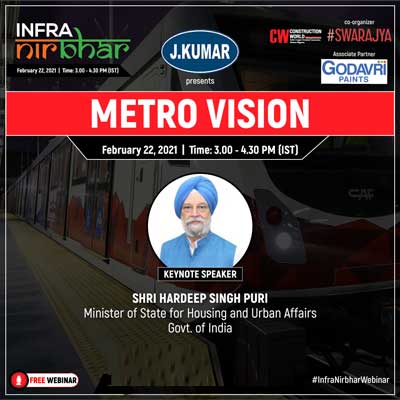
Indian urban centres and cities have become hubs of economic productivity, infrastructure, culture and diversity. They have become the key drivers of economic growth and there is a need to sustainably and inclusively expand them. Given that cities are witnessing an exponential increase in the use of personal motor vehicles, resulting in severe traffic congestion and pollution. “Efforts need to be put in to remedy this situation. There is a need to focus on improving our public transport system including the metro rail system in the most efficient and sustainable ways,” Hardeep Singh Puri, Minister for Housing and Urban Affairs, observed at the webinar on Monday, February 22, titled Metro Vision, the first of the webinar series Infra-Nirbhar, organised jointly by Construction World and Swarajya magazines.
Future metro projects in the pipeline
Puri highlights that till 2014, only about 248 km of the Metro network was operational in five cities. With a consistent push by the government, the metro network has expanded by more than 469 km, and a total of 717 km Metro is operational in 18 cities today and we envision developing the metro system in 50 cities in the years to come.
Adding to this Puri states, “We will achieve 1,000 km of the operational Metro by the 75th year of our independence, that is, 2022 and 1,700 km across 25 cities by 2025. More than 265 km of new metro lines -- 11.5 km in the city of Kochi, 58.2 km in Bengaluru, 118.9 km in Chennai, 43.8 km in Nagpur and 33 km in Nasik at a total cost of rupees Rs 887.91 billion have been included in the budget for 2021-22.” These new metro lines are expected to be made operational in the next six to seven years. Additionally, several initiatives have been taken during the last six years under the Metro Rail policy to develop an inclusive metro system together with multimodal integration and last-mile connectivity.
Additionally, two new metro systems, namely Metro Lite and Metro Neo have also been conceptualised for smaller cities with peak hour peak direction traffic (PHPDT) up to 15,000 and 8,000 respectively. The first Metro Neo system of Nasik, a 33 km network has been included in the 2021-22 Budget. The first Metro Lite is proposed for the Rithala-Narela corridor of the Delhi Metro phase four project. In March 2019, our government approved the first 82 km long RRTS corridor between Delhi, Ghaziabad and Meerut. This corridor is an innovative dual transit mode with RRTS and Metro on the same infrastructure over 22 km in Meerut city.
Aashish Chandorkar (moderator): From Metro Lite and Metro Neo which technology will apply to which city? Do you see any execution risks, for example, in some cases, issues between the centre and the state governments?
Puri: If it were left entirely to the state governments, they would all demand regular metros. The problem is that the metro system is a capital intensive system and one needs to raise finances. Most of these projects have financing from multilateral financial institutions. For example for the Delhi Metro, we had to take a loan from the Japan investment Cooperation Agency (JICA). Additionally, these capital intensive projects need to be economically viable, because then within a stipulated period, you have to pay the loan back. While our politicians, all of us included, are very ambitious and want the best of infrastructure, we shy away from the need to ensure that the project becomes economically viable.
For cities where the peak hour peak direction traffic is 15,000 Metro Lite is suitable and for up to 8,000 peak hours peak direction traffic Metro Neo is suitable. Now, in the case of Metro Lite, the cost per km comes down to about 1.2-1.4 billion per km. In the case of Metro Neo it comes down to 0.6-0.8 billion per km. But while developing these projects one needs to anticipate the likely growth in future as well and plan accordingly.
Coming to the issues between the Centre and state governments, there have been some tensions, but I wouldn't say there are any major disputes. After I became a minister in September 2017, I'm only aware of one case where we had some tension with the state government, which I was able to resolve.
Pratap Padode (moderator): As per the metro policy 2017, we were supposed to have a comprehensive mobility plan and statutory body for the Unified Metropolitan Transport Authority for ensuring an integrated approach in the planning and management of urban transport. So there is a seamless integration of the entire transport system. Somehow until and unless there is a condition in the policy, that unless the Unified Metropolitan Transport Authority is created as a statutory body and adequately staffed no Metro project should be taken up in that state unless we bring that up. I think this seamlessness and integration might become a problem later on. What is your view on that?
Let me give you the facts, Tamil Nadu, Kerala, Madhya Pradesh and Karnataka already have a UMTA and we are insisting on this for every project that we now appraise. But, you know, I think that the overall approach should be to use encouragement. Not the ‘unless you do this’ approach because then it becomes like a chicken and egg. So I think it's a good start, and we are encouraging the others to also have this UMTA as well.
Chandorkar: Is there a plan to extend any production or bring about any other specific programs to further incentivise ‘Make in India’?
Well, the overall philosophy right now is Aatmanirbhar. And I am very happy to tell you that made in India metro lines are being sold in Australia and Canada. We have 760 km of operational Metro in another few years, we'll have another 1,046 but that's not the real story.
The real story is that you are moving into a situation whereby by 2030, you will have 600 million people living in our urban centres and all of them will require urban transport. So this figure of 700 km, I am talking about, we will have to be making 600-700 km every year. These additional metro lines will be the story and will materialise through domestic manufacturing. This will create opportunities for people to manufacture in India. To promote this further we have standardised that minimum local content required for rolling stock is 60%, telecommunications 50%, signalling 50%, civil works 90% for elevated and 80% for underground structural, electrical mechanical 60%. Sixty-four items have been identified to be sourced on Indian soil. So there is a major process of domestic or indigenisation, which is going on and we will encourage that. And the production linked incentive (PLI) scheme will further incentivise the Make In India initiative.For video and full coverage of webinar Metro Vision, click here.