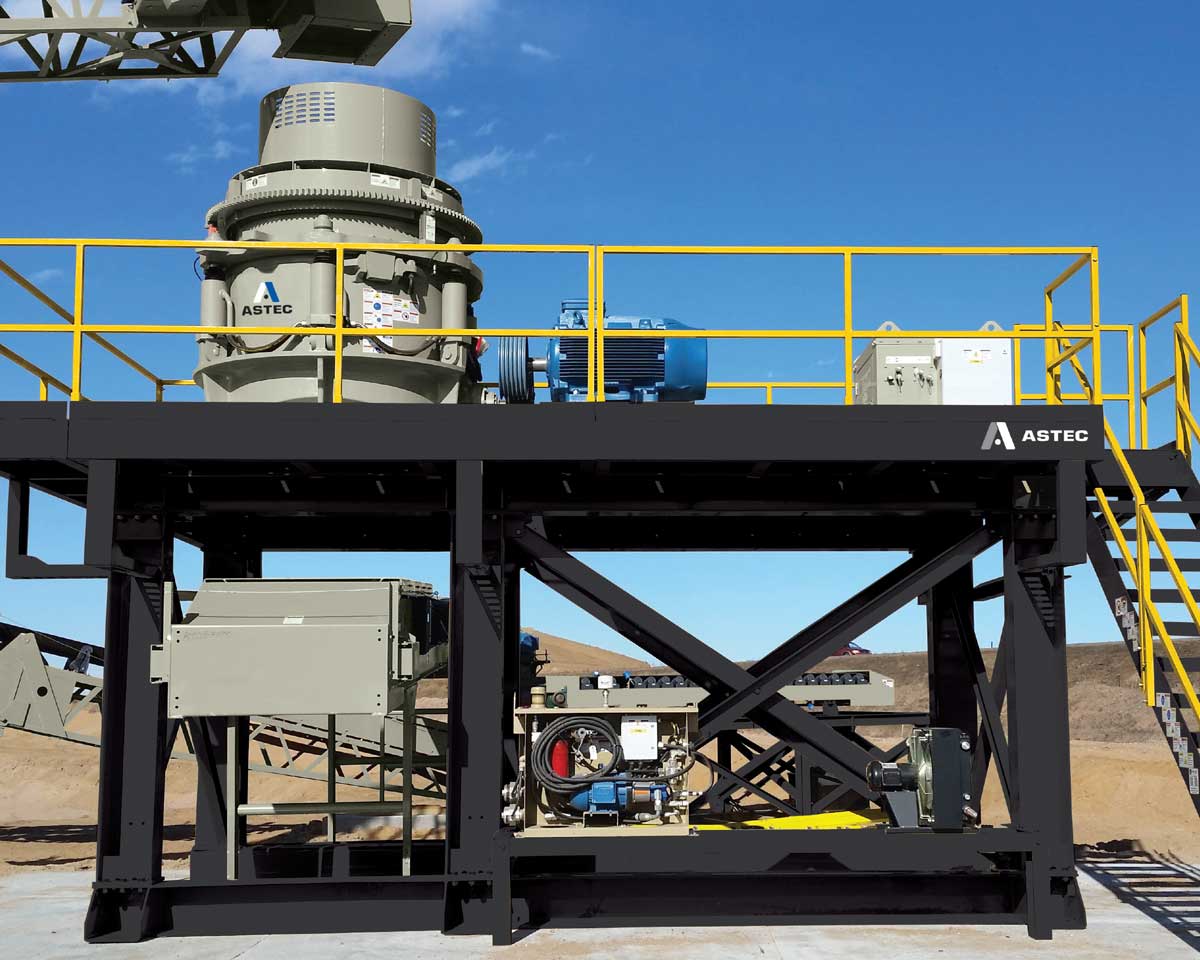
Boosting productivity through crushers and screening equipment
Equipment

Boosting productivity through crushers and screening equipment

The most obvious way to increase the productivity of crushing is to ensure a steady supply of raw material,use the right equipment combination and employ high-performing, well-designed and built, strong, fine-tuned machines.

High productivity is associated with high output and minimal waste, according to Manesh Thomas, Managing Director, Modern Road Products. “Using the right combo is especially vital when you need to crush very hard materials, a very tough job for any machine.”

Certain features of a crusher are amenable to boost operational productivity and reduce operation cost per tonne. Among these, Kiran Jain, Director, Shri Dakshayani M Sand, and Vice President, Karnataka Quarry and Crusher Owners Association, counts the motor size and the number of ports in the rotor design.

In addition, Bobby, Managing Director, Amity Rock Products, recommends “a well-enclosed hydraulic circuit with precision controls to ensure you use just the optimum power and machine capability, and reduce downtime and wear consumption.”

Dr S R Samal, Chairman and MD, Kalinga Commercial Corporation, which uses two sets of Kleemann crushers –jaw + cone + screen (MC110Z + MCO9 + MS 703) – in its iron ore mines in Odisha, suggests looking for a plant with lower fuel consumption, something the Kleeman plant achieves, or with unique features like a continuous feed system that increases production and reduces wear cost.

Plants that are used to produce both sand as well as aggregate must deliver the desired quantities of each to meet the desired productivity level. “At Mathrani Infra, a Puzzolana 200 TPH three-stage crusher is producing 45-50 per cent high-quality manufactured sand and aggregates, delivering over 1,600 tonne output in a single shift,” says Jitendra Mathrani, Director, Mathrani Mining Infrastructure. “The low power consumption makes the plant an economical, value-for-money machine.”

“Productivity implies that the machines are working fine without any shake and without even 1-mm variance,” explains Ravindra Rao, Director, Sai Srinivasa Laxmi Stone Crushers. “Our production is comparable with the industry average. The low cost of Puzzolana spares helps ensure our productivity and profitability. We have crushed upwards of 1.9 million tonne without any major replacements.”

To read the full article, CLICK HERE.

The most obvious way to increase the productivity of crushing is to ensure a steady supply of raw material,use the right equipment combination and employ high-performing, well-designed and built, strong, fine-tuned machines. High productivity is associated with high output and minimal waste, according to Manesh Thomas, Managing Director, Modern Road Products. “Using the right combo is especially vital when you need to crush very hard materials, a very tough job for any machine.” Certain features of a crusher are amenable to boost operational productivity and reduce operation cost per tonne. Among these, Kiran Jain, Director, Shri Dakshayani M Sand, and Vice President, Karnataka Quarry and Crusher Owners Association, counts the motor size and the number of ports in the rotor design. In addition, Bobby, Managing Director, Amity Rock Products, recommends “a well-enclosed hydraulic circuit with precision controls to ensure you use just the optimum power and machine capability, and reduce downtime and wear consumption.” Dr S R Samal, Chairman and MD, Kalinga Commercial Corporation, which uses two sets of Kleemann crushers –jaw + cone + screen (MC110Z + MCO9 + MS 703) – in its iron ore mines in Odisha, suggests looking for a plant with lower fuel consumption, something the Kleeman plant achieves, or with unique features like a continuous feed system that increases production and reduces wear cost. Plants that are used to produce both sand as well as aggregate must deliver the desired quantities of each to meet the desired productivity level. “At Mathrani Infra, a Puzzolana 200 TPH three-stage crusher is producing 45-50 per cent high-quality manufactured sand and aggregates, delivering over 1,600 tonne output in a single shift,” says Jitendra Mathrani, Director, Mathrani Mining Infrastructure. “The low power consumption makes the plant an economical, value-for-money machine.” “Productivity implies that the machines are working fine without any shake and without even 1-mm variance,” explains Ravindra Rao, Director, Sai Srinivasa Laxmi Stone Crushers. “Our production is comparable with the industry average. The low cost of Puzzolana spares helps ensure our productivity and profitability. We have crushed upwards of 1.9 million tonne without any major replacements.”To read the full article, CLICK HERE.

Next Story
Equipment

Schwing Stetter India Unveils New Innovations at Excon 2025

Schwing Stetter India unveiled more than 20 new machines at Excon 2025, marking one of its most significant showcases and introducing several India-first technologies to the construction equipment sector. The company launched the country’s first 56-metre boom pump designed and manufactured in India, the first fully electric truck mixer, the first CNG mixer variant and the first hybrid boom pump. Executives said the launch portfolio was engineered to support India’s move toward faster, greener and more vertically oriented infrastructure through advanced engineering, clean-energy solutions a..

Next Story
Infrastructure Energy

SEPC Resolves Hindustan Copper Dispute, Wins Rs 725 Mn Order

Engineering, procurement and construction firm SEPC Ltd has recently settled a dispute with Hindustan Copper Ltd (HCL) and secured a mining infrastructure order valued at Rs 725 million from the state-owned company. SEPC informed the stock exchanges that it has executed a settlement deed with HCL, bringing closure to all inter-se claims and counterclaims arising from arbitration proceedings. As part of the settlement, SEPC will receive Rs 304.5 million as full and final payment, marking the resolution of all pending disputes between the two entities. The company also stated that Hindustan Co..

Next Story
Infrastructure Energy

20% Ethanol Blending Cuts India’s CO2 Emissions by 73.6 Mn Tonnes

Union Road Transport and Highways Minister Nitin Gadkari recently said that India has reduced carbon dioxide emissions by 73.6 million metric tonnes due to the adoption of 20 per cent ethanol blending in petrol. He made the statement while replying to supplementary questions during the Question Hour in the Lok Sabha. Describing ethanol as a green fuel, the minister said it plays a key role in reducing pollution while also supporting higher incomes for farmers. He underlined that ethanol blending contributes both to environmental sustainability and rural economic growth. Nitin Gadkari also po..

Advertisement

Subscribe to Our Newsletter

Get daily newsletters around different themes from Construction world.

STAY CONNECTED

Advertisement

Advertisement

Advertisement

Advertisement

Open In App