

Two WOLFF Cranes Power Construction of Al-Rajhi Mosque
Equipment

Two WOLFF Cranes Power Construction of Al-Rajhi Mosque

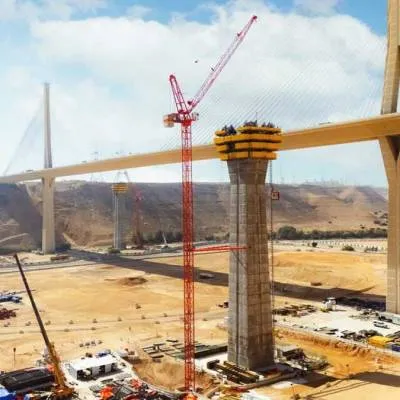
The Sheikh Saleh Al-Rajhi Mosque, a new architectural and spiritual landmark rising along the bustling King Abdullah Road in central Riyadh, is being constructed with the help of two high-performance WOLFF tower cranes. The project, led by contractor Rowad Al Riyadh, involves intricate planning due to its prime location and complex structural requirements.

To meet the demanding site conditions, Rowad Al Riyadh has deployed a WOLFF 6015.8 Clear and a WOLFF 7532.12 Cross. The WOLFF 6015.8 Clear features a hook height of 51 meters, a jib radius of 60 meters, and a maximum lifting capacity of 8 tons, while the WOLFF 7532.12 Cross offers a hook height of 41.6 meters, a 70-meter jib radius, and a 12-ton lifting capacity. Both cranes have been operating on-site since March 2025.

Spanning approximately 10,000 square meters, the mosque’s construction involves lifting large prefabricated façade panels and a complex roof structure, demanding exceptional precision and maximum reach coverage. The site’s proximity to King Abdullah Road and a metro station presents significant logistical challenges, requiring careful coordination and scheduling.

“The region’s high temperatures, dust, and occasional afternoon storms make crane operations highly time-sensitive,” explained Tariq Al-Sawaie, Managing Director, Wolffkran Ltd., Saudi Arabia. “To ensure safety and efficiency, most heavy lifts are conducted during early morning or late afternoon hours when conditions are most stable.”

Both cranes are equipped with anti-collision systems and WOLFF Link technology. The anti-collision system automatically slows or stops crane movement when obstacles or nearby cranes are detected, while WOLFF Link provides real-time activity monitoring and alerts for critical operational conditions.

During the planning phase, the Wolffkran engineering team conducted detailed reach and safety studies, optimizing jib positions and defining safety zones to ensure full site coverage with minimal disruption to surrounding public areas.

With the project scheduled for completion in the fourth quarter of 2026, the WOLFF cranes are playing a vital role in delivering one of Riyadh’s most significant new religious and community landmarks — a symbol of precision engineering and architectural excellence.

The Sheikh Saleh Al-Rajhi Mosque, a new architectural and spiritual landmark rising along the bustling King Abdullah Road in central Riyadh, is being constructed with the help of two high-performance WOLFF tower cranes. The project, led by contractor Rowad Al Riyadh, involves intricate planning due to its prime location and complex structural requirements.To meet the demanding site conditions, Rowad Al Riyadh has deployed a WOLFF 6015.8 Clear and a WOLFF 7532.12 Cross. The WOLFF 6015.8 Clear features a hook height of 51 meters, a jib radius of 60 meters, and a maximum lifting capacity of 8 tons, while the WOLFF 7532.12 Cross offers a hook height of 41.6 meters, a 70-meter jib radius, and a 12-ton lifting capacity. Both cranes have been operating on-site since March 2025.Spanning approximately 10,000 square meters, the mosque’s construction involves lifting large prefabricated façade panels and a complex roof structure, demanding exceptional precision and maximum reach coverage. The site’s proximity to King Abdullah Road and a metro station presents significant logistical challenges, requiring careful coordination and scheduling.“The region’s high temperatures, dust, and occasional afternoon storms make crane operations highly time-sensitive,” explained Tariq Al-Sawaie, Managing Director, Wolffkran Ltd., Saudi Arabia. “To ensure safety and efficiency, most heavy lifts are conducted during early morning or late afternoon hours when conditions are most stable.”Both cranes are equipped with anti-collision systems and WOLFF Link technology. The anti-collision system automatically slows or stops crane movement when obstacles or nearby cranes are detected, while WOLFF Link provides real-time activity monitoring and alerts for critical operational conditions.During the planning phase, the Wolffkran engineering team conducted detailed reach and safety studies, optimizing jib positions and defining safety zones to ensure full site coverage with minimal disruption to surrounding public areas.With the project scheduled for completion in the fourth quarter of 2026, the WOLFF cranes are playing a vital role in delivering one of Riyadh’s most significant new religious and community landmarks — a symbol of precision engineering and architectural excellence.

Next Story
Infrastructure Transport

Dhalbhumgarh Airport Faces 150-km Rule Hurdle

The issue has resurfaced following a recent statement by Union Civil Aviation Minister Ram Mohan Naidu, who said that under existing aviation policy, a new greenfield airport is generally not permitted within an aerial distance of 150 kilometres of an operational civilian airport. He added, however, that if a formal proposal is submitted, its impact on the existing airport can be examined and relaxations may be considered on a case-by-case basis. While the clarification has revived some hope for Dhalbhumgarh, it has also underlined the scale of the technical challenge facing the project. Unde..

Next Story
Infrastructure Transport

Stakeholders Seek Parallel Ops For Vizag Airports

With road and metro rail links to Bhogapuram still several years away, stakeholders in north Andhra Pradesh have renewed demands to continue civil operations at INS Dega even after the commissioning of Bhogapuram International Airport. The new airport is expected to begin commercial operations from June. Officials said close to 80 per cent of the airport infrastructure at Bhogapuram, including the terminal building and internal approach roads, has already been completed. However, inadequate external connectivity remains a key concern. Making a case for parallel operations, Andhra Pradesh Air ..

Next Story
Infrastructure Transport

Govt To Roll Out V2V Tech To Cut Road Crashes

In an effort to curb road accidents, particularly in low-visibility conditions such as dense fog, the government is set to roll out vehicle-to-vehicle (V2V) communication technology that will allow cars to exchange real-time data and alert drivers to potential dangers. The announcement was made by Union Road Transport and Highways Minister Nitin Gadkari after the 43rd meeting of the Transport Development Council. The technology involves installing an on-board unit (OBU) in vehicles, enabling wireless data exchange between nearby cars. This will allow vehicles to share information such as spee..

Advertisement

Subscribe to Our Newsletter

Get daily newsletters around different themes from Construction world.

STAY CONNECTED

Advertisement

Advertisement

Advertisement

Advertisement

Open In App