ADB partners with West Bengal govt to study on economic corridors
ECONOMY & POLICY

ADB partners with West Bengal govt to study on economic corridors

The Asian Development Bank (ADB) has partnered with the West Bengal government to conduct a comprehensive study aimed at developing economic corridors in the state, according to an official announcement. The ADB has expressed its eagerness to provide technical expertise and funding support for these projects.

As per the statement released by the government, the study aims to strategically plan economic growth in key areas such as Andal-Panagarh, Kharagapur-Goaltore-Salboni, and pivotal centres like Siliguri, Dankuni, and Kalyani. This planning will involve the integration of urban development, industrial expansion, logistics optimisation, skill development, and social sector initiatives.

The ADB, renowned for its involvement in significant projects such as the East Coast Economic Corridor and the Bangladesh Corridor study, has actively participated in this endeavour. A stakeholder consultation meeting was conducted during the day, chaired by Chief Secretary HK Dwivedi, involving key industries associated with the Industrial and Economic Corridor Project. Representatives from ADB, Deloitte, FICCI, and various businesses operating within the identified corridors attended the meeting.

Recently, Chief Minister Mamata Banerjee unveiled the Industrial and Economic Corridor Policy, announcing the government's plans to enhance and establish three corridors?Dankuni-Kalyani, Tajpur-Raghunathpur, and Dankuni-Jhargram?in southern West Bengal, as well as another corridor spanning from Panagarh to Cooch Behar, covering the northern districts.

"The Asian Development Bank (ADB) has collaborated with the Government of West Bengal for the study and development of the state's economic corridors," the official statement affirmed. Industry and logistics sector representatives have expressed their support for the government's initiatives and have provided valuable suggestions to enhance economic and industrial corridors.

The development of these corridors will be facilitated through a land availability portal and is anticipated to create significant employment opportunities throughout West Bengal, the statement further added. These corridors are poised to attract substantial investments and generate employment in diverse sectors, including manufacturing, logistics, and tourism, according to an official source.

The Asian Development Bank (ADB) has partnered with the West Bengal government to conduct a comprehensive study aimed at developing economic corridors in the state, according to an official announcement. The ADB has expressed its eagerness to provide technical expertise and funding support for these projects. As per the statement released by the government, the study aims to strategically plan economic growth in key areas such as Andal-Panagarh, Kharagapur-Goaltore-Salboni, and pivotal centres like Siliguri, Dankuni, and Kalyani. This planning will involve the integration of urban development, industrial expansion, logistics optimisation, skill development, and social sector initiatives. The ADB, renowned for its involvement in significant projects such as the East Coast Economic Corridor and the Bangladesh Corridor study, has actively participated in this endeavour. A stakeholder consultation meeting was conducted during the day, chaired by Chief Secretary HK Dwivedi, involving key industries associated with the Industrial and Economic Corridor Project. Representatives from ADB, Deloitte, FICCI, and various businesses operating within the identified corridors attended the meeting. Recently, Chief Minister Mamata Banerjee unveiled the Industrial and Economic Corridor Policy, announcing the government's plans to enhance and establish three corridors?Dankuni-Kalyani, Tajpur-Raghunathpur, and Dankuni-Jhargram?in southern West Bengal, as well as another corridor spanning from Panagarh to Cooch Behar, covering the northern districts. The Asian Development Bank (ADB) has collaborated with the Government of West Bengal for the study and development of the state's economic corridors, the official statement affirmed. Industry and logistics sector representatives have expressed their support for the government's initiatives and have provided valuable suggestions to enhance economic and industrial corridors. The development of these corridors will be facilitated through a land availability portal and is anticipated to create significant employment opportunities throughout West Bengal, the statement further added. These corridors are poised to attract substantial investments and generate employment in diverse sectors, including manufacturing, logistics, and tourism, according to an official source.

Related Stories

Gold Stories

Next Story
Infrastructure Urban

KONE Opens India's First Digital Experience Centre in Pune

KONE, a global elevator and escalator manufacturer, has inaugurated its first Digital Experience Centre (DEC) in India, located in Pune. The facility aims to showcase how artificial intelligence (AI), connectivity and data-driven technologies can enhance customer experiences and improve building operations.The centre was inaugurated by Jussi Herlin, Executive Vice Chair, KONE Corporation; Philippe Delorme, President and CEO, KONE; and Nandan Nilekani, Co-founder and Chairman of the Board, Infosys.Designed as an interactive customer environment, the facility demonstrates digital solutions cover..

Next Story
Infrastructure Urban

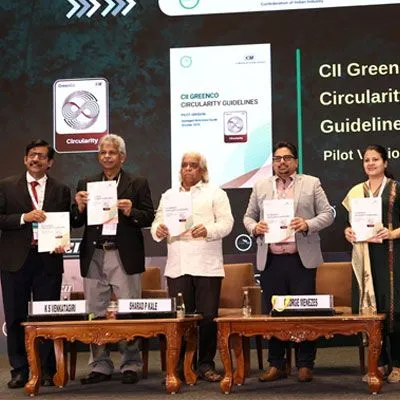
CII GreenCo Launches Circularity Guidelines for Indian Industry

The Confederation of Indian Industry (CII) GreenCo Council has launched the CII GreenCo Circularity Guidelines – Pilot Version at the 17th CII GreenCo Waste & Resource Management Summit 2026 in Chennai. The initiative aims to strengthen resource efficiency, waste reduction and circular economy practices across Indian manufacturing and process industries.The guidelines introduce a structured framework with circularity indices covering raw materials, consumables, packaging and other resource inputs. These indicators will help industries assess existing practices, identify opportunities to ..

Next Story
Infrastructure Energy

Global Electronics Association Launches IPC-1783-CO2E Standard

The Global Electronics Association has introduced IPC-1783-CO2E, a new international standard aimed at improving consistency, transparency and comparability in product carbon footprint reporting across the electronics manufacturing industry.The standard, titled International Standard for Data Collection and Reporting of CO2 Equivalent (CO2e) Emissions for the Electronics Manufacturing Supply Chain, provides industry-specific guidance for collecting, estimating and reporting carbon emissions data.With increasing regulatory requirements and customer expectations, electronics manufacturers face c..

Advertisement

Subscribe to Our Newsletter

Get daily newsletters around different themes from Construction world.

STAY CONNECTED

Advertisement

SPECIAL OFFER
QR Code