Ashok Leyland Signs MoU with Rajasthan Gramin Bank for Vehicle Financing
ECONOMY & POLICY

Ashok Leyland Signs MoU with Rajasthan Gramin Bank for Vehicle Financing

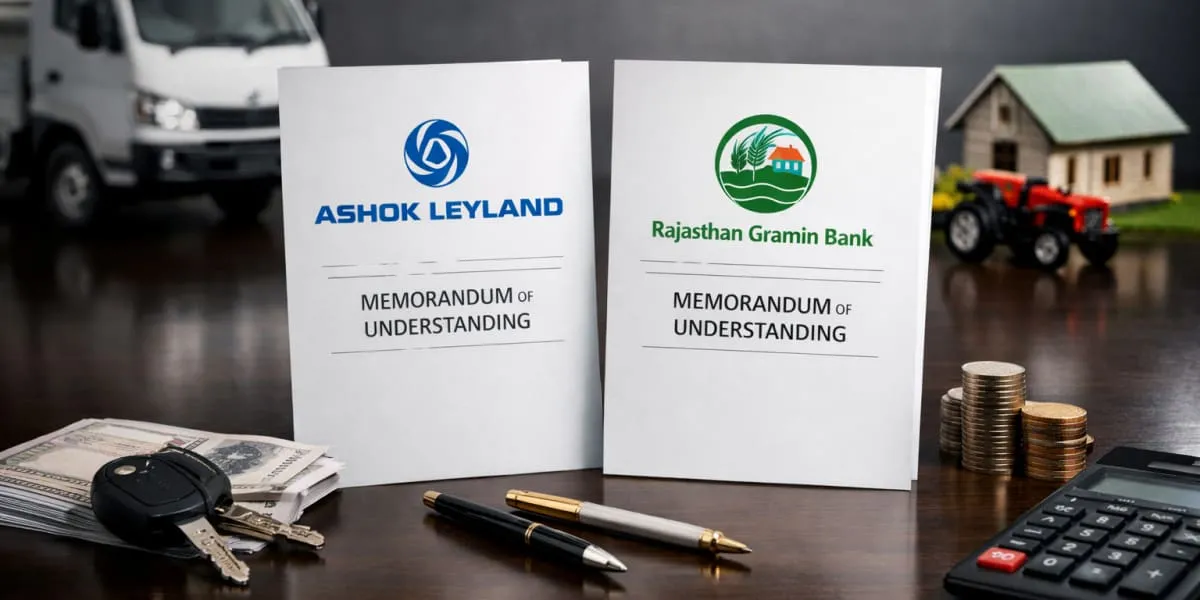
Ashok Leyland (AL) has signed a memorandum of understanding with Rajasthan Gramin Bank (RGB) to expand vehicle financing for rural and semi urban customers. The deal aims to broaden access to credit for small entrepreneurs, farmers and transport operators who seek light commercial and last mile distribution vehicles. The partners intend to leverage AL's dealer network and RGB's branch presence to design finance solutions that reflect seasonal income patterns and varied credit profiles in rural markets.

Under the agreement, the institutions will develop tailored loan products with flexible repayment schedules and supportive credit assessment processes. The initiative will include simplified documentation, faster loan sanction cycles and digital tools to reduce the time from enquiry to disbursal. The arrangement is expected to strengthen vehicle uptake in underserved districts and support livelihoods dependent on goods movement and local distribution.

The banks will work with AL dealerships to provide end to end customer support that spans finance counselling, after sales assistance and warranty facilitation. Training for frontline staff and credit officers is planned to ensure appropriate product placement and risk management. The collaboration will seek to balance commercial viability with inclusive financing goals by adapting collateral and guarantee structures where feasible. Stakeholder feedback will inform subsequent refinements and marketing outreach.

Industry observers note that increased tailored finance options can accelerate fleet modernisation and improve operational efficiency for small operators. The memorandum also aims to enhance financial inclusion by bringing more rural borrowers into formal credit channels and fostering long term credit relationships. Both partners will monitor uptake and adjust product features to meet evolving demand across Rajasthan and adjacent regions. The partners will set up monitoring frameworks and periodic reviews to refine eligibility criteria and outreach mechanisms, and to measure borrower satisfaction and repayment performance across different segments on a quarterly basis where feasible.

Ashok Leyland (AL) has signed a memorandum of understanding with Rajasthan Gramin Bank (RGB) to expand vehicle financing for rural and semi urban customers. The deal aims to broaden access to credit for small entrepreneurs, farmers and transport operators who seek light commercial and last mile distribution vehicles. The partners intend to leverage AL's dealer network and RGB's branch presence to design finance solutions that reflect seasonal income patterns and varied credit profiles in rural markets. Under the agreement, the institutions will develop tailored loan products with flexible repayment schedules and supportive credit assessment processes. The initiative will include simplified documentation, faster loan sanction cycles and digital tools to reduce the time from enquiry to disbursal. The arrangement is expected to strengthen vehicle uptake in underserved districts and support livelihoods dependent on goods movement and local distribution. The banks will work with AL dealerships to provide end to end customer support that spans finance counselling, after sales assistance and warranty facilitation. Training for frontline staff and credit officers is planned to ensure appropriate product placement and risk management. The collaboration will seek to balance commercial viability with inclusive financing goals by adapting collateral and guarantee structures where feasible. Stakeholder feedback will inform subsequent refinements and marketing outreach. Industry observers note that increased tailored finance options can accelerate fleet modernisation and improve operational efficiency for small operators. The memorandum also aims to enhance financial inclusion by bringing more rural borrowers into formal credit channels and fostering long term credit relationships. Both partners will monitor uptake and adjust product features to meet evolving demand across Rajasthan and adjacent regions. The partners will set up monitoring frameworks and periodic reviews to refine eligibility criteria and outreach mechanisms, and to measure borrower satisfaction and repayment performance across different segments on a quarterly basis where feasible.

Related Stories

Gold Stories

Next Story
Infrastructure Urban

KONE Opens India's First Digital Experience Centre in Pune

KONE, a global elevator and escalator manufacturer, has inaugurated its first Digital Experience Centre (DEC) in India, located in Pune. The facility aims to showcase how artificial intelligence (AI), connectivity and data-driven technologies can enhance customer experiences and improve building operations.The centre was inaugurated by Jussi Herlin, Executive Vice Chair, KONE Corporation; Philippe Delorme, President and CEO, KONE; and Nandan Nilekani, Co-founder and Chairman of the Board, Infosys.Designed as an interactive customer environment, the facility demonstrates digital solutions cover..

Next Story
Infrastructure Urban

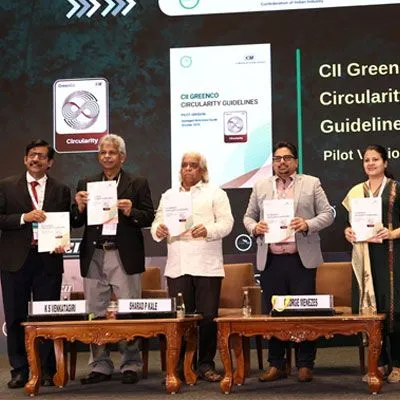
CII GreenCo Launches Circularity Guidelines for Indian Industry

The Confederation of Indian Industry (CII) GreenCo Council has launched the CII GreenCo Circularity Guidelines – Pilot Version at the 17th CII GreenCo Waste & Resource Management Summit 2026 in Chennai. The initiative aims to strengthen resource efficiency, waste reduction and circular economy practices across Indian manufacturing and process industries.The guidelines introduce a structured framework with circularity indices covering raw materials, consumables, packaging and other resource inputs. These indicators will help industries assess existing practices, identify opportunities to ..

Next Story
Infrastructure Energy

Global Electronics Association Launches IPC-1783-CO2E Standard

The Global Electronics Association has introduced IPC-1783-CO2E, a new international standard aimed at improving consistency, transparency and comparability in product carbon footprint reporting across the electronics manufacturing industry.The standard, titled International Standard for Data Collection and Reporting of CO2 Equivalent (CO2e) Emissions for the Electronics Manufacturing Supply Chain, provides industry-specific guidance for collecting, estimating and reporting carbon emissions data.With increasing regulatory requirements and customer expectations, electronics manufacturers face c..

Advertisement

Subscribe to Our Newsletter

Get daily newsletters around different themes from Construction world.

STAY CONNECTED

Advertisement

SPECIAL OFFER
QR Code