DoT, NCA And GSMA Sign Pact To Boost Telecom Innovation
ECONOMY & POLICY

DoT, NCA And GSMA Sign Pact To Boost Telecom Innovation

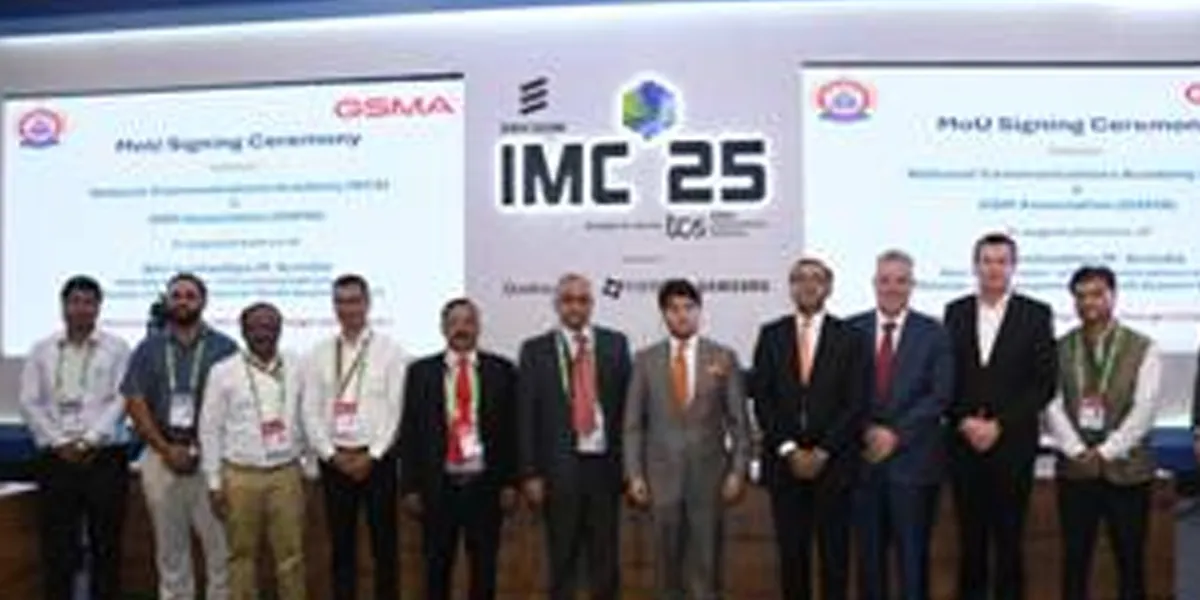
The Department of Telecommunications (DoT), National Communications Academy (NCA), and the GSM Association (GSMA) signed a Memorandum of Understanding (MoU) at the India Mobile Congress (IMC) 2025 in New Delhi, in the presence of Minister of Communications Jyotiraditya M. Scindia and Secretary (Telecom) Dr Neeraj Mittal.
The MoU was formally signed by Mr Vivek Badrinath, Director General, GSMA, and Mr Atul Sinha, Director General, NCA. Also present were Mr John Giusti, Chief Regulatory Officer, GSMA, and Mr Julian Gorman, Head of APAC, GSMA.
The agreement sets a broad framework for collaboration between NCA and GSMA in the fields of policy development, research, training, and capacity building in the telecommunications sector. The initiative aims to reinforce India’s Digital India vision by enhancing institutional capabilities, promoting regulatory best practices, and accelerating the adoption of next-generation technologies to drive sustainable digital transformation.
Under this partnership, NCA and GSMA will jointly:
• Conduct research, analysis, and training programmes to promote digital inclusion, sustainability, and socio-economic development, with a focus on bridging the digital divide.
• Collaborate on emerging technologies including 5G, 6G, Artificial Intelligence (AI), Internet of Things (IoT), quantum communications, and spectrum management.
• Organise workshops, knowledge-sharing sessions, and international exposure programmes to develop leadership and regulatory expertise in telecom policy.
The collaboration is expected to strengthen India’s engagement in global telecom standards and policy forums, while advancing the country’s goal of self-reliance and innovation in digital communications.
In his address, Mr Atul Sinha, Director General, NCA, stated, “Today we formalise a partnership that is simple in design yet transformative in purpose—to build the next generation of policy and regulatory capability for India’s digital communications sector, at scale, with speed, and to global standards. Networks are no longer just utilities; they are the operating system of our economy, powering inclusion, innovation, public services, and national security.”
Mr Vivek Badrinath, Director General, GSMA, added, “We are delighted to work with the National Communications Academy and the Department of Telecommunications to strengthen policy, training, and capacity building. This collaboration marks an important step towards achieving Digital India’s vision and bringing the benefits of mobile technology to millions.”
The MoU underscores India’s growing leadership in the global telecom ecosystem, paving the way for a future-ready, innovation-driven communications sector built on international best practices.

The Department of Telecommunications (DoT), National Communications Academy (NCA), and the GSM Association (GSMA) signed a Memorandum of Understanding (MoU) at the India Mobile Congress (IMC) 2025 in New Delhi, in the presence of Minister of Communications Jyotiraditya M. Scindia and Secretary (Telecom) Dr Neeraj Mittal.The MoU was formally signed by Mr Vivek Badrinath, Director General, GSMA, and Mr Atul Sinha, Director General, NCA. Also present were Mr John Giusti, Chief Regulatory Officer, GSMA, and Mr Julian Gorman, Head of APAC, GSMA.The agreement sets a broad framework for collaboration between NCA and GSMA in the fields of policy development, research, training, and capacity building in the telecommunications sector. The initiative aims to reinforce India’s Digital India vision by enhancing institutional capabilities, promoting regulatory best practices, and accelerating the adoption of next-generation technologies to drive sustainable digital transformation.Under this partnership, NCA and GSMA will jointly:• Conduct research, analysis, and training programmes to promote digital inclusion, sustainability, and socio-economic development, with a focus on bridging the digital divide.• Collaborate on emerging technologies including 5G, 6G, Artificial Intelligence (AI), Internet of Things (IoT), quantum communications, and spectrum management.• Organise workshops, knowledge-sharing sessions, and international exposure programmes to develop leadership and regulatory expertise in telecom policy.The collaboration is expected to strengthen India’s engagement in global telecom standards and policy forums, while advancing the country’s goal of self-reliance and innovation in digital communications.In his address, Mr Atul Sinha, Director General, NCA, stated, “Today we formalise a partnership that is simple in design yet transformative in purpose—to build the next generation of policy and regulatory capability for India’s digital communications sector, at scale, with speed, and to global standards. Networks are no longer just utilities; they are the operating system of our economy, powering inclusion, innovation, public services, and national security.”Mr Vivek Badrinath, Director General, GSMA, added, “We are delighted to work with the National Communications Academy and the Department of Telecommunications to strengthen policy, training, and capacity building. This collaboration marks an important step towards achieving Digital India’s vision and bringing the benefits of mobile technology to millions.”The MoU underscores India’s growing leadership in the global telecom ecosystem, paving the way for a future-ready, innovation-driven communications sector built on international best practices.

Next Story
Infrastructure Energy

Vedanta Aluminium Uses 1.57 bn Units of Green Energy in FY25

Vedanta Aluminium, India’s largest aluminium producer, recently reported consumption of 1.57 billion units of renewable energy in FY25, marking a significant milestone in its 2030 decarbonisation roadmap. The company also achieved an 8.96 per cent reduction in greenhouse gas (GHG) emissions intensity compared to FY21, reinforcing its leadership in India’s low-carbon manufacturing transition. During FY25, Vedanta Aluminium expanded its renewable energy portfolio through long-term power purchase agreements, strengthening its strategy to source nearly 1,500 MW of renewable power over the lon..

Next Story
Real Estate

Oberoi Group to Develop Luxury Resort at Makaibari Tea Estate

EIH Limited, the flagship company of The Oberoi Group, has announced the signing of a management agreement to develop an Oberoi luxury resort at the iconic Makaibari Tea Estate in Darjeeling. The project marks a key milestone in the Group’s long-term strategy of creating distinctive hospitality experiences in rare and environmentally significant locations. Established in 1859, Makaibari is one of the world’s oldest tea estates and is globally recognised for its Himalayan landscape, primary forests and exceptional biodiversity. Spread across 1,236 acres, the estate houses one of the world..

Next Story
Real Estate

GHV Infra Secures Rs 1.09 Bn EPC Order in Jamshedpur

GHV Infra Projects Ltd, a fast-growing EPC company in India’s infrastructure and construction sector, has recently secured a Rs 1.09 billion work order in Jamshedpur, Jharkhand. Awarded by a reputed group entity, the contract covers end-to-end civil construction, mechanical, electrical and plumbing (MEP) systems, along with high-quality finishing works for a large building development. The project will be executed over a 30-month period, with defined benchmarks for quality, safety and timely delivery. The order strengthens GHV Infra’s footprint in Jamshedpur, a key industrial hub known fo..

Advertisement

Subscribe to Our Newsletter

Get daily newsletters around different themes from Construction world.

STAY CONNECTED

Advertisement

Advertisement

Advertisement

Advertisement

Open In App