GVMC Rs 41.8 Billion Budget Boosts Visakhapatnam Infrastructure
ECONOMY & POLICY

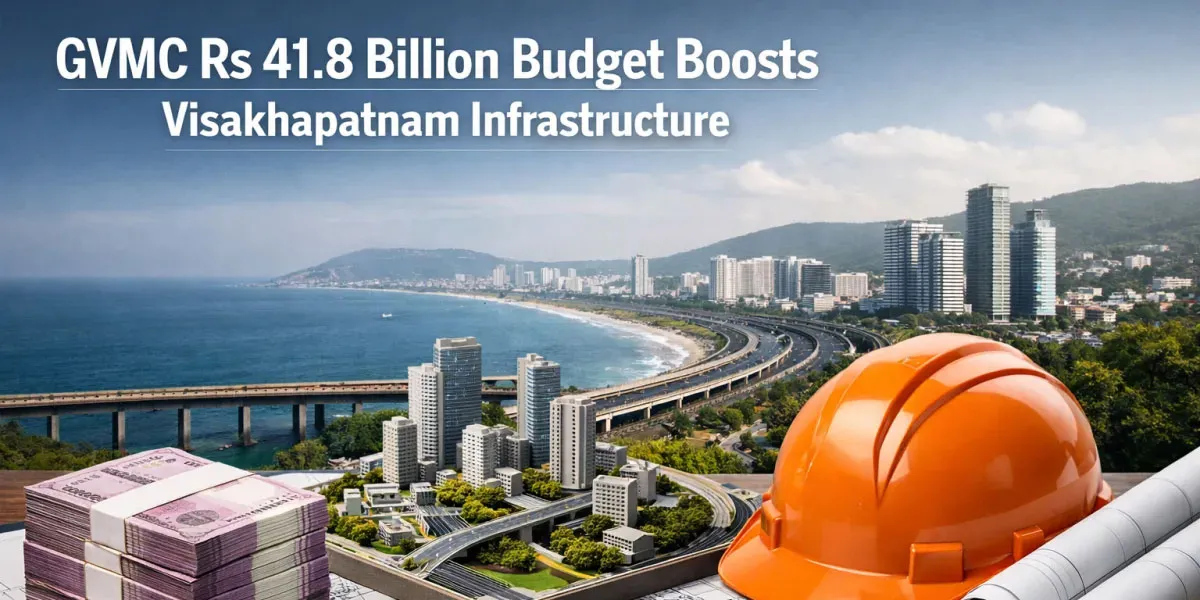
GVMC Rs 41.8 Billion Budget Boosts Visakhapatnam Infrastructure

GVMC has unveiled a budget of Rs 41.8 billion (bn) for the upcoming fiscal year, and the Confederation of Real Estate Developers Association of India said the allocation is a strong boost to infrastructure growth in Visakhapatnam. The civic plan, according to CREDAI, signals a commitment to urban improvements that can support both public amenities and private investment. CREDAI, which represents private real estate developers, said the measures will help coordinate public and private efforts to deliver projects. The announcement was welcomed by stakeholders who see potential for accelerated project implementation across the city.

CREDAI noted that targeted spending on core services and connectivity is fundamental to creating a favourable environment for construction and allied sectors. The association said predictable municipal funding and clear priorities help developers plan projects, mobilise resources and meet timelines. Such alignment between civic priorities and market activity can reduce delays and improve overall efficiency in delivery.

Market observers expect that improved infrastructure will stimulate demand for housing and commercial developments and generate employment in construction and related trades. CREDAI emphasised that timely procurement processes and transparent governance are essential to translating budgetary provisions into tangible outcomes on the ground. The association advised close coordination between civic authorities, utilities and private firms to ensure integrated urban delivery. Developers expect improved amenities to increase land values and catalyse reinvestment in older neighbourhoods.

Longer term, CREDAI suggested that sustained investment in infrastructure can strengthen investor confidence and support balanced urban growth across neighbourhoods. The association urged careful monitoring of expenditure and periodic review of project progress to safeguard public value and minimise cost overruns. Stakeholders expressed cautious optimism about the prospects for Visakhapatnam's development given the scale of the civic budget.

GVMC has unveiled a budget of Rs 41.8 billion (bn) for the upcoming fiscal year, and the Confederation of Real Estate Developers Association of India said the allocation is a strong boost to infrastructure growth in Visakhapatnam. The civic plan, according to CREDAI, signals a commitment to urban improvements that can support both public amenities and private investment. CREDAI, which represents private real estate developers, said the measures will help coordinate public and private efforts to deliver projects. The announcement was welcomed by stakeholders who see potential for accelerated project implementation across the city. CREDAI noted that targeted spending on core services and connectivity is fundamental to creating a favourable environment for construction and allied sectors. The association said predictable municipal funding and clear priorities help developers plan projects, mobilise resources and meet timelines. Such alignment between civic priorities and market activity can reduce delays and improve overall efficiency in delivery. Market observers expect that improved infrastructure will stimulate demand for housing and commercial developments and generate employment in construction and related trades. CREDAI emphasised that timely procurement processes and transparent governance are essential to translating budgetary provisions into tangible outcomes on the ground. The association advised close coordination between civic authorities, utilities and private firms to ensure integrated urban delivery. Developers expect improved amenities to increase land values and catalyse reinvestment in older neighbourhoods. Longer term, CREDAI suggested that sustained investment in infrastructure can strengthen investor confidence and support balanced urban growth across neighbourhoods. The association urged careful monitoring of expenditure and periodic review of project progress to safeguard public value and minimise cost overruns. Stakeholders expressed cautious optimism about the prospects for Visakhapatnam's development given the scale of the civic budget.

Next Story
Technology

Twin Tracks

Digital-twin adoption in India’s rail sector is gradually making its presence felt across asset management, infrastructure planning, predictive maintenance, construction monitoring and operator training.While large-scale deployments of digital twins are still evolving, Nipun Dumpala, a Senior Technical Lead specialising in digital twins, synthetic data, simulation and mixed reality technologies, points out that several organisations are exploring BIM-integrated digital twins, IoT-enabled monitoring, AI-based analytics and simulation platforms to improve operational efficiency and reduce life..

Next Story
Infrastructure Urban

Centre Clears Power Distribution Upgrade for Uttar Pradesh

The Central Government has approved power distribution projects worth Rs 407.39 billion for Uttar Pradesh under the Revamped Distribution Sector Scheme (RDSS). The investment will be used to modernise the state's electricity distribution infrastructure and strengthen network capacity across urban and rural areas. The package targets one of the country's largest distribution networks as the state experiences rapid urbanisation and rising electricity consumption. Planned interventions include the strengthening of distribution lines, modernisation of substations, replacement of ageing electrical ..

Next Story
Infrastructure Energy

India Data Centres To Consume 191 TWh By 2040 Driving Renewables

A Wood Mackenzie report says India's operational data centre capacity is projected to increase more than fivefold to 12 gigawatt (GW) by 2030 from 2.2 GW in 2025 as artificial intelligence (AI) and cloud computing drive demand. It projects electricity consumption to rise from 10 terawatt-hour (TWh) in 2025 to 191 TWh by 2040. The study forecasts a compound annual growth rate of around 40 per cent and notes AI-dedicated capacity will surge nearly 24-fold from 275 megawatt (MW) in 2025 to 6,546 MW by 2030. The report places India's digital economy at Rs 32 trillion (tn) in 2025 and says it contr..

Advertisement

Subscribe to Our Newsletter

Get daily newsletters around different themes from Construction world.

STAY CONNECTED

Advertisement

Advertisement

Advertisement