+
India Calls For Equity-Focused Global Just Transition Mechanism
ECONOMY & POLICY

India Calls For Equity-Focused Global Just Transition Mechanism

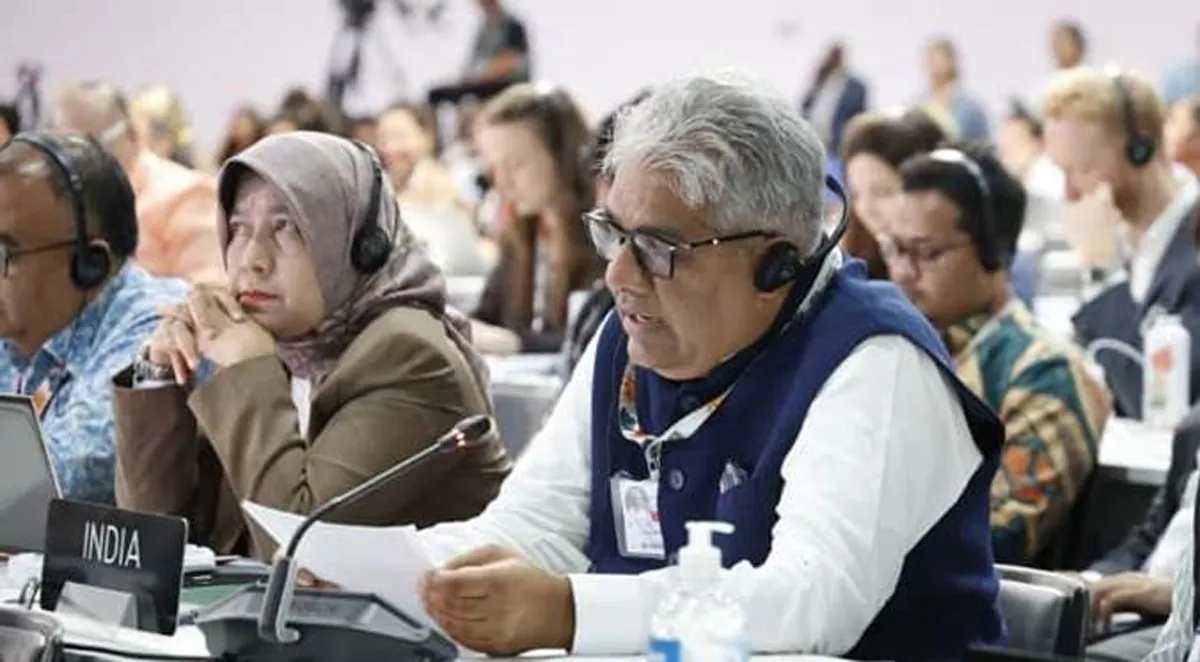
Union Minister for Environment, Forest and Climate Change, Bhupender Yadav, addressed the Third Annual High-Level Ministerial Roundtable on Just Transition under the UAE Just Transition Work Programme during UNFCCC CoP30 in Belém, Brazil, on 20 November 2025. He welcomed the opportunity to contribute, noting that the four dialogues held so far have been highly engaging and effective platforms for sharing perspectives.

The Minister emphasised that a just transition extends far beyond the energy sector, describing it as an economy-wide, people-centred transformation that must respect national circumstances, uphold equity and advance social justice. Such a transition, he said, must enable all countries to contribute their fair share to global mitigation efforts without undermining their developmental priorities.

Yadav highlighted that just transition inherently includes building resilience, generating employment, protecting livelihoods, eradicating poverty, ensuring food security and providing social protection. Each country, he stressed, must retain the autonomy to determine its own sustainable development pathway in accordance with national priorities and circumstances.

Acknowledging the different starting points and development needs of nations, the Minister said this diversity underscores the need for nationally determined, demand-driven approaches rather than uniform or prescriptive models. Global equity, he affirmed, must remain central to all just transition efforts. Developing countries require sufficient policy space to bridge development gaps, address systemic vulnerabilities and safeguard the well-being of their populations.

Expressing concern over unilateral measures, Yadav warned that trade-restrictive climate actions undermine equity and justice, acting as serious barriers to a fair global transition. He called for stronger multilateralism, enhanced international cooperation and affordable, accessible and adequate means of implementation for developing nations.

On tangible outcomes for the UAE Just Transition Work Programme, Yadav reiterated India’s strong support — along with other developing countries — for creating a Just Transition Mechanism. Such a mechanism, he noted, is essential to closing existing gaps and advancing workable solutions. For the Global South, ensuring affordable access to finance, technology and capacity building, aligned with national realities, will be vital to ensuring that no one is left behind.

The Minister concluded by expressing India’s expectation of an ambitious and meaningful outcome at CoP30. He said India looks forward to the establishment of the Just Transition Mechanism, which will address a critical gap in delivering on the Convention and Paris Agreement. He urged countries to operationalise the principles of Equity and Common but Differentiated Responsibilities and Respective Capabilities (CBDR-RC) to advance a truly just and equitable global transition.

Union Minister for Environment, Forest and Climate Change, Bhupender Yadav, addressed the Third Annual High-Level Ministerial Roundtable on Just Transition under the UAE Just Transition Work Programme during UNFCCC CoP30 in Belém, Brazil, on 20 November 2025. He welcomed the opportunity to contribute, noting that the four dialogues held so far have been highly engaging and effective platforms for sharing perspectives. The Minister emphasised that a just transition extends far beyond the energy sector, describing it as an economy-wide, people-centred transformation that must respect national circumstances, uphold equity and advance social justice. Such a transition, he said, must enable all countries to contribute their fair share to global mitigation efforts without undermining their developmental priorities. Yadav highlighted that just transition inherently includes building resilience, generating employment, protecting livelihoods, eradicating poverty, ensuring food security and providing social protection. Each country, he stressed, must retain the autonomy to determine its own sustainable development pathway in accordance with national priorities and circumstances. Acknowledging the different starting points and development needs of nations, the Minister said this diversity underscores the need for nationally determined, demand-driven approaches rather than uniform or prescriptive models. Global equity, he affirmed, must remain central to all just transition efforts. Developing countries require sufficient policy space to bridge development gaps, address systemic vulnerabilities and safeguard the well-being of their populations. Expressing concern over unilateral measures, Yadav warned that trade-restrictive climate actions undermine equity and justice, acting as serious barriers to a fair global transition. He called for stronger multilateralism, enhanced international cooperation and affordable, accessible and adequate means of implementation for developing nations. On tangible outcomes for the UAE Just Transition Work Programme, Yadav reiterated India’s strong support — along with other developing countries — for creating a Just Transition Mechanism. Such a mechanism, he noted, is essential to closing existing gaps and advancing workable solutions. For the Global South, ensuring affordable access to finance, technology and capacity building, aligned with national realities, will be vital to ensuring that no one is left behind. The Minister concluded by expressing India’s expectation of an ambitious and meaningful outcome at CoP30. He said India looks forward to the establishment of the Just Transition Mechanism, which will address a critical gap in delivering on the Convention and Paris Agreement. He urged countries to operationalise the principles of Equity and Common but Differentiated Responsibilities and Respective Capabilities (CBDR-RC) to advance a truly just and equitable global transition.

Related Stories

Gold Stories

Next Story
Infrastructure Transport

Mumbai-Ahmedabad Bullet Train’s Surat-Vapi Section Set for 2027

The first section of the Mumbai-Ahmedabad Bullet Train corridor, linking Surat and Vapi, is targeted to begin services in 2027. Construction is expected to be completed by December 2026, while Railway Minister Ashwini Vaishnaw has indicated that an inauguration could take place around the middle of 2027. The National High Speed Rail Corporation (NHSRCL) said the train being manufactured in India is expected to reach the tracks around April or May 2027. The train will undergo extensive testing before the section is opened for passenger services. The project began construction in 2021 and includ..

Next Story
Infrastructure Transport

Indian Railways Approves Four Projects Worth Rs. 7.36 bn Across Four States

Indian Railways has approved four projects with a combined value of Rs. 7.36 bn across Uttar Pradesh, Maharashtra, Andhra Pradesh and Gujarat. The programme covers train protection, signalling, electric traction supply and a road overbridge, with each project assigned to a different railway zone. In Uttar Pradesh, Rs. 2.52 bn has been approved to extend the Kavach 4.0 automatic train protection system across 607.7 km in the Lucknow Division of North Eastern Railway. The system monitors train movements and can apply the brakes if a driver fails to observe a signal or exceeds a safe speed. The w..

Next Story
Infrastructure Urban

Chandru Raheja Sells 1.49% Stake in Mindspace REIT for Rs. 5 bn

Billionaire Chandru Lachmandas Raheja has sold a 1.49 per cent holding in Mindspace Business Parks REIT for Rs. 5 bn through a bulk deal on the BSE. The transaction involved 9.9 mn units and was executed at an average price of Rs. 505 per unit, according to exchange data. Following the sale, units of Mindspace Business Parks REIT were trading 0.18 per cent lower at Rs. 504.05 on Tuesday. Exchange data did not identify the buyers involved in the transaction. Raheja is the chairman of real estate company K Raheja Corp. The sale involved 99,00,990 units, representing 1.49 per cent of the Mumbai-b..

Advertisement

Subscribe to Our Newsletter

Get daily newsletters around different themes from Construction world.

STAY CONNECTED

Advertisement

SPECIAL OFFER
QR Code