India, Norway Forge Ties, Plan to Launch Startup Bridge
ECONOMY & POLICY

India, Norway Forge Ties, Plan to Launch Startup Bridge

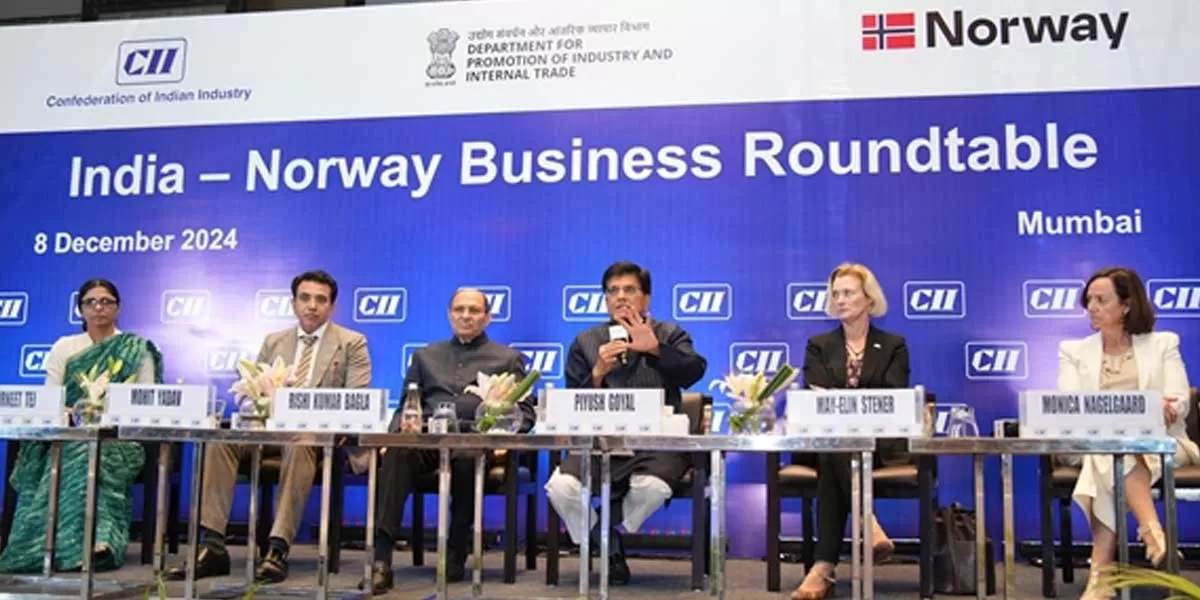
Union Commerce and Industry Minister Piyush Goyal proposed on Sunday the launch of a startup bridge between Norway and India, as the two countries explored ways to strengthen their trade relations. Norwegian Ambassador to India, May-Elin Stener, suggested that the initiative could be launched during the Indo-Nordic summit next year.

While addressing the India-Norway Business Forum, organised by the Confederation of Indian Industry (CII) in collaboration with the Department for Promotion of Industry and Internal Trade (DPIIT), Goyal committed to working collectively with the relevant ministries to address various concerns and further enhance bilateral trade and investment between the two nations. The forum, which brought together policymakers, industry leaders, and stakeholders, focused on deepening trade and investment ties across priority sectors.

During the forum, several key issues were raised, including regulatory challenges, public procurement concerns, and quality standards compliance across various sectors. Concerns were presented to the minister regarding sectors such as maritime, shipping, energy, food processing, logistics, oil and gas, renewable energy, and the circular economy.

In a video message, Cecilie Myrseth, Norwegian Minister of Trade and Industry, highlighted the potential for Norwegian companies to expand in India under the Trade and Economic Partnership Agreement (TEPA).

Goyal emphasised India's favourable investment landscape, stressing the country's strong value proposition for international partners. He highlighted India's strategic advantages, including its youthful and dynamic workforce, robust democratic institutions, expanding consumer market, and decisive national leadership. The Commerce Minister further positioned India as an attractive global investment hub, inviting Norwegian companies to tap into local talent for domestic opportunities and as a gateway for expanding into international markets.

Gurneet Tej, Joint Secretary of DPIIT, emphasised the growing India-Norway partnership, noting that bilateral trade had reached $1.1 billion, with Norway emerging as India's 33rd largest investor. She highlighted key areas of cooperation, including the blue economy, green hydrogen, renewable energy, fisheries, and water management, and underscored Norway's increasing role in India's infrastructure development.

The recently signed TEPA between India and the European Free Trade Association (EFTA) was praised as a significant step towards strengthening economic collaboration, with India having signed TEPA agreements with Switzerland, Iceland, Norway, and Liechtenstein, an important economic bloc in Europe.

Union Commerce and Industry Minister Piyush Goyal proposed on Sunday the launch of a startup bridge between Norway and India, as the two countries explored ways to strengthen their trade relations. Norwegian Ambassador to India, May-Elin Stener, suggested that the initiative could be launched during the Indo-Nordic summit next year. While addressing the India-Norway Business Forum, organised by the Confederation of Indian Industry (CII) in collaboration with the Department for Promotion of Industry and Internal Trade (DPIIT), Goyal committed to working collectively with the relevant ministries to address various concerns and further enhance bilateral trade and investment between the two nations. The forum, which brought together policymakers, industry leaders, and stakeholders, focused on deepening trade and investment ties across priority sectors. During the forum, several key issues were raised, including regulatory challenges, public procurement concerns, and quality standards compliance across various sectors. Concerns were presented to the minister regarding sectors such as maritime, shipping, energy, food processing, logistics, oil and gas, renewable energy, and the circular economy. In a video message, Cecilie Myrseth, Norwegian Minister of Trade and Industry, highlighted the potential for Norwegian companies to expand in India under the Trade and Economic Partnership Agreement (TEPA). Goyal emphasised India's favourable investment landscape, stressing the country's strong value proposition for international partners. He highlighted India's strategic advantages, including its youthful and dynamic workforce, robust democratic institutions, expanding consumer market, and decisive national leadership. The Commerce Minister further positioned India as an attractive global investment hub, inviting Norwegian companies to tap into local talent for domestic opportunities and as a gateway for expanding into international markets. Gurneet Tej, Joint Secretary of DPIIT, emphasised the growing India-Norway partnership, noting that bilateral trade had reached $1.1 billion, with Norway emerging as India's 33rd largest investor. She highlighted key areas of cooperation, including the blue economy, green hydrogen, renewable energy, fisheries, and water management, and underscored Norway's increasing role in India's infrastructure development. The recently signed TEPA between India and the European Free Trade Association (EFTA) was praised as a significant step towards strengthening economic collaboration, with India having signed TEPA agreements with Switzerland, Iceland, Norway, and Liechtenstein, an important economic bloc in Europe.

Next Story
Real Estate

AI: The New Recruit

From getting ideas to evaluating designs, presenting concepts to clients and tracking projects, artificial intelligence (AI) is helping architects work better and faster.“AI allows architects to spend more time doing what only they can do: think critically, synthesise complexity and design with intent,” says Dikshu C Kukreja, Managing Principal, CP Kukreja Architects. “Every minute reclaimed from repetitive processes can be invested in creativity, contextual understanding, interdisciplinary collaboration and innovation – the qualities that define meaningful architecture.”To read the ..

Next Story
Real Estate

Redevelopment 2.0

In 2017, Mumbai identified 160,000 ageing buildings due for structural audit. Close to half of these were in the Western Suburbs. Redeveloping the oldest and structurally weakest of these would help unlock new housing, much needed given the city’s growing population density and constant developed area of 437.7 sq km. At 30,600 people per sq km in 2024, Mumbai’s density was almost thrice that of Gurugram, and 60 per cent higher than Bengaluru’s.Essentially, Mumbai’s realty market has demand. It has capital. It has realty development potential.Fast forward to 2026. Mumbai has 1,094 regis..

Next Story
Technology

Cost intelligence will become a strategic contributor to project success

As India's construction industry accelerates its digital transformation, integrated platforms, AI and connected data are becoming essential to improving cost certainty, project efficiency and sustainability. Ravi Kumar, Sales Director – India, RIB Software India, shares how digital workflows are reshaping project planning, commercial management and decision-making across the construction value chain.India's construction sector is embracing digital technologies at an unprecedented pace. From your perspective, what are the biggest shifts driving this transformation and how is RIB Software enab..

Advertisement

Subscribe to Our Newsletter

Get daily newsletters around different themes from Construction world.

STAY CONNECTED

Advertisement

Advertisement

Advertisement