Joshi Inaugurates NISE’s PV Lab, Eyes Global Solar Leadership
ECONOMY & POLICY

Joshi Inaugurates NISE’s PV Lab, Eyes Global Solar Leadership

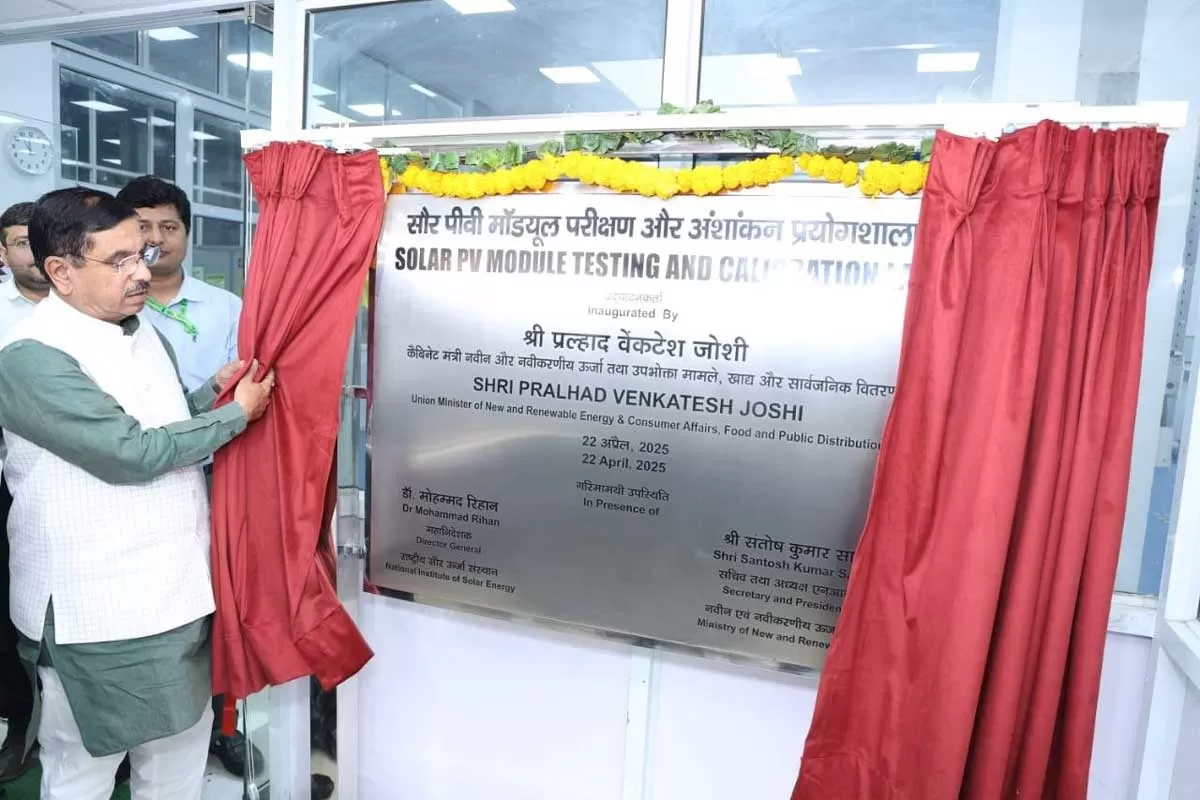
Union Minister for New and Renewable Energy, Shri Pralhad Joshi, inaugurated the cutting-edge PV Module Testing and Calibration Lab at the National Institute of Solar Energy (NISE) in Gwal Pahari, Haryana—marking a major milestone in India’s journey towards clean energy leadership.

Calling the lab a game-changer, the Minister said it would set global benchmarks in solar R&D, testing, and certification, while bolstering India's Production Linked Incentive (PLI) scheme and its ambitions to become a solar manufacturing powerhouse. The facility is equipped to test new-age photovoltaic modules for which no international standards currently exist, and it aligns with BIS norms for quality assurance.

He also praised NISE for training over 55,000 Suryamitras, and supporting local livelihoods in Ladakh by installing over 300 solar dryer-cum-heating systems for farmers. With the new lab, Joshi said, India would further strengthen its technical capabilities and global research presence.

India’s Renewable Leap: Shri Joshi highlighted India’s solar growth from 2.82 GW in 2014 to over 106 GW today—a 3700% rise—alongside a manufacturing boom from 2 GW to 80 GW. He reaffirmed India’s commitment to achieving 500 GW of non-fossil fuel capacity by 2030, including 292 GW of solar, as envisioned by Prime Minister Narendra Modi.

Pushing the Innovation Frontier: The Minister emphasised research in emerging solar technologies such as perovskite cells, bifacial panels, AI-driven solar forecasting, building-integrated photovoltaics (BIPV), and solar-powered EV charging. He urged NISE to collaborate globally and push the boundaries of innovation and patents.

Global Solar Synergy and Earth Day Commitment: During a review meeting of the International Solar Alliance, Joshi called for enhanced global cooperation. Commemorating Earth Day, he also planted a sapling as part of PM Modi’s ‘Ek Ped Maa Ke Naam’ campaign—symbolising a greener future and tribute to motherhood.

Union Minister for New and Renewable Energy, Shri Pralhad Joshi, inaugurated the cutting-edge PV Module Testing and Calibration Lab at the National Institute of Solar Energy (NISE) in Gwal Pahari, Haryana—marking a major milestone in India’s journey towards clean energy leadership. Calling the lab a game-changer, the Minister said it would set global benchmarks in solar R&D, testing, and certification, while bolstering India's Production Linked Incentive (PLI) scheme and its ambitions to become a solar manufacturing powerhouse. The facility is equipped to test new-age photovoltaic modules for which no international standards currently exist, and it aligns with BIS norms for quality assurance. He also praised NISE for training over 55,000 Suryamitras, and supporting local livelihoods in Ladakh by installing over 300 solar dryer-cum-heating systems for farmers. With the new lab, Joshi said, India would further strengthen its technical capabilities and global research presence. India’s Renewable Leap: Shri Joshi highlighted India’s solar growth from 2.82 GW in 2014 to over 106 GW today—a 3700% rise—alongside a manufacturing boom from 2 GW to 80 GW. He reaffirmed India’s commitment to achieving 500 GW of non-fossil fuel capacity by 2030, including 292 GW of solar, as envisioned by Prime Minister Narendra Modi. Pushing the Innovation Frontier: The Minister emphasised research in emerging solar technologies such as perovskite cells, bifacial panels, AI-driven solar forecasting, building-integrated photovoltaics (BIPV), and solar-powered EV charging. He urged NISE to collaborate globally and push the boundaries of innovation and patents. Global Solar Synergy and Earth Day Commitment: During a review meeting of the International Solar Alliance, Joshi called for enhanced global cooperation. Commemorating Earth Day, he also planted a sapling as part of PM Modi’s ‘Ek Ped Maa Ke Naam’ campaign—symbolising a greener future and tribute to motherhood.

Next Story
Infrastructure Urban

Infrastructure Opportunity Outlook by IMPACCT.Info

India’s infrastructure pipeline is witnessing dynamic activity across stages — from immediate bidding to future planning. IMPACCT segments these into three categories: Immediate, 3–6 Month, and Future Opportunities, enabling businesses to identify, prepare, and participate in high-value tenders and projects across sectors.To read the full article Click Here..

Next Story
Infrastructure Transport

The Road Ahead Begins Here

The future of India’s roads took centrestage at RAHSTA Expo 2026, where policymakers, contractors and industry leaders came together under one roof. The event blended thought leadership, technology showcase and industry recognition into a single powerful platform.India’s roads and highways community gathered in full strength at the Jio World Convention Centre, Mumbai, on July 8-9, 2026, for the 16th edition of the RAHSTA Expo (Roads and Highways Sustainable Technologies & Advancement). Over two action-packed days, the event brought together policymakers, contractors, consultants, devel..

Next Story
Infrastructure Urban

Wricks® is 50 per cent stronger than conventional bricks

India’s construction boom is colliding with mounting plastic and demolition waste. Angirus is responding with Wricks®, made from recycled waste and already deployed in over 400,000 units nationwide. Kunjpreet Arora, Cofounder and CEO, explains the technology, impact and growth roadmap.With several alternative building materials available, what industry gap did Angirus identify and how does Wricks® address it?The construction industry already has alternatives such as AAC blocks, fly-ash bricks and concrete blocks but these have limitations. AAC blocks may crack due to contraction and expans..

Advertisement

Subscribe to Our Newsletter

Get daily newsletters around different themes from Construction world.

STAY CONNECTED

Advertisement

Advertisement

Advertisement