




Modi Launches Rs 106 Billion Urea Plant In Assam
ECONOMY & POLICY

Modi Launches Rs 106 Billion Urea Plant In Assam

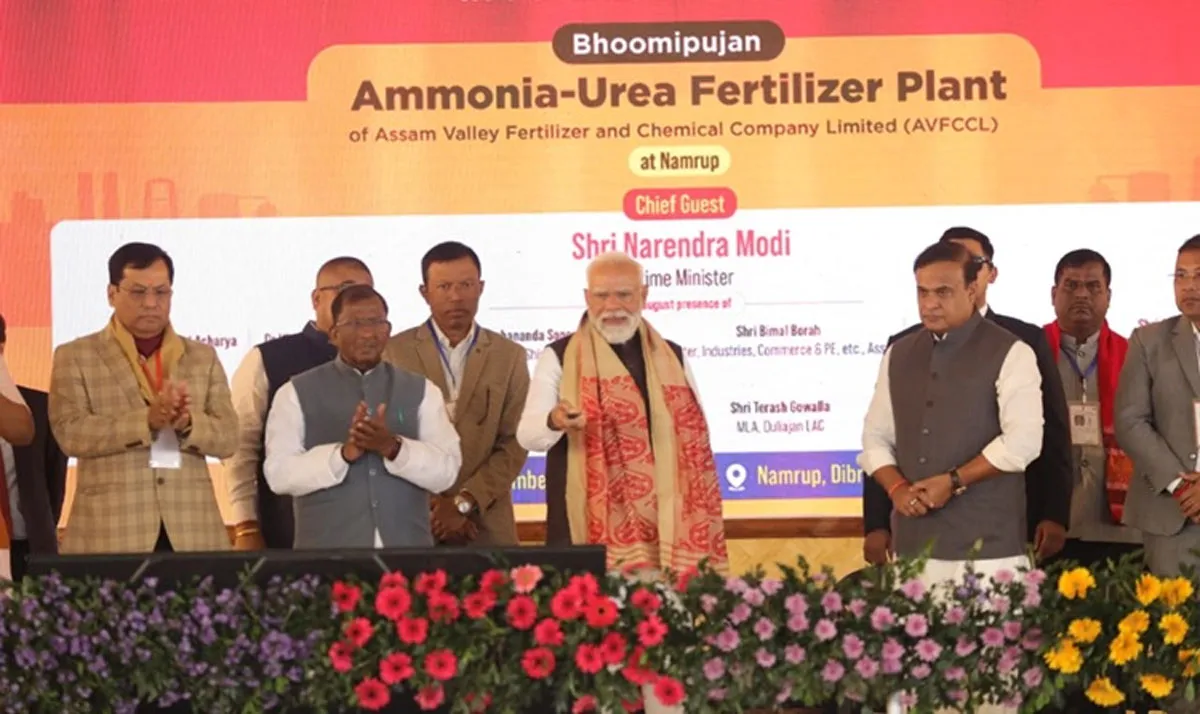
Prime Minister Narendra Modi on Sunday laid the foundation stone of a Rs 106.01 billion brownfield ammonia-urea plant in Assam’s Dibrugarh district, calling it the start of a new phase of industrial development for the state and the wider Northeast.

The facility will be developed by Assam Valley Fertiliser and Chemical Company within the existing premises of Brahmaputra Valley Fertiliser Corporation at Namrup. Once operational, the plant will have an annual urea production capacity of 1.27 million metric tonnes and is scheduled to be commissioned by 2030.

Addressing a public gathering after unveiling the project at the end of his two-day visit to Assam, the Prime Minister said the long-pending aspirations of Namrup and Dibrugarh had finally been fulfilled. He described the project as a historic step that would usher in a new chapter of industrial progress for Assam and the entire Northeast.

Modi said the investment of nearly Rs 110 billion would help ensure faster fertiliser availability while lowering logistics costs through local production. He added that the project would create thousands of employment and self-employment opportunities, including in ancillary services such as repair, supply and logistics, benefiting local youth.

Criticising previous governments, the Prime Minister said outdated technology had led to the gradual shutdown of fertiliser units at Namrup, adversely affecting farmers across the Northeast and reducing incomes. He said modernisation had been neglected for years despite Namrup’s importance as a major fertiliser hub in the past.

Highlighting the need for uninterrupted fertiliser supply, Modi said the new urea plant would support farmers’ requirements and improve agricultural productivity. He noted that national urea production has risen from 22.5 million metric tonnes in 2014 to about 30.6 million metric tonnes currently, against an annual requirement of nearly 38 million metric tonnes. Efforts are under way to bridge this gap while continuing subsidies to shield farmers from the cost of imports.

The Prime Minister also cautioned against excessive use of urea, warning that indiscriminate application could damage soil health. Emphasising farmer welfare, he said around Rs 4 trillion has been transferred directly to farmers’ bank accounts under the PM Kisan Samman Nidhi scheme. He added that the government’s palm oil mission would help the Northeast become self-sufficient in edible oils and raise farm incomes in the coming years.

The Namrup project is expected to play a crucial role in strengthening fertiliser security, supporting farmers and accelerating industrial growth across Assam and the Northeast.

Prime Minister Narendra Modi on Sunday laid the foundation stone of a Rs 106.01 billion brownfield ammonia-urea plant in Assam’s Dibrugarh district, calling it the start of a new phase of industrial development for the state and the wider Northeast. The facility will be developed by Assam Valley Fertiliser and Chemical Company within the existing premises of Brahmaputra Valley Fertiliser Corporation at Namrup. Once operational, the plant will have an annual urea production capacity of 1.27 million metric tonnes and is scheduled to be commissioned by 2030. Addressing a public gathering after unveiling the project at the end of his two-day visit to Assam, the Prime Minister said the long-pending aspirations of Namrup and Dibrugarh had finally been fulfilled. He described the project as a historic step that would usher in a new chapter of industrial progress for Assam and the entire Northeast. Modi said the investment of nearly Rs 110 billion would help ensure faster fertiliser availability while lowering logistics costs through local production. He added that the project would create thousands of employment and self-employment opportunities, including in ancillary services such as repair, supply and logistics, benefiting local youth. Criticising previous governments, the Prime Minister said outdated technology had led to the gradual shutdown of fertiliser units at Namrup, adversely affecting farmers across the Northeast and reducing incomes. He said modernisation had been neglected for years despite Namrup’s importance as a major fertiliser hub in the past. Highlighting the need for uninterrupted fertiliser supply, Modi said the new urea plant would support farmers’ requirements and improve agricultural productivity. He noted that national urea production has risen from 22.5 million metric tonnes in 2014 to about 30.6 million metric tonnes currently, against an annual requirement of nearly 38 million metric tonnes. Efforts are under way to bridge this gap while continuing subsidies to shield farmers from the cost of imports. The Prime Minister also cautioned against excessive use of urea, warning that indiscriminate application could damage soil health. Emphasising farmer welfare, he said around Rs 4 trillion has been transferred directly to farmers’ bank accounts under the PM Kisan Samman Nidhi scheme. He added that the government’s palm oil mission would help the Northeast become self-sufficient in edible oils and raise farm incomes in the coming years. The Namrup project is expected to play a crucial role in strengthening fertiliser security, supporting farmers and accelerating industrial growth across Assam and the Northeast.

Next Story
Equipment

PALFINGER Reinforces India Focus at EXCON 2025

PALFINGER strengthened its long-term commitment to India at EXCON 2025, marking its largest participation at the exhibition with a 1,000 sq m booth. The global lifting and technology solutions provider showcased advanced lifting equipment, digital solutions and outlined a clear roadmap for expanding its India operations.India has emerged as a priority growth market for PALFINGER, driven by sustained infrastructure development and rising demand for high-performance lifting solutions. Alexander Susanek, COO, PALFINGER, said India is playing an increasingly influential role in the company’s glo..

Next Story
Infrastructure Transport

HAL Airport Reopening Needs BIAL Consent: Centre

The Union government has said that reopening the existing HAL Airport in Bengaluru for civilian operations would require the consent of Bengaluru International Airport Limited (BIAL), in line with the concession agreement governing Kempegowda International Airport (KIA). Informing the Lok Sabha, Minister of State for Civil Aviation Murlidhar Mohol said the concession agreement between the Government of India and Bengaluru International Airport Limited stipulates that no new or existing airport—except for the development of Mysuru and Hassan as domestic airports—can be developed, improved,..

Next Story
Infrastructure Transport

Guwahati Airport Plans Second Terminal As Traffic Grows

Even as Prime Minister Narendra Modi is set to inaugurate the new terminal at Lokapriya Gopinath Bordoloi International Airport on December 20, the Assam government has begun planning a second terminal at Guwahati’s main aviation hub to cater to rising passenger traffic and the airport’s expanding regional role. Chief Minister Himanta Biswa Sarma said the state is considering a completely new additional terminal, noting that planning work is already under way. Following the inauguration, all operations will initially be shifted to the new terminal, while the existing terminal will be phas..

Advertisement

Subscribe to Our Newsletter

Get daily newsletters around different themes from Construction world.

STAY CONNECTED

Advertisement

Advertisement

Advertisement

Advertisement

Open In App














